


Human rights lawyer Xie Yang (謝陽) has been detained in China on suspicion of “inciting state subversion,” according to an official notice obtained by his wife weeks after he spoke out for a hospitalized teacher.
Xie — who has previously defended Christians and democracy advocates — has not been heard from since he was detained more than a week ago in Changsha, Hunan Province.
Beijing has stepped up its crackdown on civil society since Chinese President Xi Jinping (習近平) took power in 2012, tightening restrictions on freedom of speech, and detaining hundreds of rights advocates and lawyers.
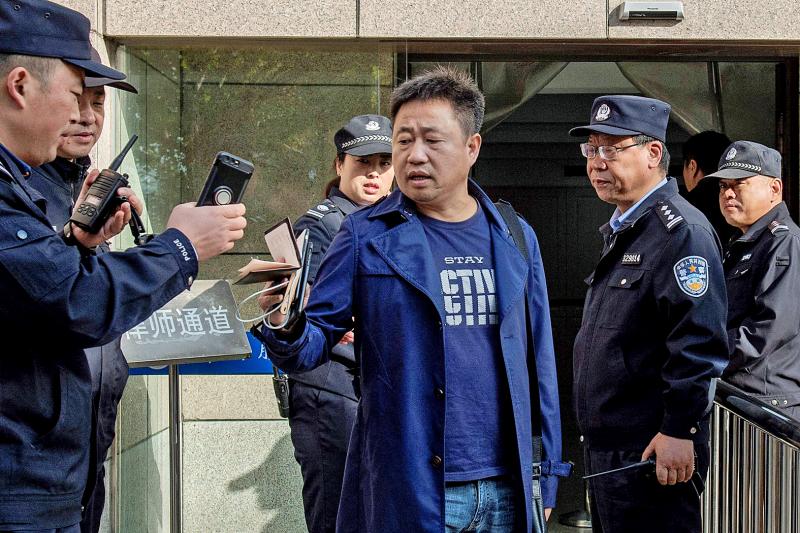
Photo: AFP
The police notice, dated Monday and seen by Agence France-Presse (AFP), said 49-year-old Xie had been held on suspicion of inciting subversion of state power, and “picking quarrels and provoking trouble” — a catch-all phrase often used against dissidents and rights advocates.
“I am very angry that he has been detained on trumped-up charges,” his wife, Chen Guiqiu (陳桂秋), said from the US, where she lives with their two children.
His home was also ransacked, Chen said.
“Anything that could be opened was opened or torn open, even his pillows were ripped apart,” she said, adding that two computers and his safe were missing.
His detention comes weeks after he tried to visit a teacher, Li Tiantian (李田田), who friends said was forcibly committed to a psychiatric hospital after expressing sympathy for views questioning Beijing’s narrative of the Nanjing Massacre in 1937. The tragedy is a hugely sensitive topic in China.
Li was believed to have been held after she publicly sympathized with a Shanghai professor who questioned the official death toll of 300,000 attributed to the six-week spree of killing, rape and destruction.
Xie was a vocal advocate for the 27-year-old pregnant teacher, who authorities have said was willingly admitted to the hospital.
Last month, he shared a video on Twitter showing himself outside the local police headquarters holding a poster calling for her release.
The Changsha Public Security Bureau declined to comment, while the detention center and local propaganda department did not answer telephone calls.
“Xie Yang has participated in almost all the hot-button issues in China,” said rights advocate Cheng Xiaofeng (程曉峰), who attempted to visit the hospital with Xie. “His actions probably make the authorities very uncomfortable.”
Xie was previously detained for almost two years during the “709 crackdown” targeting human rights advocates and lawyers in 2015, when he said he was tortured.
Another human rights lawyer, Yang Maodong (楊茂), was arrested last week also on suspicion of “inciting subversion of state power,” a police notice shared with AFP showed. He had been detained in Guangzhou since last month.
Yang has repeatedly been imprisoned because of his advocacy.
Yang’s wife died of cancer in the US last week, after he was prevented from leaving China to reunite with her.


Through the noise of rushing papers and whirring belts at a print factory in Kyoto, two creators watch their photo essay come to life in broadsheet form — part of an effort to win new audiences in the age of artificial intelligence (AI). Despite the decline of the publishing industry, self-publication and handmade “zine” magazines are growing in popularity in Japan, reflecting the nation’s enduring love of paper in the digital era. While speaking to Agence France-Presse at the plant, his hands black with ink, one of the creators, Kazuma Obara, said: “I think [paper] is a medium that engages all five
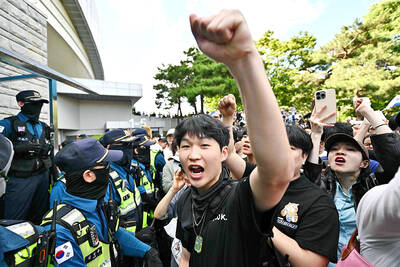
‘ABSURD MISTAKE’: The election commission said that there had been a failure to anticipate turnout after 14 polling stations ran short of ballot papers South Korean riot police yesterday cleared protesters from a Seoul polling station after a 35-hour blockade sparked by a shortage of ballot papers during local elections earlier this week. Wednesday’s election was the first nationwide vote since South Korean President Lee Jae-myung took office following the ouster of Yoon Suk-yeol over his short-lived martial law declaration. Lee’s ruling Democratic Party swept most races, but failed to flip the crucial Seoul mayoral seat. The South Korean National Election Commission apologized, blaming a failure to anticipate turnout after 14 polling stations in Seoul ran short of ballot papers. Some polling stations stayed open until 10pm to

France experienced its hottest spring on record, the French weather service said on Tuesday, after an exceptional early heat wave that also broke highs for the season in England and Wales. Meteo-France said the average nationwide temperature over March to May was 13.8°C — about 1.7°C above the norm, and surpassing records set in 2011 and 2020. “The warmest spring since records began in 1900,” it said in a bulletin. All three months were warmer than average, but the onset of an “unprecedented heatwave” late last month pushed the mercury to highs typically seen at the height of the summer. “Our country had never

A Sherpa guide was found crawling to base camp on Mount Everest a week after he went missing and was reunited with his family, who had given up hope he would return. Dawa Sherpa was last seen on Friday last week descending the mountain, but he did not reach base camp even though his client did. The pair were among the last climbers on the mountain as the climbing season came to an end and the route was dismantled. Dawa was located by a cleaning crew on Thursday morning as he was crawling down the snowy slopes around the Khumbu Icefall, just above


 RSS
RSS