


The world’s biggest coal producer and consumer mined 384.67 million tonnes of the fossil fuel last month, easily topping its previous record of 370.84 million tonnes set in November last year, after the government called for miners to work at maximum capacity to help fuel the country’s economic growth.
Official government figures show that China’s coal binge also spurred the country to record-high coal output over the year as a whole. Chinese coal production climbed to an all-time high of 4.07 billion tonnes, up 4.7 percent on the previous year, in a blow to climate campaigners months after the UN’s COP26 climate talks in Glasgow, Scotland.
The International Energy Agency (IEA) predicted that global consumption of coal power, which is the world’s single biggest source of climate emissions, would reach record levels last year driven by a surge in demand for energy to kick-start global economies following the COVID-19 pandemic.
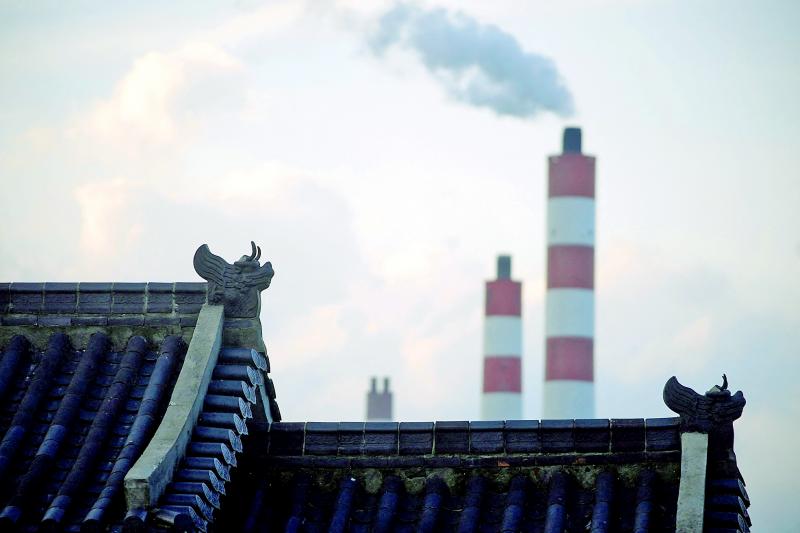
Photo: Reuters
Coal power fell by 4 percent in 2020 as the pandemic caused a global economic slowdown, but the IEA found that the surge in demand for electricity during last year outpaced the growth in low-carbon sources, leading many wealthy economies to rely more heavily on fossil-fuel power plants.
The IEA’s most recent report, published last week, found that the steepest-ever increase in global electricity demand last year was stoked by a 9 percent increase in coal use compared with the year before, or more than half of the global increase in power demand, to reach an all-time peak.
China’s record coal consumption comes weeks after the conclusion of the COP26 climate talks, which ended in a fierce disagreement over a pledge to abandon coal.
A last-minute intervention by India watered down the language of the pact from “phasing out” to “phasing down.”
After the talks, held last month, COP26 president Alok Sharma said India and China would “have to explain themselves to poor nations” after watering down the Glasgow climate pact, adding that their actions had left him “deeply frustrated.”
The IEA found that coal plants in the US and the EU produced 20 percent more electricity last year, from low levels in 2020, but their use remained below the levels recorded in 2019.
The reliance on coal plants is expected to decline again next year as electricity demand slows and the expansion of renewable energy alternatives continues.

SPEAKING OUT: After Siranudh Scott’s allegations surfaced, celebrities and public figures took to social media to share their own experiences of sexual misconduct and abuse A high-profile alleged sexual abuse case within a wealthy Thai beer brewing family has prompted a wave of painful accounts from survivors of unconnected abuse in the conservative nation. Siranudh Scott, a member of the billionaire Thai family that founded the ubiquitous Singha beer brand, posted an emotional video this month accusing his elder brother Sunit of repeatedly abusing him when he was a teenager. Sunit, who is in his 30s, later denied the allegations in a video posted online, but Singha parent Boonrawd dismissed him from his executive role with the company on Tuesday last week. “I felt I needed to speak

‘CROSSING THE LINE’: China’s embassy in Seoul criticized US Forces Korea Commander General Xavier Brunson, asking if his ‘hostile’ remarks were authorized by Washington South Korea and the US are in talks over recent public remarks by the commander of US Forces Korea, Seoul’s presidential office said yesterday, after the comments drew sharp criticism from China. In a recent podcast interview, US Forces Korea Commander General Xavier Brunson described South Korea as “the dagger in the heart of Asia” from China’s east coast, prompting the Chinese embassy in Seoul to say that he had “truly crossed the line.” The interview came amid growing speculation that Washington might seek to expand the role of US Forces Korea in countering the growing regional influence of China, a key

SEEKING ORDER: Rodrigo Paz said that ‘anyone who wants to destroy the nation will have to deal with this president and the full force of the constitution’ Bolivian President Rodrigo Paz on Wednesday said that the nation was at a “breaking point” after nearly a month of protests that have caused shortages of food, fuel and medicine. Paz, who took office six months ago amid the worst economic crisis there in four decades, is battling a groundswell of fury over his policies. The political capital, La Paz, has been besieged by low-income workers and members of the indigenous majority calling for his resignation. “The country needs order and is reaching breaking point,” the 58-year-old said at a public event in La Paz, renewing his appeal for dialogue. On Tuesday, the Bolivian

Forecasters in Europe yesterday warned of exceptional heat as record temperatures driven by a “heat dome” push temperatures well above seasonal norms across the continent. The surge follows a record-breaking Monday, with France logging its hottest day in the month of May on record, its weather agency said, and the UK also posting unprecedented highs. A so-called “heat dome” of warm air from northern Africa trapped under a high-pressure system over western Europe is behind the high temperatures not usually seen until high summer. Restrictions on outdoor work were imposed in parts of Italy, beaches in southwest France filled earlier than usual and


 RSS
RSS