

US President Joe Biden’s arrival in the White House nearly a year ago seemed to herald a historic shift toward less US reliance on nuclear weapons and possibly a shrinking of their numbers. Even a pledge of “no first use” — a promise to never again be the first to use a nuclear weapon — seemed possible.
Then China happened — revelations about its expanding nuclear force and talk of potential war with Taiwan.
Then Russia happened — signs that it might be preparing to invade Ukraine.
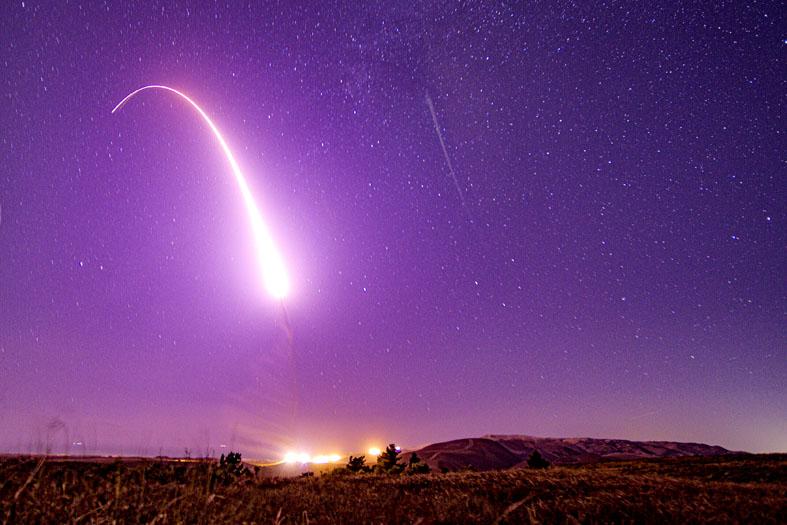
Photo: Staff Sergeant J.T. Armstrong / US Air Force via AP
Now, major shifts in US nuclear weapons policy seem much less likely, and while Biden might insist on certain adjustments, momentum toward a historic departure from the policies of former US President Donald Trump policy appears to have stalled.
The outlook would be clearer when the Biden administration completes its so-called nuclear posture review — an internal relook at the numbers, kinds and purposes of weapons in the nuclear arsenal, as well as the policies that govern their potential use. The results could be made public as early as this month.
The biggest unknown is how forcefully Biden will weigh in on these questions, based on White House calculations of the political risk.
During his years as vice president, Biden talked of new directions in nuclear policy, but heightened concerns about China and Russia would seem to improve the political leverage of Republicans seeking to portray such change as a gift to nuclear adversaries.
Russia became a more urgent focus of Biden’s attention after Russian President Vladimir Putin in the past few weeks sent about 100,000 troops to positions near Ukraine’s border and demanded US security guarantees.
Biden and Putin discussed Ukraine by telephone on Thursday, and senior US and Russian officials are scheduled to follow up with more detailed talks in Geneva next week.
Tom Z. Collina, policy director at Ploughshares Fund, an advocate for nuclear disarmament, said that the China and Russia problems complicate the politics of Biden’s nuclear review, but should not stop him from acting to reduce nuclear dangers.
“We do not want a new nuclear arms race with either nation and the only way to prevent that is with diplomacy,” Collina said. “We must remember the main lesson we learned in the Cold War with Russia — the only way to win an arms race is not to run.”
In March, in what the White House called “interim national security guidance,” Biden said China and Russia had changed “the distribution of power across the world.”
“Both Beijing and Moscow have invested heavily in efforts meant to check US strengths and prevent us from defending our interests and allies around the world,” the guidance said.
Biden pledged to counter with actions to bolster the US at home, repair its alliances abroad and elevate the role of diplomacy. Nuclear weapons were mentioned only briefly.
“We will take steps to reduce the role of nuclear weapons in our national security strategy,” the guidance said without offering details, while also ensuring a safe and reliable US nuclear force and seeking arms control opportunities.
Since then, worries about China and Russia have only increased. Private satellite imagery revealed last year that China was building large numbers of new underground silos for nuclear missiles, and in November, a Pentagon report said that China might quadruple the size of its nuclear stockpile by 2030.
“Because of what China has done, it has really changed the complexion of this review,” said Robert Soofer, who was the Pentagon’s top nuclear policy official during the Trump administration and led a 2018 nuclear review.
“Rather than it being a review that examines reducing the role of nuclear weapons and even eliminating a leg of the triad, now they’ve been obliged to basically stay the course and determine how to tweak it at the margins,” he said.
In June, even before the latest Russian troop buildup near Ukraine, US Undersecretary of Defense for Policy Colin Kahl said the outlook for US nuclear policy was colored not only by China’s nuclear ambitions, but also by “real anxiety” among US allies in Europe over Russian defense and nuclear policy.
“And so, obviously Russia is the wolf closest to the shed as it relates to the nuclear issue, but close behind is China’s desire to grow their nuclear arsenal, both quantitatively and qualitatively,” Kahl said on June 23 at a nuclear policy conference sponsored by the Carnegie Endowment for International Peace.
Kahl did not preview the policy review outcome, but he said it is intended to fit inside a broader defense strategy, which also is to be published early this year.
The Pentagon has not publicly discussed details of the nuclear review, but the administration seems likely to keep the existing contours of the nuclear force — the traditional “triad” of sea, air and land-based weapons, which critics call overkill.
It also might embrace a US$1 trillion modernization of that force, which was launched by former US President Barack Obama’s administration and continued by Trump.
It is unclear whether Biden will approve any significant change in what is called “declaratory policy,” which states the purpose of nuclear weapons and the circumstances under which they might be used.
The Obama administration, with Biden as vice president, said in 2010 that it would “only consider the use of nuclear weapons in extreme circumstances to defend the vital interests of the United States or its allies and partners.” It did not define “extreme circumstances.”
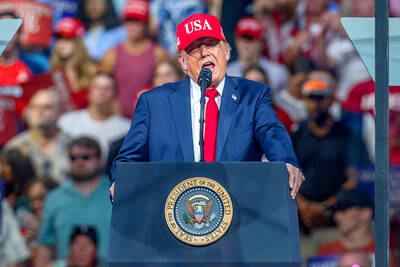
US President Donald Trump on Wednesday threatened to take action against the EU if it moves forward with European Commission President Ursula von der Leyen’s proposal to make Canada the bloc’s first associate member. “If they do that, if I think it’s at all a hostile act; I will put very serious tariffs or stop trading with Europe on many things,” Trump told reporters en route to an event in North Carolina, calling the proposal “laughable.” “If it’s a good intention, that’s fine. If it’s a bad intention, we’ll put very heavy tariffs on Europe,” he said. Von der Leyen made the proposal

SECRET FOOTAGE: A 17-year-old girl told British broadcaster Channel 4 that she had been approached by a man who covertly recorded her and their interaction Calls are growing louder in Europe for action against “pervert” smart glasses after secretly filmed footage of girls and women appeared online — with a petition in Britain demanding a ban on their sale. Anyone wearing smart glasses can take photos, film videos, listen to music, make phone calls, translate text or interact with an artificial intelligence (AI) assistant, with sales now hitting millions. The devices grabbed attention this summer after a marketing tie-up between Kylie Jenner, beauty mogul and member of the Kardashian dynasty, and tech giant Meta. Since smartphones are now embedded in daily life, “big tech” is
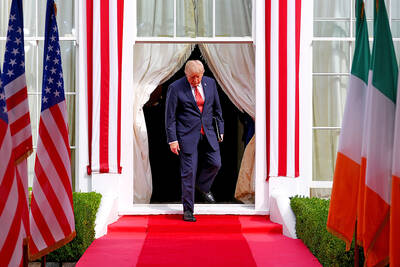
FROSTY RECEPTION: ‘I conveyed the strong view of the Irish people that the normalization of war and genocide can never be accepted,’ the Irish president said US President Donald Trump on Saturday said that he would “love to see” a united Ireland, wading into a politically sensitive subject as he embarked on a two-day Irish visit that blurs the lines between his presidency and personal business interests. After meeting Irish Prime Minister Micheal Martin in Dublin, Trump said reunification of the Republic of Ireland and Northern Ireland — split for more than a century — would be “a fantastic thing.” “It’s going to happen eventually. It may as well happen now,” he told reporters, adding that “the UK will have something to say about it, obviously.”
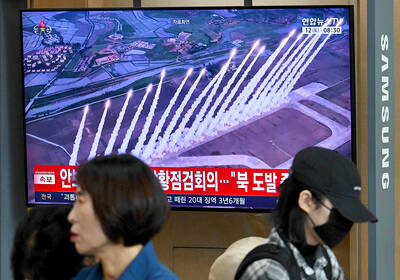
North Korea yesterday fired multiple ballistic missiles, Seoul said, a day after South Korea concluded five days of joint maritime drills with the US and Japan that were focused on the North. Pyongyang last month slammed plans for the so-called Freedom Edge joint exercises in international waters off South Korea as a “threat” to North Korea and other countries of the region. Yesterday, Seoul’s military detected “multiple short-range ballistic missiles launched from the Wonsan area toward the East Sea [the Sea of Japan],” the South Korean Joint Chiefs of Staff said in a statement. The missiles were detected at about


 RSS
RSS