


An editorial on a Chinese state-run news site has suggested that Chinese Communist Party (CCP) members are obliged to have three children for the good of the country, as Beijing seeks to address plummeting birthrates.
The editorial, which was first published last month, went viral this week and drew sharp reaction from Chinese Internet users, with millions of shares, views and comments.
As the wave of reaction grew, the original article disappeared from the Web site.
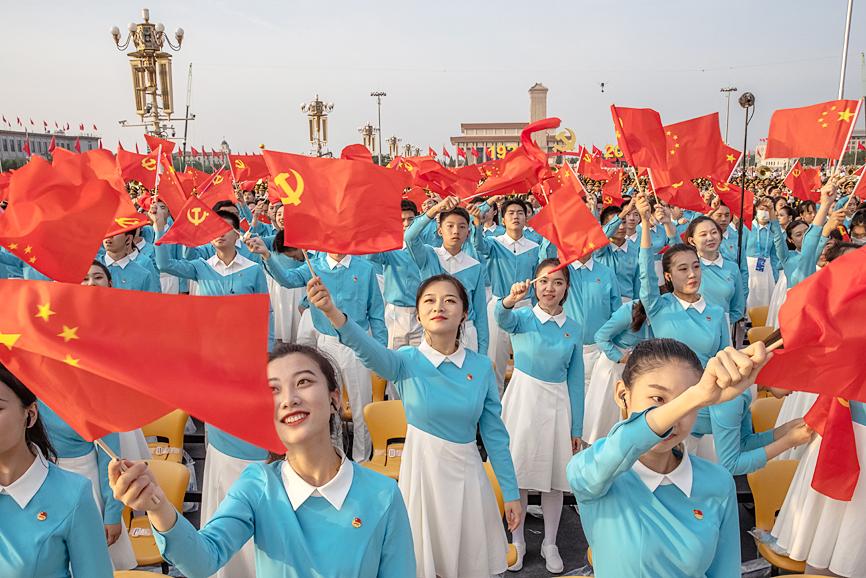
Photo: EPA-EFE
The piece, published by the China Reports Network, said that every CCP member — of which there are about 95 million — “should shoulder the responsibility and obligation of the country’s population growth and act on the three-child policy.”
“No party member should use any excuse, objective or personal, to not marry or have children, nor can they use any excuse to have only one or two children,” it said.
The post appears to have been deleted, but screenshots have been widely shared, and associated hashtags have reportedly been viewed millions of times.
China is facing a demographic crisis with an aging population and a declining birthrate. More than 18 percent of the population is aged 60 or older, census data showed last year.
Figures released by the Chinese National Bureau of Statistics last month showed that there were 8.5 births per 1,000 people last year, the first time in decades that the figure has fallen below 10.
In 1978, the figure was more than 18 per 1,000.
The CCP has implemented a range of measures in response, including relaxing long-held limits on having children, easing the costs associated with education and child rearing, subsidies for second and third children, and introducing mandatory “cooling off” periods for divorces, but they have had limited effect.
China’s one-child policy formally ended in 2016 and was replaced by a two-child limit on most couples, which was this year been lifted to three.
However young Chinese continue to say that the high cost of living and pressures of long working hours are obstacles to having children.
“Although the three-child policy has come out, many people don’t have the conditions, ability, money or time to take care of children, especially for women, who have to go home early, and this will make more companies not want to hire women,” one commenter said on social media. “Shouldn’t society be balanced in development? When does it become a mandatory rule to have three children?”
Another said: “I’m just an ordinary person. My time, energy and money only allow me to raise a child in the future. Most party members are also ordinary people.”
Some warned that the editorial’s message could harm people’s faith in the party.
“’Party members take the lead’ has always been our party’s fine tradition, which has withstood many tests of history,” one commenter said.
“The impact of this bad public opinion, like other public opinions, could easily change from accusations against the China Reports Network to resistance to the three-child policy and shaken trust in the government.”
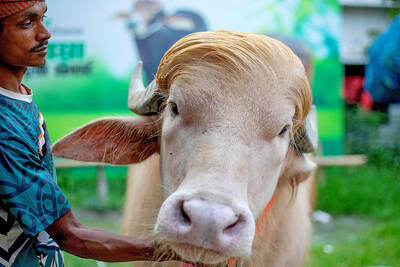
Crowds in Bangladesh are flocking to snap photographs with an unlikely social media star — an albino buffalo with flowing blond hair nicknamed “Donald Trump” that is due to be sacrificed within days. Owner Zia Uddin Mridha, 38, said his brother named the 700kg bull over its flowing helmet of hair resembling the signature look of the US president. “My younger brother picked this name because of the buffalo’s extraordinary hair,” he said at his farm in Narayanganj, just outside the capital, Dhaka. Mridha said that a constant stream of curious visitors — social media fans, onlookers and children — have come throughout

It began as a satirical online project. Now millions of young people in India are flocking to it as an outlet for their frustration. A parody political party called the Cockroach Janta Party, with the insect as its symbol, has exploded across India’s social media by turning absurdist humor into protest. Memes and short videos mocking corruption, joblessness and political dysfunction have flooded social media sites, where millions of users are embracing the cockroach — known for its ability to survive harsh conditions — as a tongue-in-cheek symbol of endurance. The online movement’s rise has been unusually rapid. The Cockroach Janta Party (CJP)
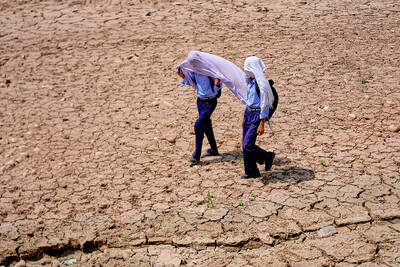
HOTTER: While Indians are accustomed to summer heat, climate change has caused northwestern India to warm faster than other parts of the country, an academic said Roads and markets have emptied during afternoons and some farmers have switched to nighttime work to avoid scorching temperatures as a heat wave grips large parts of India. The India Meteorological Department forecast maximum temperatures for yesterday of about 45°C in the capital, New Delhi, where authorities have opened temporary “cooling zones” to help people cope. The weather department warned that conditions would likely persist across several northern regions in the coming days, with temperatures staying well above seasonal averages. Authorities urged people to stay indoors during the hottest hours and take precautions against heat-related illnesses. India declares a heat wave whenever maximum temperatures

A Hong Kong astronaut is to join a Chinese space mission for the first time as part of a three-person crew launching today, as Beijing edges closer to its goal of landing people on the moon. The Tiangong space station — crewed by teams of three astronauts that are typically rotated every six months — is the crown jewel of China’s space program, boosted by billions in state investment in a bid to catch up with the US and Russia. The Shenzhou-23 mission is to blast off at 11:08pm from the Jiuquan Satellite Launch Center in northwestern China, carrying three astronauts to


 RSS
RSS