


Reams of black wiring suspended between poles, haphazardly bundled into nest-like knots, and often hanging at head height are a common sight in Bangkok, and has become almost synonymous with the city.
“If you walk around my area, there are many wire bundles hanging down to human height or sitting on the ground along the pedestrian walkway,” says Kullapa Sakkaravech, a language teacher from Bangkok.
She lives in what is considered “the new central business district” of Bangkok, where she says “clouds of wire bundles” still hang in front of her apartment.
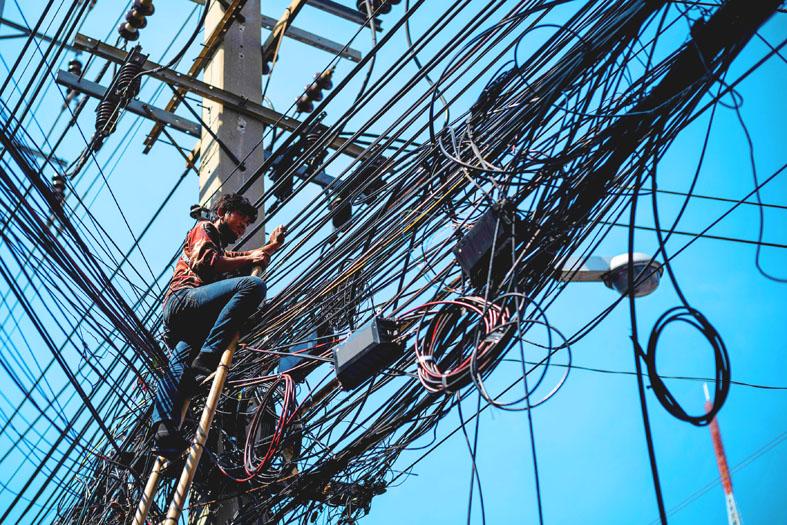
Photo: Reuters
“Apart from being unappealing, this can potentially be dangerous for kids and especially hazardous during flood or raining season,” she says.
However, following a Twitter post by actor Russell Crowe, that could be about to change.
In a post captioned “Bangkok dreaming,” Crowe, who was in Thailand throughout September and October filming Vietnam war movie The Greatest Beer Run Ever, shared a photograph of the city’s much-reviled communication and electrical wires.
The post spurred others to share similar images, along with questions as to why they were in such a state.
Now, Thai Prime Minister Prayuth Chan-ocha has called for electrical and communications cables to be better organized and put underground.
Many wires might no longer be needed, but cannot be removed because they’re so entangled, says Napong Rugkhapan, an assistant professor in urban planning at Thammasat University in Bangkok.
“When an internet service provider wants to add in a new line for a new condominium being constructed, they add to that because it’s not their responsibility to take [any] out,” he says.
However, given the numerous previous calls for the webs of wires to be moved underground, some are skeptical as to whether this latest push — even one inspired by a Hollywood actor — would change anything.
The fact that no one has died as a result of the wires means that it is not at the top of the agenda, Rugkhapan says.
Yet people stumble over fallen cables daily, he added.
Sakkaravech says: “There was a time when we had heavy rain, a tree fell and pulled down a bundled wire causing an electricity outage to residents.”
Thus far, a lack of coordination between the various agencies and limited political will has been to blame for the slow progress, Rugkhapan says.
Celebrity involvement in the issue can be traced back to 2016, when Microsoft cofounder and philanthropist Bill Gates commented on Thailand’s “tangled wires” on Facebook.
The post was deleted after Gates wrongly identified the wires as power lines rather than communication wires.
Historically, electrical authorities have blamed the telecommunications industry for the increasing number of lines and messy wires.
Following Gates’ post, the Thai Provincial Electricity Authority reportedly produced a graphic making the distinction.
In response to Crowe’s picture, Bangkok’s Metropolitan Electricity Authority released a statement clarifying that the wires depicted were not power lines, but communications lines.
Authorities in 2016 committed to putting 127km of power and communication cables underground. Prayuth urged the agencies to speed up the first phase, which focused on 39 roads in and around the capital. In 2019, Bangkok Governor Aswin Kwanmuang launched another initiative, committing the city government to moving communications lines underground within two years.
Progress has been made in certain areas, including on major thoroughfares such as Silom and Sukhumvit, but navigating hazardous wiring is still a part of daily life in much of the city.
A ship that appears to be taking on the identity of a scrapped gas carrier exited the Strait of Hormuz on Friday, showing how strategies to get through the waterway are evolving as the Middle East war progresses. The vessel identifying as liquefied natural gas (LNG) carrier Jamal left the Strait on Friday morning, ship-tracking data show. However, the same tanker was also recorded as having beached at an Indian demolition yard in October last year, where it is being broken up, according to market participants and port agent’s reports. The ship claiming to be Jamal is likely a zombie vessel that

Cannabis-based medicines have shown little evidence of effectiveness for treating most mental health and substance-use disorders, according to a large review of past studies published in a major medical journal on Monday. Medical use of cannabinoids has been expanding, including in the US, Canada and Australia, where many patients report using cannabis products to manage conditions such as anxiety, post-traumatic stress disorder and sleep problems. Researchers reviewed data from 54 randomized clinical trials conducted between 1980 and May last year involving 2,477 participants for their analysis published in The Lancet. The studies assessed cannabinoids as a primary treatment for mental disorders or substance-use

NATIONWIDE BLACKOUT: US President Donald Trump cut off Venezuelan oil shipments to Cuba, strangling the Caribbean island’s already antiquated grid Cuba’s national electric grid collapsed on Monday, the nation’s grid operator said, leaving about 10 million people without power amid a US-imposed oil blockade that has crippled the already obsolete generation system. Grid operator UNE on social media said that it is investigating the causes of the blackout, the latest in a series of widespread outages that last for hours or days and that this weekend sparked a rare violent protest in the communist-run nation. Officials ruled out a major power plant failure, but had still not pinpointed the root cause of the grid collapse, suggesting a problem with transmission. Officials said that

‘HEALTH ISSUE’: More than 250 women are hospitalized every day due to complications from unsafe abortions, and about three die, a study showed Jane had been bleeding heavily for days before finally seeking help, not from a hospital, but from the man who sold her the pills meant to end her six-week pregnancy. Abortions are strictly outlawed in the mainly Catholic Philippines, forcing women to turn to a patchwork of providers operating in the online shadows. While rare in practice, Philippine law allows for prison terms of up to six years for abortion patients and providers, leaving thousands of Filipinas to search for solutions in online forums where unlicensed sellers promote abortifacients. “It was very painful, as if my abdomen was being twisted,” said Jane, whose


 RSS
RSS