


Riot police were deployed in force on Saturday in the Iranian city of Isfahan, a day after dozens were arrested in violent protests over the drying up of a lifeblood river.
Security forces fired tear gas during the clashes with stone-throwers in the protest in the dry bed of the Zayadneh Rud that crosses the city, the Fars news agency and the Iranian Students’ News Agency (ISNA) said.
“We have arrested 67 of the main actors and agitators behind the troubles,” police General Hassan Karami said on Saturday.
He said between 2,000 and 3,000 “rioters” took part in the protest.
On Saturday, the situation was “calm” and streets empty, with riot police deployed on the city’s Khadjou Bridge, an Isfahan resident said.
US Department of State spokesman Ned Price said Washington was “deeply concerned about the violent crackdown against peaceful protestors.”
He wrote on Twitter that “the people of Iran have a right to voice their frustrations and hold their government accountable.”
The demonstration was the latest since protests started on Nov. 9 in Isfahan, about 340km south of Tehran, a tourist magnet due to its majestic mosques and heritage sites, including a historic bridge across the river.
However, it was the first to turn violent.
Between 30,000 and 40,000 farmers and city residents turned up for the gatherings last week, estimated Karami.
The riverbed has been the rallying spot for farmers and other people from across Isfahan Province protesting the lack of water.
Drought is a cause, but they also accuse the authorities of diverting water from the city to supply the neighboring province of Yazd, which is also desperately short on supplies.
During the clashes on Friday, some people set fire to objects in the city, Fars and ISNA reported.
“After the farmers left, the opportunists and counter-revolutionaries were left behind, which made it easy for the security apparatus, especially the police, to identify and arrest those who destroyed public and state property,” Isfahan Police Chief Mohammad-Reza Mirheidari said on television.
However, members of the security forces were hit by fire from hunting rifles, he said, without specifying how many.
One of them was stabbed, although his condition was not believed to be critical.
A Fars journalist said two bulldozers were used to destroy a pipe taking water from Isfahan Province to Yazd.
“Among the injured demonstrators, two are in a serious condition,” Nourodin Soltanian, spokesman for Isfahan University of Medical Sciences, told the Mehr news agency on Saturday.
On Saturday, the conservative daily Kayhan blamed the violence on “mercenary thugs,” whereas the pro-reform Etemad said the protests in Isfahan showed a “lack of trust in the government.”
On Sunday last week, more than 1,000 people marched toward the governor’s office in the western province of Chahar-Mahal Bakhtiari to demand a solution to water shortages, state media reported.
According to Fars, farmers and local authorities struck a deal on Thursday about water distribution.
Iranian President Ebrahim Raisi met with representatives from the provinces of Isfahan, Yazd and Semnan earlier this month and vowed to resolve water issues.
Iranian Supreme Leader Ayatollah Ali Khamenei has said the topic is the country’s top problem, without making reference to the protests.
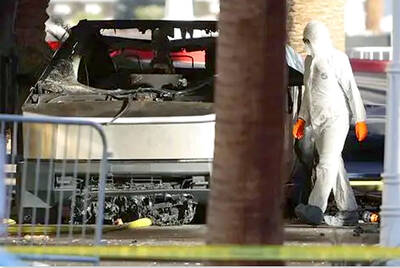
ACTIONABLE ADVICE: The majority of chatbots tested provided guidance on weapons, tactics and target selections, with Perplexity and Meta AI deemed to be the least safe From school shootings to synagogue bombings, leading artificial intelligence (AI) chatbots helped researchers plot violent attacks, according to a study published on Wednesday that highlighted the technology’s potential for real-world harm. Researchers from the nonprofit watchdog Center for Countering Digital Hate and CNN posed as 13-year-old boys in the US and Ireland to test 10 chatbots, including ChatGPT, Google Gemini, Perplexity, Deepseek and Meta AI. Eight of the chatbots assisted the make-believe attackers in more than half the responses, providing advice on “locations to target” and “weapons to use” in an attack, the study said. The chatbots had become a “powerful accelerant for
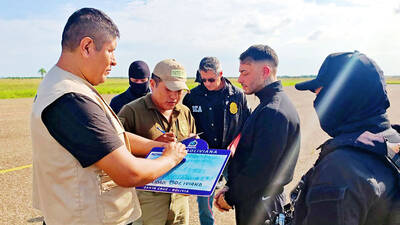
KINGPIN: Marset allegedly laundered the proceeds of his drug enterprise by purchasing and sponsoring professional soccer teams and even put himself in the starting lineups Notorious Latin American narco trafficker Sebastian Marset, who eluded police for years, was handed over to US authorities after his arrest on Friday in Bolivia. Marset, a Uruguayan national who was on the US most-wanted list, was passed to agents of the US Drug Enforcement Administration at Santa Cruz airport in Bolivia, then put on a US airplane, Bolivian state television showed. “The arrest and deportation were carried out pursuant to a court order issued by the US justice system,” Bolivian Minister of Government Marco Antonio Oviedo told reporters. The alleged kingpin was arrested in an upscale neighborhood of Santa
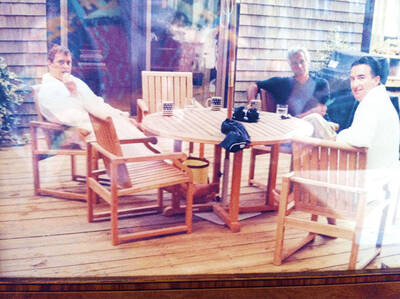
SCANDAL: Other images discovered earlier show Andrew bent over a female and lying across the laps of a number of women, while Mandelson is pictured in his underpants A photograph of former British prince Andrew and veteran politician Peter Mandelson sitting in bathrobes alongside late sex offender Jeffrey Epstein was unearthed on Friday in previously published documents. The image is believed to be the first known photograph of the two men with Epstein. They are currently engulfed in scandal in the UK over their ties to their mutual friend. The undated photograph, first reported by ITV News, shows King Charles III’s disgraced brother and former British ambassador to the US sitting barefoot outside on a wooden deck. They appear to have mugs with a US flag on them
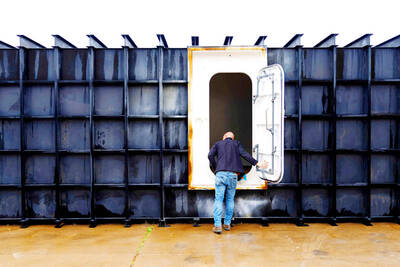
Since the war in the Middle East began nearly two weeks ago, the telephone at Ron Hubbard’s bomb shelter company in Texas has not stopped ringing. Foreign and US clients are rushing to buy his bunkers, seeking refuge in case of air raids, nuclear fallout or apocalypse. With the US and Israel pounding Iran, and Tehran retaliating with strikes across the region, Hubbard has seen demand for his product soar, mostly from Gulf nation customers in Bahrain, Qatar, Kuwait and the United Arab Emirates. “You can imagine how many people are thinking: ‘I wish I had a bomb shelter,’” Hubbard, 63, said in


 RSS
RSS