


United in their love for canines, an unlikely Albanian and Serb duo have teamed up in Kosovo to run a shelter for abandoned dogs, in a rare example of cooperation in a country still deeply divided along ethnic lines more than two decades after a devastating war.
Distrust still undercuts relations between the Albanian and Serb communities, without a common language and with ethnic tensions never far from the surface.
However, the lingering distrust has done little to separate Mentor Hoxha, 55, the Albanian founder of the Pristina Dog Shelter, and Slavisa Stojanovic, his 57-year-old Serb counterpart.
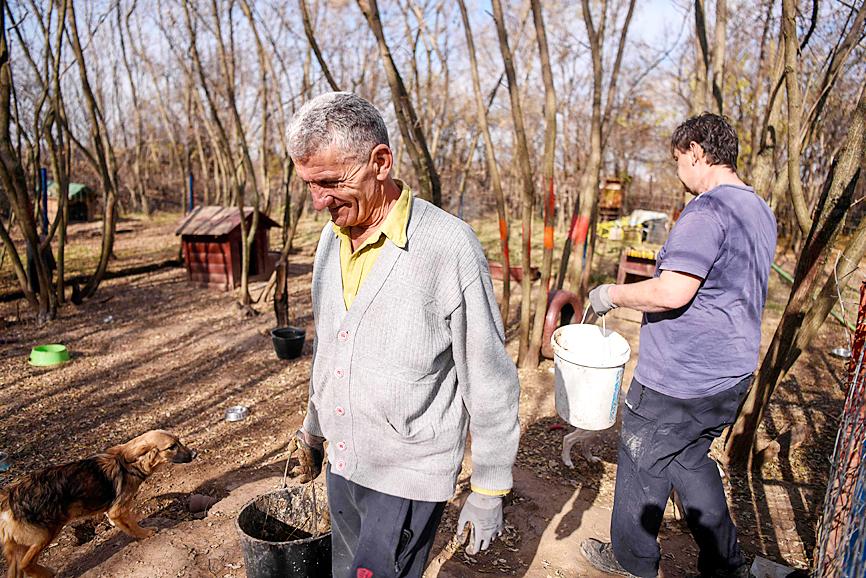
Photo: AFP
Their operation provides shelter to about 40 dogs in a handful of kennels sitting near farmland in Gracanica, a Serb-majority town near Kosovo’s capital, Pristina.
“We are connected by our love of dogs,” Hoxha said.
The two have helped more than 1,000 canines since they joined forces in 2010.
Typically, the dogs are vaccinated and sterilized before being released back into the streets, while puppies and other more vulnerable canines remain at the shelter.
Hoxha and Stojanovic place about 80 dogs a year with families across western Europe.
Animal shelters are rare in the nation, where stray dogs have long been a scourge in cities and villages.
The numbers soared after the conflict pitting Serb forces against Albanian guerrillas in the late 1990s, with abandoned pets pouring into the streets as the internecine fighting displaced their owners.
To combat the problem, Kosovo authorities offered bounties to hunters to gun them down — until a public outcry spurred on by celebrities including French actress Brigitte Bardot stopped the culling.
However, abandoned canines still roam Kosovo’s streets, lounging near traffic roundabouts and sleeping in public parks.
Following a string of dog attacks on children in 2017, the Kosovo government released 1.3 million euros (US$1.5 million) for a four-year sterilization program.
However, an estimated 10,000 canines have yet to be neutered, leaving a persistent population of dogs on the streets.
With few willing to help the strays, Hoxha and Stojanovic channeled their love of dogs into creating one of the few shelters working with street dogs — and outsiders marveled over their ability to overcome their ethnic differences.
“I find it strange when people ask about us,” Hoxha said. “It’s completely normal for people to socialize. The war ended 20 years ago.”
An estimated 13,000 people were killed in the 1998-1999 war, which ended after a three-month-long NATO bombing campaign forced Belgrade to withdraw its troops and leave the governance of the region to the UN.
Kosovo unilaterally declared independence from Serbia in 2008, with about 100 countries recognizing it as a sovereign state — with the exception of Serbia and its allies, Russia and China.
Hoxha suggested starting the shelter after a chance meeting with Stojanovic in the street, discovering that they shared a passion for helping the abandoned dogs in their area.
“Mentor and I are alike in heart and soul, and in our love of animals,” Stojanovic said.
The shelter relies mostly on donations and an army of volunteers, with the lion’s share of their funds helping to cover the costs of vaccinations and sterilizations.
“Our project has had a lot of impact on the situation, and the awareness and attitude of society towards abandoned dogs — primarily the importance of sterilization,” Hoxha said.
Kosovo filmmaker and animal rights advocate Hana Noka said that more needs to be done in the country to raise awareness about the issue of strays.
“There are stray dogs that live in horrific conditions and left alone on the streets all year round,” Noka said. “Most passers-by don’t even look at them.”
Despite the hardships and perennial lack of funding, Stojanovic said that he has no regrets about dedicating himself to stray dogs.
“If I started again, I wouldn’t change anything. I feel at home with animals. I’m with the dogs nonstop,” he said.
“They show great love — they just don’t talk,” he added.

‘IN A DIFFERENT PLACE’: The envoy first visited Shanghai, where he attended a Chinese basketball playoff match, and is to meet top officials in Beijing tomorrow US Secretary of State Antony Blinken yesterday arrived in China on his second visit in a year as the US ramps up pressure on its rival over its support for Russia while also seeking to manage tensions with Beijing. The US diplomat tomorrow is to meet China’s top brass in Beijing, where he is also expected to plead for restraint as Taiwan inaugurates president-elect William Lai (賴清德), and to raise US concerns on Chinese trade practices. However, Blinken is also seeking to stabilize ties, with tensions between the world’s two largest economies easing since his previous visit in June last year. At the

UNSETTLING IMAGES: The scene took place in front of TV crews covering the Trump trial, with a CNN anchor calling it an ‘emotional and unbelievably disturbing moment’ A man who doused himself in an accelerant and set himself on fire outside the courthouse where former US president Donald Trump is on trial has died, police said yesterday. The New York City Police Department (NYPD) said the man was declared dead by staff at an area hospital. The man was in Collect Pond Park at about 1:30pm on Friday when he took out pamphlets espousing conspiracy theories, tossed them around, then doused himself in an accelerant and set himself on fire, officials and witnesses said. A large number of police officers were nearby when it happened. Some officers and bystanders rushed

Beijing is continuing to commit genocide and crimes against humanity against Uyghurs and other Muslim minorities in its western Xinjiang province, U.S. Secretary of State Antony Blinken said in a report published on Monday, ahead of his planned visit to China this week. The State Department’s annual human rights report, which documents abuses recorded all over the world during the previous calendar year, repeated language from previous years on the treatment of Muslims in Xinjiang, but the publication raises the issue ahead of delicate talks, including on the war in Ukraine and global trade, between the top U.S. diplomat and Chinese

RIVER TRAGEDY: Local fishers and residents helped rescue people after the vessel capsized, while motorbike taxis evacuated some of the injured At least 58 people going to a funeral died after their overloaded river boat capsized in the Central African Republic’s (CAR) capital, Bangui, the head of civil protection said on Saturday. “We were able to extract 58 lifeless bodies,” Thomas Djimasse told Radio Guira. “We don’t know the total number of people who are underwater. According to witnesses and videos on social media, the wooden boat was carrying more than 300 people — some standing and others perched on wooden structures — when it sank on the Mpoko River on Friday. The vessel was heading to the funeral of a village chief in


 RSS
RSS