


Exhibiting a torture instrument as an innocent rocking chair, Chinese dissident artist Badiucao (巴丟草) mocks the propaganda of Beijing in a new show — while appropriating its codes.
Defying calls from the Chinese government to cancel it, the northern Italian city of Brescia is hosting the first international solo exhibition by the 35-year-old artist and exile from China who lives in Australia.
Badiucao’s works are “full of anti-Chinese lies” that “jeopardize the friendly relations between China and Italy,” the Chinese embassy in Rome said in a letter sent last month to Brescia’s town hall.
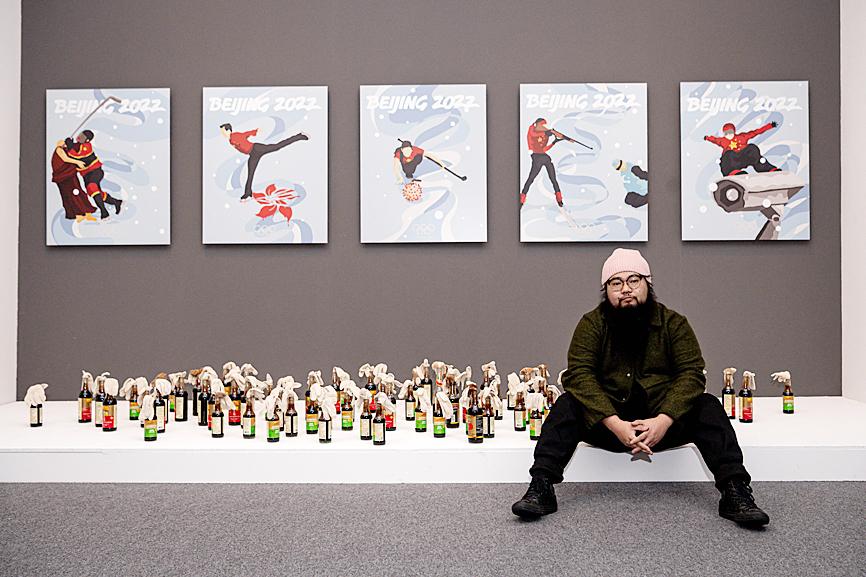
Photo: AFP
However, the city stood its ground.
“None of us in Brescia, neither in the city council nor among the citizens, had the slightest doubt about this exhibition going ahead,” Brescia Deputy Mayor Laura Castelletti said.
Brescia, known for its Roman ruins, has a long tradition of welcoming dissidents, painters and writers, in the “defense of artistic freedom,” she said.
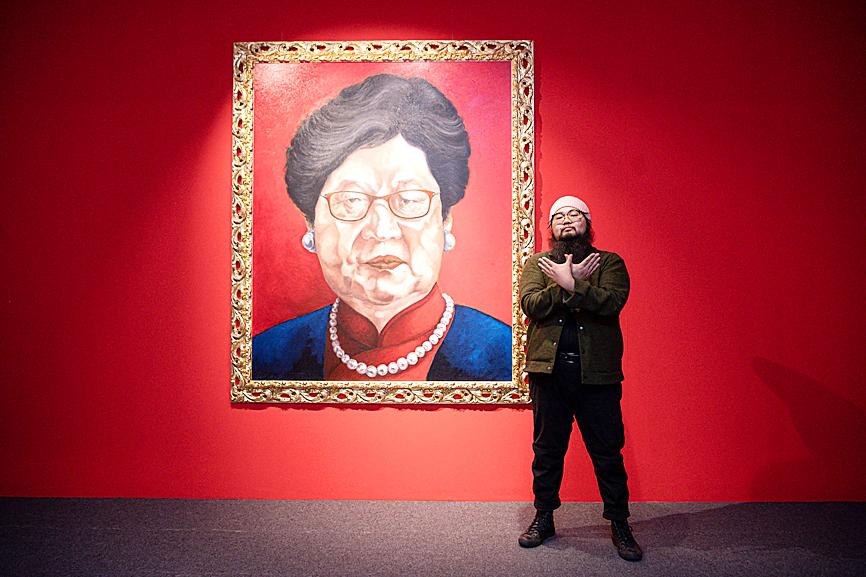
Photo: AFP
The last was in 2019, with the works of Kurdish artist Zehra Dogan, who spent nearly three years in jail in Turkey. The new show, “China is (not) near — works of a dissident artist,” which opened on Friday, denounces political repression in China and the country’s censorship of the origins of COVID-19, two explosive subjects for Beijing.
The exhibition, whose title alludes to a famous Italian film from 1967, China Is Near, runs until Feb. 13 next year at the Santa Giulia Museum.
In an interview, Badiucao — who has been called “the Chinese Banksy” — said he was “very happy and proud” that the city “had the courage to say ‘no’ to China to defend fundamental rights.”
“I want to use my art to expose the lies, to expose the problems of the Chinese government, to criticize the Chinese government. However, on the other hand it’s also celebrating the Chinese people, for how brave Chinese people are ... even when they have been subjected to this very harsh environment with an authoritarian government,” Badiucao said, speaking in English.
Plans for a Hong Kong show in 2018 fell through after pressure on the artist and his entourage, said the bespectacled Badiucao, who sports a long, shaggy beard.
“The national security police went to intimidate my family in Shanghai,” he said, adding that they threatened to “send officers” to the opening if the exhibition was held.
Among the works exhibited in Brescia that have provoked the ire of Beijing is a famous image of Chinese President Xi Jinping (習近平) merged with the face of Hong Kong Chief Executive Carrie Lam (林鄭月娥) to illustrate the erosion of self-rule in the former British colony.
The Chinese Communist Party “thinks that all free artists are its enemies, that’s why it hates me so much,” said Badiucao, adding that he receives “daily death threats” on social media.
Due to heavy censorship, he said he only learned decades later as a university student studying law in China about the government’s brutal 1989 crackdown on protesters in Tiananmen Square.
Badiucao decided to dedicate himself to art, moving to Australia in 2009 and only revealing his identity publicly on its 30th anniversary a decade later.
Another of his works depicts 64 watches painted with the artist’s own blood, representing those given to Chinese soldiers as a reward for their participation in the bloody Tiananmen Square Massacre, Badiucao said.
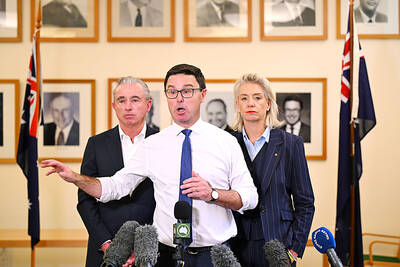
BACKLASH: The National Party quit its decades-long partnership with the Liberal Party after their election loss to center-left Labor, which won a historic third term Australia’s National Party has split from its conservative coalition partner of more than 60 years, the Liberal Party, citing policy differences over renewable energy and after a resounding loss at a national election this month. “Its time to have a break,” Nationals leader David Littleproud told reporters yesterday. The split shows the pressure on Australia’s conservative parties after Prime Minister Anthony Albanese’s center-left Labor party won a historic second term in the May 3 election, powered by a voter backlash against US President Donald Trump’s policies. Under the long-standing partnership in state and federal politics, the Liberal and National coalition had shared power

CONTROVERSY: During the performance of Israel’s entrant Yuval Raphael’s song ‘New Day Will Rise,’ loud whistles were heard and two people tried to get on stage Austria’s JJ yesterday won the Eurovision Song Contest, with his operatic song Wasted Love triumphing at the world’s biggest live music television event. After votes from national juries around Europe and viewers from across the continent and beyond, JJ gave Austria its first victory since bearded drag performer Conchita Wurst’s 2014 triumph. After the nail-biting drama as the votes were revealed running into yesterday morning, Austria finished with 436 points, ahead of Israel — whose participation drew protests — on 357 and Estonia on 356. “Thank you to you, Europe, for making my dreams come true,” 24-year-old countertenor JJ, whose
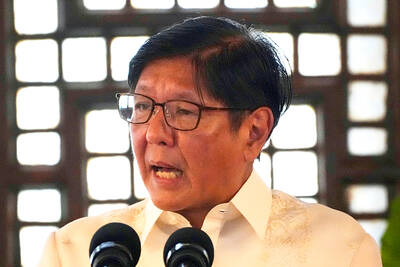
NO EXCUSES: Marcos said his administration was acting on voters’ demands, but an academic said the move was emotionally motivated after a poor midterm showing Philippine President Ferdinand Marcos Jr yesterday sought the resignation of all his Cabinet secretaries, in a move seen as an attempt to reset the political agenda and assert his authority over the second half of his single six-year term. The order came after the president’s allies failed to win a majority of Senate seats contested in the 12 polls on Monday last week, leaving Marcos facing a divided political and legislative landscape that could thwart his attempts to have an ally succeed him in 2028. “He’s talking to the people, trying to salvage whatever political capital he has left. I think it’s
A documentary whose main subject, 25-year-old photojournalist Fatima Hassouna, was killed in an Israeli airstrike in Gaza weeks before it premiered at Cannes stunned viewers into silence at the festival on Thursday. As the cinema lights came back on, filmmaker Sepideh Farsi held up an image of the young Palestinian woman killed with younger siblings on April 16, and encouraged the audience to stand up and clap to pay tribute. “To kill a child, to kill a photographer is unacceptable,” Farsi said. “There are still children to save. It must be done fast,” the exiled Iranian filmmaker added. With Israel


 RSS
RSS