


Dozens of relatives and dignitaries gathered in South Korea’s capital yesterday to pay their final respects to former South Korean president Roh Tae-woo, a key participant in a 1979 military coup who later won a landmark democratic election, before his political career ended with imprisonment for corruption and treason.
COVID-19 pandemic restrictions limited the size of funeral services for Roh, who died on Tuesday at the age of 88 from complications from various illnesses.
Doctors said that his condition had worsened over the past few years because of a degenerative disorder.
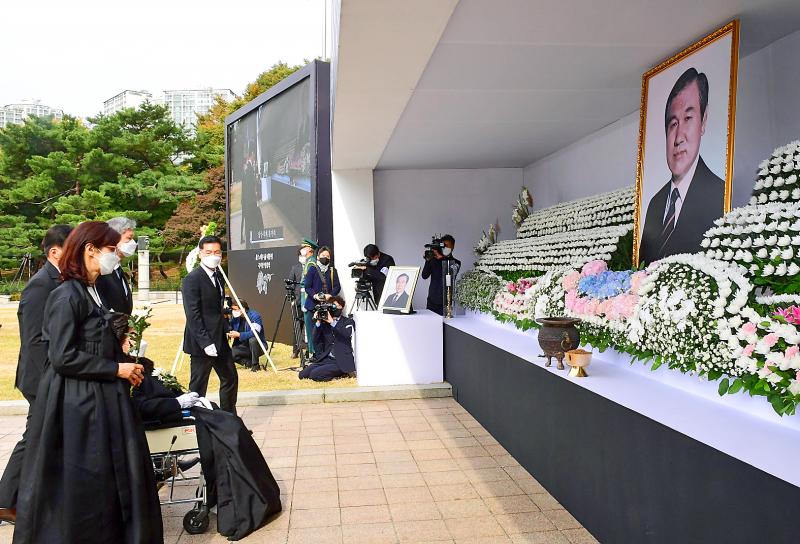
Photo: EPA-EFE
South Korean President Moon Jae-in’s decision to hold a state funeral for Roh was controversial because of his links to the coup and a bloody suppression of democracy protesters in the southern city of Gwangju in 1980 that killed about 200 people and injured hundreds of others.
Gwangju and several other cities and provincial governments refused to raise flags half-mast or set up memorial altars for Roh in accordance with state funeral procedures.
Moon, who did not visit Roh’s memorial altar at a Seoul hospital before leaving for Rome on Thursday for meetings with Pope Francis and G20 leaders, said through his office that Roh made “significant contributions to national development despite many historical wrongdoings.”
On the final day of a five-day funeral procession, honor guards wrapped Roh’s coffin with the national flag and placed it into the back of a limousine.
The vehicle then rolled out of the hospital and followed a black convertible topped with a huge portrait of Roh in a motorcade that drove toward his house in northern Seoul.
Family members quietly toured the house, led by a grandson who carried a smaller portrait of Roh. Then they headed toward southern Seoul for a funeral service at a square at Olympic Park, a venue built for the 1988 Seoul Olympic Games held during the first year of Roh’s presidency.
The funeral’s participants were limited to 50 people, including relatives, government officials, religious leaders and foreign diplomats.
Roh’s wife, Kim Ok-suk, and their two children, Roh Soh-young and Roh Jae-heon, sat quietly in chairs distanced apart, looking solemnly at the ground.
South Korean Prime Minister Kim Boo-kyum, told the ceremony that Roh Tae-woo would be remembered for his many accomplishments as president, including the successful hosting of the Olympics, expanding relations with communist nations and easing tensions with North Korea.
Kim also regretted that the late president never apologized in person over the coup and military atrocities, although his children conveyed his remorse while his health deteriorated.
“It’s undisputable truth President Roh Tae-woo has an immense fault that cannot be erased,” Kim said. “Attending the funeral service today, we realize that nobody is free from the [judgement] of history.”
Roh Tae-woo’s criminal convictions legally prevent him from being buried with other former leaders and national heroes at the country’s national cemetery. His cremated remains are to be kept at a Buddhist temple in Paju, north of Seoul, until his tomb is ready at nearby Paju Reunification Park, which was built during his presidency in 1989 as a symbol of peace between the two Koreas.
Gwangju Mayor Lee Yong-sup, a member of Moon’s Democratic Party, said the city could not honor Roh, who was a core member of then-South Korean president Chun Doo-hwan’s military junta that massacred its citizens.
“He was the president of our country, and while it’s our traditional sentiment to mourn a person who died, Gwangju cannot do that” for Roh Tae-woo, Lee said on Wednesday.
Roh Tae-woo was a major player in the 1979 military coup that brought his long-time army friend Chun to power.
Their takeover came months after their mentor, then South Korean president Park Chung-hee, was assassinated by his spy chief following 18 years of rule.
Roh Tae-woo had been Chun’s hand-picked successor, but massive democracy protests in 1987 forced them to accept a direct presidential election, which initiated South Korea’s transition toward democracy.
Despite his military background, Roh Tae-woo crafted a softer image during the presidential campaign, calling himself an “average person.” He won a closely contested vote in December 1987, largely thanks to a split in liberal votes between opposition candidates, and served as president for five years.
After his successor, Kim Young-sam, investigated the coup and the crackdown in Gwangju, Roh Tae-woo was arrested, convicted of mutiny, treason and corruption and received a prison term of 22-and-a-half years.
Roh Tae-woo was in 1997 released under a special pardon requested by then South Korean president-elect Kim Dae-jung, who sought national reconciliation.
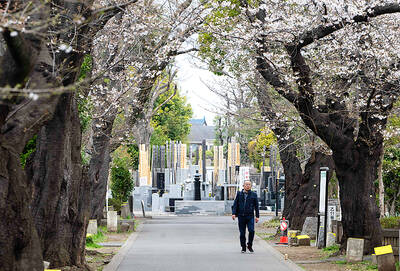
ROCKY RELATIONS: The figures on residents come as Chinese tourist numbers drop following Beijing’s warnings to avoid traveling to Japan The number of Chinese residents in Japan has continued to rise, even as ties between the two countries have become increasingly fractious, data released on Friday showed. As of the end of December last year, the number of Chinese residents had increased by 6.5 percent from the previous year to 930,428. Chinese people accounted for 22.6 percent of all foreign residents in Japan, making them by far the largest group, Japanese Ministry of Justice data showed. Beijing has criticized Tokyo in increasingly strident terms since Japanese Prime Minister Sanae Takaichi last year suggested that a military conflict around Taiwan could
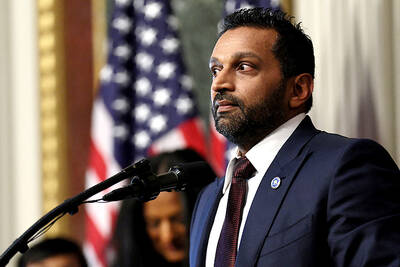
A pro-Iran hacking group claimed to breach FBI Director Kash Patel’s personal e-mail inbox and posted some of the contents online. The e-mails provided by the hacking group include travel details, correspondence with leasing agents in Washington and global entry, and loyalty account numbers. The e-mail address the hackers claim to have compromised has been previously tied to Patel’s personal details, and the leaked e-mails contain photos of Patel and others, in addition to correspondence with family members and colleagues. “The FBI is aware of malicious actors targeting Director Patel’s personal email information,” the agency said in a statement on
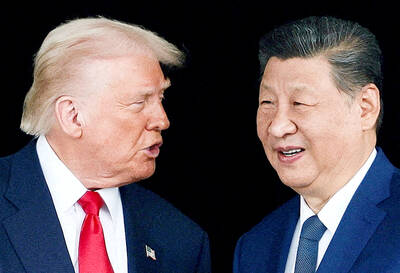
RIVALRY: ‘We know that these are merely symbolic investigations initiated by China, which is in fact the world’s most profligate disrupter of supply chains,’ a US official said China has started a pair of investigations into US trade practices, retaliating against similar probes by US President Donald Trump’s administration as the superpowers stake out positions before an expected presidential summit in May. The move, announced by the Chinese Ministry of Commerce on Friday, is a direct mirror of steps Trump took to revive his tariff agenda after the US Supreme Court last month struck down some of his duties. “China expresses its strong dissatisfaction and firm opposition to these actions,” a ministry spokesperson said in a statement, referring to the so-called Section 301 investigations initiated on March 11.
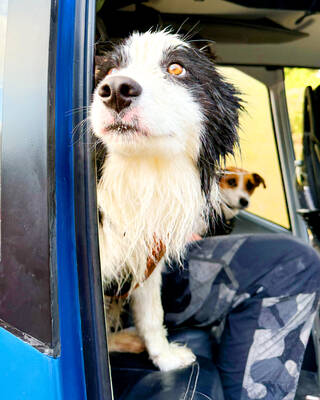
When a hiker fell from a 55m waterfall in wild New Zealand bush, rescuers were forced to evacuate the badly hurt woman without her dog, which could not be found. After strangers raised thousands of dollars for a search, border collie Molly was flown to safety by a helicopter pilot who was determined to reunite the pet and the owner. A week earlier, an emergency rescue helicopter found the woman with bruises and lacerations after a fall at a rocky spot at the waterfall on the South Island’s West Coast. She was airlifted on March 24, but they were forced to


 RSS
RSS