


Voting was under way in Uzbekistan’s presidential election yesterday, with incumbent Shavkat Mirziyoyev facing no real opposition, but plenty of challenges as he bids to reform the former Soviet country while maintaining its authoritarian foundations.
Mirziyoyev has been credited for launching what he calls a “New Uzbekistan,” ending a decades-old system of forced labor and introducing limited media freedom. He came to power in 2016 after the death of his mentor, former Uzbek president Islam Karimov, who had ruled the country for 27 years.
Mirziyoyev has presided over an unprecedented boom in foreign tourism in a country that borders Afghanistan and counts China and Russia among its partners.
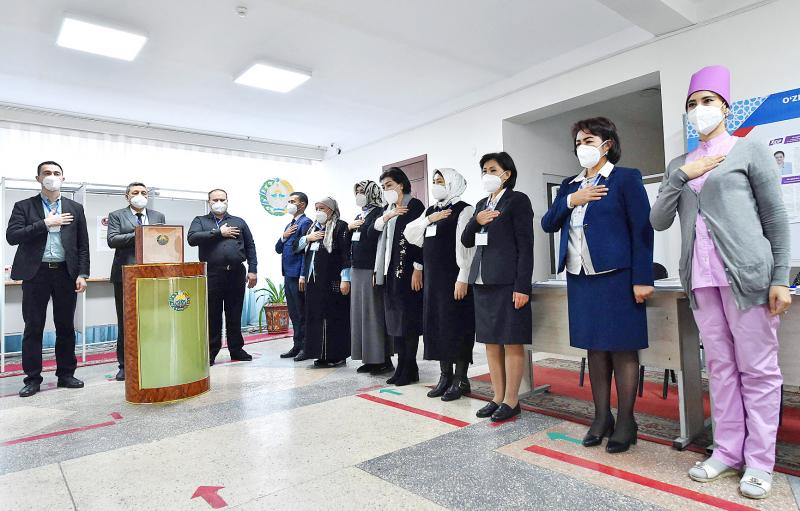
Photo: AFP
However, as his first term ends, the 64-year-old is struggling to counter impressions that his government is sliding back toward the habits of his long-reigning predecessor.
The effects of the COVID-19 pandemic have also blunted his initial economic achievements, with unemployment rife amid sharp rises in living costs.
Zera, a 55-year-old woman who was part of a slow trickle of mostly middle-aged and elderly voters casting their ballots at a high school in the capital, Tashkent, said that she backed Mirziyoyev, but was worried about the situation over the border in Afghanistan.
“This country worries me a lot now that [the Taliban] has taken over,” she told Agence France-Presse (AFP), only giving her first name. “The whole world warred with them and nothing good came of it. Can we be their friends? I am not sure.”
A 45-year-old man who also only gave his first name, Georgy, said he voted “against everyone, including him” — a reference to Mirziyoyev.
“I don’t like any of these choices,” he said.
Mirziyoyev cast his own vote at a polling station on Tashkent’s outskirts, where he appeared alongside his wife, Ziroatkhon Hoshimova, and their three children.
Mirziyoyev smiled as he posed for photographs before dropping his vote in the ballot box, but did not address the media.
Voting across the landlocked country of 34 million people began at 8am and was to last until 8pm.
Prolonged isolation under Karimov meant that commodity-rich Uzbekistan fell well short of its economic potential for most of independence. It is against the founding president’s brutal rule that the successes of Mirziyoyev’s reforms have been judged.
Mirziyoyev’s public disavowal of torture and his administration’s campaign to clean up mass forced labor in cotton fields — where thousands of schoolchildren once toiled alongside their teachers — gained international praise.
However, the past two years have seen a crackdown on dissent, particularly in Internet freedoms that bloomed after 2016, rights groups have said.
Mirziyoyev has also sidestepped reforms that would allow competition to his rule.
He faces four regime-loyal opponents plucked from parties in the country’s rubber-stamp parliament in his bid to secure a second five-year term.
An independent challenger, academic Khidirnazar Allakulov, fell at the first hurdle after failing to register a party that could nominate him.
Human Rights Watch earlier this month said that officials “harassed [Allakulov’s] party supporters and interfered in their efforts to collect signatures for registration.”
However, many Uzbeks interviewed by AFP in Tashkent ahead of the vote said they were unconcerned by the lack of real choice on the ballot.
“When things are going well, why do we need so many choices?” asked pensioner Yakub Otazhanov. “Let Mirziyoyev [get on with it].”
Under his rule, Uzbekistan has strengthened traditional relations with regional powerhouses Beijing and Moscow, while welcoming back international organizations and media effectively banned under Karimov.
However, for many in Tashkent, poverty rather than rights is the issue of the day. “There are a lot of poor and homeless people. We need to find housing for people,” a 26-year-old money-changer at the city’s Chorsu market said.
The man — who gave his first name, Sardor — said he would vote for Mirziyoyev.
“I hope he will help solve these problems,” he said.
His colleague, who did not want to be named, implied that the president’s reforms were cosmetic.
“New buildings do not mean a new Uzbekistan,” he said.

When a hiker fell from a 55m waterfall in wild New Zealand bush, rescuers were forced to evacuate the badly hurt woman without her dog, which could not be found. After strangers raised thousands of dollars for a search, border collie Molly was flown to safety by a helicopter pilot who was determined to reunite the pet and the owner. A week earlier, an emergency rescue helicopter found the woman with bruises and lacerations after a fall at a rocky spot at the waterfall on the South Island’s West Coast. She was airlifted on March 24, but they were forced to
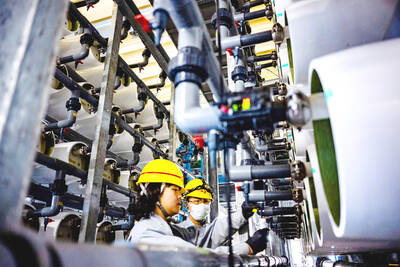
HIGH HOPES: The power source is expected to have a future, as it is not dependent on the weather or light, and could be useful for places with large desalination facilities A Japanese water plant is harnessing the natural process of osmosis to generate renewable energy that could one day become a common power source. The possibility of generating power from osmosis — when water molecules pass from a less salty solution to a more salty one — has long been known. However, actually generating energy from that has proved more complicated, in part due the difficulty of designing the membrane through which the molecules pass. Engineers in Fukuoka, Japan, and their private partners think they might have cracked it, and have opened what is only the world’s second osmotic power plant. It generates
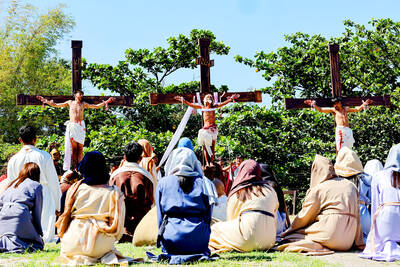
Hundreds of Filipinos and tourists flocked to a sun-bleached field north of Manila yesterday, on Good Friday, to witness one of the country’s most blood-soaked displays of religious fervor, undeterred by rising fuel prices. Scores of bare-chested flagellants with covered faces walked barefoot through the dusty streets of Pampanga Province’s San Fernando as they flogged their backs with bamboo whips in the scorching heat. Agence France-Presse (AFP) journalists said they saw devotees deliberately puncturing their skin with glass shards attached to a small wooden paddle to ensure their bleeding during the ritual, a way to atone for sins and seek miracles from
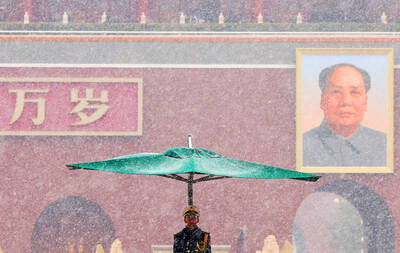
Chinese dissident artist Gao Zhen (高兟), famous for making provocative satirical sculptures of former Chinese leader Mao Zedong (毛澤東), was tried on Monday over accusations of “defaming national heroes and martyrs,” his wife and a rights group said. Gao, 69, who was detained in 2024 during a visit from the US, faces a maximum three-year prison sentence, said his wife, Zhao Yaliang (趙雅良), and Shane Yi, a researcher at the Chinese Human Rights Defenders group which operates outside the nation. The closed-door, one-day trial took place at Sanhe City People’s Court in Hebei Province neighboring the capital, Beijing, and ended without a


 RSS
RSS