


Kim Yo-jong, the influential sister of North Korean leader Kim Jong-un, reached out to South Korea for a second time in recent days, saying Pyongyang would consider taking part in another inter-Korean summit and declaring an end to the war if Seoul adopts a less hostile policy.
“I felt that the atmosphere of the South Korean public desiring to recover the inter-Korean relations from a deadlock and achieve peaceful stability as soon as possible is irresistibly strong,” Kim Yo-jong said in a statement issued by the official Korean Central News Agency. “We, too, have the same desire.”
Kim’s statement follows one she issued on Friday saying that South Korean President Moon Jae-in’s proposal to officially declare an end to the Korean War is an “interesting and good idea” in that it suggests a cessation of hostilities between the two sides. The countries are still technically at war after the 1950-1953 conflict ended in an armistice rather than a peace treaty.
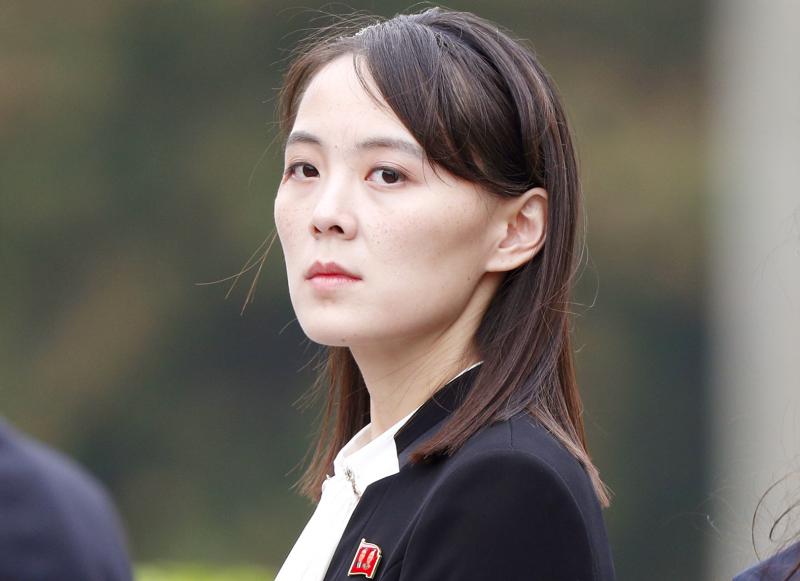
Photo: AP
North Korea cut off communications with South Korea and symbolically exploded an inter-Korean liaison office on its side of the border last year as Seoul continued its support for the US-led sanctions campaign that’s hobbled the North’s economy. Earlier this month, Pyongyang launched two cruise missiles with capabilities of reaching South Korea and Japan, the US Pentagon said.
“Only by maintaining fairness and respect for each other can the two Koreas resolve other relational problems, like declaring the end of war at the proper time, re-establishing North and South liaison office, and arranging inter-Korean summits between the two leaders through constructive discussions,” Kim Yo-jong said, stressing that she was expressing her “personal opinion.”
Moon on Tuesday reiterated his call for formally ending the Korean War in an address to the UN General Assembly. He has less than a year left in office and is attempting to achieve a key policy priority of reconciliation with North Korea.
Washington signaled its interest in the proposal, with Pentagon press secretary John Kirby on Wednesday stating that the US is “open to discussing the possibility of an end of war declaration.”
Just last month, Kim Yo-jong sister ramped up the tension on the Korean Peninsula, saying “a dear price should be paid” if South Korea and the US proceed with “self-destructive” joint military drills. North Korea also did not answer an inter-Korean hotline call earlier last month in protest against the military drills.
Seoul and Washington have been holding joint exercises for decades and held some last month as planned, despite Pyongyang’s protests.
South Korea test-launched a missile from a submarine this month, stepping up its strike capabilities and joining seven other countries to demonstrate the technology. The test came after US President Joe Biden and Moon ended a bilateral guideline in May that had long restricted Seoul’s development of missiles to under the range of 800 kilometers.
The move put major Chinese cities under South Korea’s range and increases Seoul’s ability to strike North Korea. Resuming inter-Korean talks could influence Moon — a long-time proponent of reconciliation — to prioritize the high-stakes negotiations rather than military modernization.

When a hiker fell from a 55m waterfall in wild New Zealand bush, rescuers were forced to evacuate the badly hurt woman without her dog, which could not be found. After strangers raised thousands of dollars for a search, border collie Molly was flown to safety by a helicopter pilot who was determined to reunite the pet and the owner. A week earlier, an emergency rescue helicopter found the woman with bruises and lacerations after a fall at a rocky spot at the waterfall on the South Island’s West Coast. She was airlifted on March 24, but they were forced to

HIGH HOPES: The power source is expected to have a future, as it is not dependent on the weather or light, and could be useful for places with large desalination facilities A Japanese water plant is harnessing the natural process of osmosis to generate renewable energy that could one day become a common power source. The possibility of generating power from osmosis — when water molecules pass from a less salty solution to a more salty one — has long been known. However, actually generating energy from that has proved more complicated, in part due the difficulty of designing the membrane through which the molecules pass. Engineers in Fukuoka, Japan, and their private partners think they might have cracked it, and have opened what is only the world’s second osmotic power plant. It generates

Hundreds of Filipinos and tourists flocked to a sun-bleached field north of Manila yesterday, on Good Friday, to witness one of the country’s most blood-soaked displays of religious fervor, undeterred by rising fuel prices. Scores of bare-chested flagellants with covered faces walked barefoot through the dusty streets of Pampanga Province’s San Fernando as they flogged their backs with bamboo whips in the scorching heat. Agence France-Presse (AFP) journalists said they saw devotees deliberately puncturing their skin with glass shards attached to a small wooden paddle to ensure their bleeding during the ritual, a way to atone for sins and seek miracles from
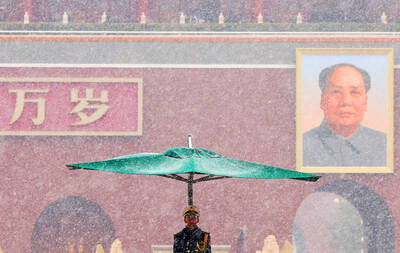
Chinese dissident artist Gao Zhen (高兟), famous for making provocative satirical sculptures of former Chinese leader Mao Zedong (毛澤東), was tried on Monday over accusations of “defaming national heroes and martyrs,” his wife and a rights group said. Gao, 69, who was detained in 2024 during a visit from the US, faces a maximum three-year prison sentence, said his wife, Zhao Yaliang (趙雅良), and Shane Yi, a researcher at the Chinese Human Rights Defenders group which operates outside the nation. The closed-door, one-day trial took place at Sanhe City People’s Court in Hebei Province neighboring the capital, Beijing, and ended without a


 RSS
RSS