


Taliban fighters have taken over the glitzy Kabul mansion of one of their fiercest enemies — former Afghan vice president Abdul Rashid Dostum, a warlord and now fugitive.
In the hands of rank-and-file Taliban fighters, the opulent villa has given the austere Islamists a peek into the lives of Afghanistan’s former rulers, and they say the luxury is the proceeds of years of endemic corruption.
Along an endless corridor with a thick apple-green carpet, a young fighter sleeps slumped on a sofa, his Kalashnikov rifle resting against him, as exotic fish glide above him in one of seven giant tanks.
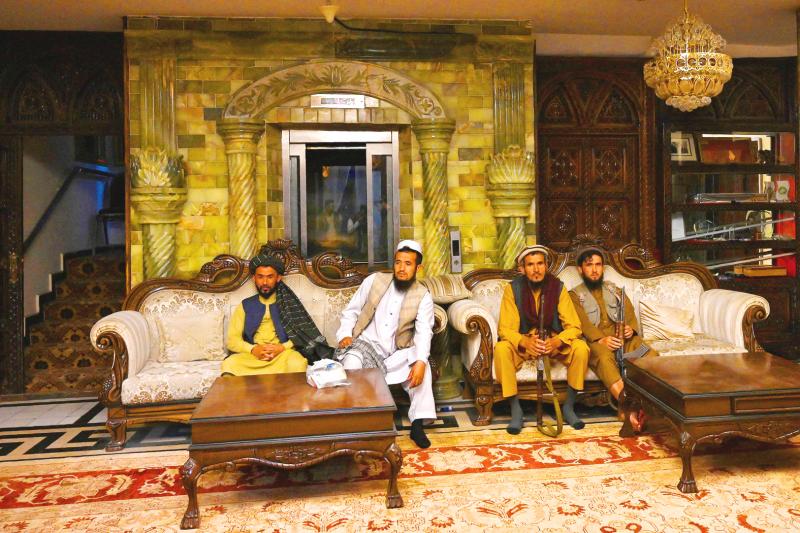
Photo: AFP
The fighter is part of the personal security detail of Qari Salahuddin Ayoubi — one of the new regime’s most powerful commanders — who installed his company of 150 men in the mansion on Aug. 15, the day that Kabul fell.
The luxury of the mansion would be unimaginable for most ordinary Afghans.
Huge glass chandeliers hang in cavernous halls, large soft sofas furnish a maze of lounges and an indoor swimming pool is finished with intricate turquoise tiles.
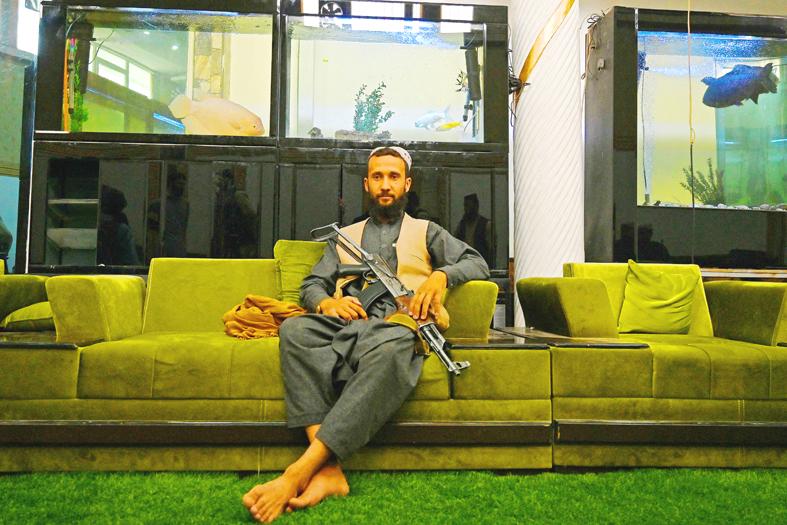
Photo: AFP
It even boasts a sauna, a Turkish steam bath and a gym.
It is an out-of-this-world experience for the new occupants, who for years sacrificed creature comforts for rebellion — living on their wits in the plains, valleys and mountains of rural Afghanistan.
However, the new head of the household — now the military commander of four provinces — makes it clear that his men are not to get used to the luxury.
“Islam never wants us to have a luxurious life,” Ayoubi said, adding luxury comes in paradise, the “life after death.”
The mansion’s owner, Dostum, is a notorious figure woven into the fabric of Afghanistan’s recent history.
A former paratrooper, communist commander, warlord and vice president, he was the very definition of a cunning political survivor who weathered more than four decades of conflict in war-torn Afghanistan.
Despite a series of war crimes linked to Dostum’s forces, the former Afghan government hoped that his military acumen and seething hatred of the Taliban would help them survive, but his stronghold was overrun and the graying 67-year-old fled across the border to Uzbekistan.
The former vice president is widely suspected to have hugely profited from the corruption and embezzlement that discredited the former government.
Several officials illegally took land to build luxurious mansions in one neighborhood, earning it the nickname “Thieves’ Quarter” among locals.
In one wing of the enormous house, Taliban fighters relaxed in a massive tropical greenhouse of several hundred square meters under a huge glass roof.
That is overlooked by a mezzanine dominated by a dark wood bar — a testament to the reported decadent tastes of a general renowned for a penchant for late nights and strong liquor.
The Taliban have good reason to hate Dostum.
In 2001, he was accused of killing more than 2,000 fighters — locking many in containers in the middle of the desert where they suffocated under a scorching sun.
Ayoubi rejected any desire for revenge.
“If other people who had been oppressed like us came here, you would not have seen the chairs and tables. They might have destroyed them,” he said.
However, the new Taliban regime would not allow such luxury to be constructed with ill-gotten gains in the future, Ayoubi said.
“We are on the side of the poor,” he said, as dozens of visitors wait patiently in the corridor, idly watching the indifferent fish.
A ship that appears to be taking on the identity of a scrapped gas carrier exited the Strait of Hormuz on Friday, showing how strategies to get through the waterway are evolving as the Middle East war progresses. The vessel identifying as liquefied natural gas (LNG) carrier Jamal left the Strait on Friday morning, ship-tracking data show. However, the same tanker was also recorded as having beached at an Indian demolition yard in October last year, where it is being broken up, according to market participants and port agent’s reports. The ship claiming to be Jamal is likely a zombie vessel that

Cannabis-based medicines have shown little evidence of effectiveness for treating most mental health and substance-use disorders, according to a large review of past studies published in a major medical journal on Monday. Medical use of cannabinoids has been expanding, including in the US, Canada and Australia, where many patients report using cannabis products to manage conditions such as anxiety, post-traumatic stress disorder and sleep problems. Researchers reviewed data from 54 randomized clinical trials conducted between 1980 and May last year involving 2,477 participants for their analysis published in The Lancet. The studies assessed cannabinoids as a primary treatment for mental disorders or substance-use

NATIONWIDE BLACKOUT: US President Donald Trump cut off Venezuelan oil shipments to Cuba, strangling the Caribbean island’s already antiquated grid Cuba’s national electric grid collapsed on Monday, the nation’s grid operator said, leaving about 10 million people without power amid a US-imposed oil blockade that has crippled the already obsolete generation system. Grid operator UNE on social media said that it is investigating the causes of the blackout, the latest in a series of widespread outages that last for hours or days and that this weekend sparked a rare violent protest in the communist-run nation. Officials ruled out a major power plant failure, but had still not pinpointed the root cause of the grid collapse, suggesting a problem with transmission. Officials said that

CONSERVING FUEL: State institutions are to operate only four days a week starting tomorrow, with the measures also applying to schools and universities Sri Lanka on Monday announced a shorter working week to conserve its scarce fuel reserves as it prepares for a prolonged war in the Middle East. The Strait of Hormuz, a key waterway through which about 20 percent of global exports pass in peacetime, has been effectively closed by Iran in retaliation over the US and Israeli war against it, now in its third week. Sri Lankan Commissioner-General of Essential Services Prabath Chandrakeerthi said state institutions would operate only four days a week starting tomorrow. The new austerity measures would also apply to schools and universities, and would remain in place indefinitely. “We are


 RSS
RSS