


Fifteen to 20 villagers, including several teenagers, have been killed in some of Myanmar’s deadliest fighting since July between government troops and resistance forces, a villager and reports by independent media said on Friday.
The fighting near Gangaw township in the northwestern Magway region started on Thursday, two days after a call for a nationwide uprising was issued by the National Unity Government, an opposition organization that seeks to coordinate resistance to military rule.
The fighting broke out when more than 100 troops arrived in four military vehicles to secure the area in Myin Thar and five other nearby villages, a resident told reporters by telephone.
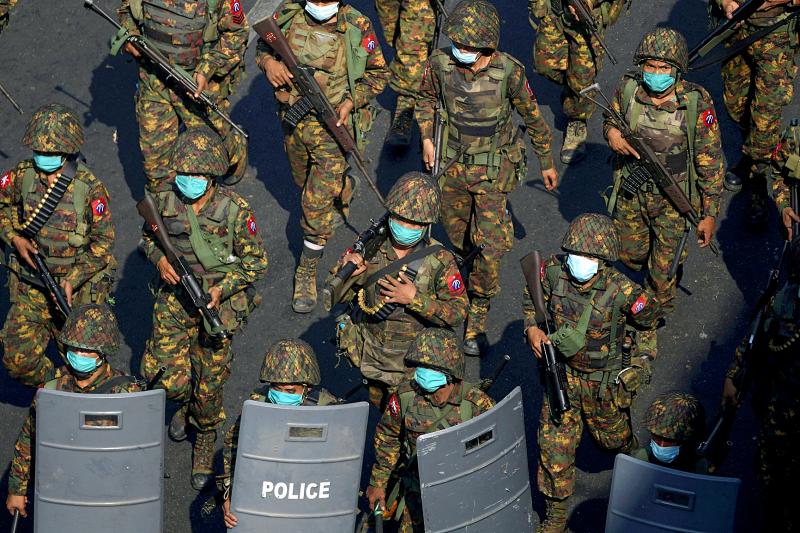
Photo: Reuters
Members of a lightly armed village self-defense militia fired warning shots, but could not stop the soldiers from entering the area and clashes continued after that, said the resident, who spoke on condition of anonymity to safeguard his personal security.
The opposition movement that rose against the army’s February seizure of power from the elected government of Burmese State Counselor Aung San Suu Kyi was initially peaceful, but gradually began fighting back after security forces used deadly force to break up nonviolent protests.
The National Unity Government’s call on Tuesday for a “people’s defensive war” has received an enthusiastic response on social media, but its actual impact on the ground is hard to measure.
Media sympathetic to the opposition reported an outburst of small-scale shootings and sabotage by the resistance, particularly the toppling of cellphone transmission towers.
However, similar activities have been happening for several months and details are difficult to independently verify.
The villager who described the new fighting said at least 11 members of the self-defense group were killed, according to what others in his village told him.
Photographs of what were described to be their bodies circulated widely on the Internet, and were clear enough to be identifiable to those familiar with them.
“We only have handmade guns and percussion lock firearms,” the villager said. “When it rained, the guns became useless. There are many casualties due to the imbalance in weapons.”
Myanmar’s government troops are well-equipped with modern weapons, and have access to air and artillery support.
The villager said other residents told him that most members of the village’s defense force are youths and that five of those killed were ninth and 10th-grade students.
A middle-school teacher was also said to have been killed, the villager said.
Members of the more than 2,000 households in the area had fled to the jungle, he added, while soldiers camped in abandoned homes and at the local Buddhist monastery.
Four more people were confirmed dead after fighting broke out again Friday morning, he said, and an unknown number of houses were burned.
Reports by independent media put the death toll among the villagers at 20 or more. Khit Thit Media, an online news service, said it was told by villagers that the dead included seven non-combatants in addition to the militants.
According to the Assistance Association for Political Prisoners, an independent organization that keeps detailed tallies of people killed or detained by the military government, there have been 1,058 activists and bystanders killed since February’s army takeover.
The government this week said that resistance forces have been responsible for the deaths of 933 people, Popular News reported, citing Burmese Deputy Home Minister General Soe Tint Naing.
In a Thursday briefing for foreign diplomats also attended by the news service, Soe Tint Naing said those killed included security personnel, civil servants and people believed by the resistance to be government informers.

An American scientist convicted of lying to US authorities about payments from China while he was at Harvard University has rebuilt his research lab in Shenzhen, China, to pursue technology the Chinese government has identified as a national priority: embedding electronics into the human brain. Charles Lieber, 67, is among the world’s leading researchers in brain-computer interfaces. The technology has shown promise in treating conditions such as amyotrophic lateral sclerosis and restoring movement in paralyzed people. It also has potential military applications: Scientists at the Chinese People’s Liberation Army have investigated brain interfaces as a way to engineer super soldiers by boosting

Indonesian police have arrested 13 people after shocking images of alleged abuse against small children at a daycare center went viral, sparking outrage across the nation, officials said on Monday. Police on Friday last week raided Little Aresha, a daycare center in Yogyakarta on Java island, following a report from a former employee. CCTV footage circulating on social media showed children, most younger than two, lying on the floor wearing only diapers, their hands and feet bound with rags. The police have confirmed that the footage is authentic. Police said they also found 20 children crammed into a room just 3m by 3m. “So

A grieving mother has ended her life at a clinic in Switzerland four years after the death of her only child. Wendy Duffy, 56, a physically healthy woman, died at the Pegasos clinic in Basel after struggling to cope with the death of her 23-year-old son, Marcus. The former care worker, from the West Midlands, England, had previously attempted to take her own life. The case comes as assisted dying would not become law in England and Wales after proposed legislation, branded “hopelessly flawed” by opponents, ran out of time. Ruedi Habegger, the founder of Pegasos, described Duffy’s death as

From post offices and parks to stations and even the summit of Mount Fuji, Japan’s vending machines are ubiquitous, but with the rapid pace of inflation cooling demand for their drinks, operators are being forced to rethink the business. Last month beverage giant DyDo Group Holdings announced it would remove about 20,000 vending machines — about 7 percent of their stock nationwide — by January next year, to “reconstruct a profitable network.” Pokka Sapporo Food & Beverage, based in Nagoya, also said last month it would sell its 40,000-machine operation to Osaka-based Lifedrink Co. “The strength of the vending machine


 RSS
RSS