


It is safer to transport a rhinoceros upside-down, and beards might be an evolutionary development to help protect men’s faces from punches, scientific studies that won Ig Nobel prizes on Thursday found.
An annual honor for unusual accomplishments in science and the humanities that aim to make you laugh and then think, the Ig Nobels are presented by Nobel laureates and are usually held at Harvard University’s Sanders Theater in Cambridge, Massachusetts.
It is the second year that the spoof awards have been issued online.
This year, each winner was given a paper trophy to assemble themselves and a counterfeit Zimbabwean $10 trillion (US$2.76 billion) note, in line with the light-hearted nature of the satirical prize.
A choral meditation on how bridges bring people together was interspersed between the presentations.
“The thing I love about wildlife veterinarians is you guys have to really think on your feet and think outside the box,” said 2012 Nobel Prize in Chemistry laureate Robert Lefkowitz, who gave out the prize for the African study that concluded rhinoceroses are more safely transported on their backs. “You have to be a genius and creative and sometimes even a little bit crazy to move rhinos this way.”
The findings that people might have begun growing beards to help cushion the impact of blows was accorded the peace prize.
ORGASMS, MEOWING
Chewing gum, orgasms and cats’ meows were some of the other topics of research awarded Ig Nobels.
Swedish researcher Susanne Schotz won the biology prize for analyzing variations in “purring, chirping, chattering, trilling, tweedling, murmuring, meowing, moaning, squeaking, hissing, yowling, howling, growling and other modes of cat-human communication,” and even demonstrated some of the noises she had studied.
The ecology prize was given to a group of scientists studying bacteria in wads of chewing gum discarded on pavements all over the world, and the medicine prize was awarded to research that demonstrated that orgasms can be as effective as medication in clearing congested noses.
Marc Abrahams, master of ceremonies and editor of the Annals of Improbable Research magazine, which produced the event, had the last word after the show.
“If you didn’t win an Ig Nobel prize this year, and especially if you did, better luck next year,” he said.

‘IN A DIFFERENT PLACE’: The envoy first visited Shanghai, where he attended a Chinese basketball playoff match, and is to meet top officials in Beijing tomorrow US Secretary of State Antony Blinken yesterday arrived in China on his second visit in a year as the US ramps up pressure on its rival over its support for Russia while also seeking to manage tensions with Beijing. The US diplomat tomorrow is to meet China’s top brass in Beijing, where he is also expected to plead for restraint as Taiwan inaugurates president-elect William Lai (賴清德), and to raise US concerns on Chinese trade practices. However, Blinken is also seeking to stabilize ties, with tensions between the world’s two largest economies easing since his previous visit in June last year. At the
Nearly half of China’s major cities are suffering “moderate to severe” levels of subsidence, putting millions of people at risk of flooding, especially as sea levels rise, according to a study of nationwide satellite data released yesterday. The authors of the paper, published by the journal Science, found that 45 percent of China’s urban land was sinking faster than 3mm per year, with 16 percent at more than 10mm per year, driven not only by declining water tables, but also the sheer weight of the built environment. With China’s urban population already in excess of 900 million people, “even a small portion

UNSETTLING IMAGES: The scene took place in front of TV crews covering the Trump trial, with a CNN anchor calling it an ‘emotional and unbelievably disturbing moment’ A man who doused himself in an accelerant and set himself on fire outside the courthouse where former US president Donald Trump is on trial has died, police said yesterday. The New York City Police Department (NYPD) said the man was declared dead by staff at an area hospital. The man was in Collect Pond Park at about 1:30pm on Friday when he took out pamphlets espousing conspiracy theories, tossed them around, then doused himself in an accelerant and set himself on fire, officials and witnesses said. A large number of police officers were nearby when it happened. Some officers and bystanders rushed
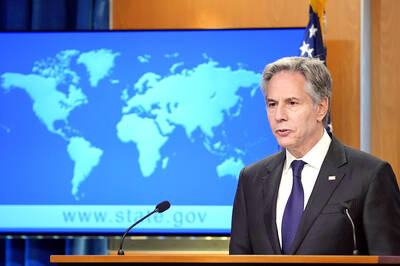
Beijing is continuing to commit genocide and crimes against humanity against Uyghurs and other Muslim minorities in its western Xinjiang province, U.S. Secretary of State Antony Blinken said in a report published on Monday, ahead of his planned visit to China this week. The State Department’s annual human rights report, which documents abuses recorded all over the world during the previous calendar year, repeated language from previous years on the treatment of Muslims in Xinjiang, but the publication raises the issue ahead of delicate talks, including on the war in Ukraine and global trade, between the top U.S. diplomat and Chinese


 RSS
RSS