


The world must take urgent action on climate change at upcoming UN talks in Glasgow, Scotland, or low-lying Pacific nations would face a “dire” future, Samoa’s new prime minister said in an interview.
Samoan Prime Minister Fiame Naomi Mata’afa, who took office as the nation’s first female leader in late July, gave a stark assessment of the Pacific’s prospects if efforts to tackle climate change continue to stall.
Mata’afa said rising seas were already swamping the region’s tiny atoll states — which include nations such as Tokelau, Tuvalu and Kiribati.
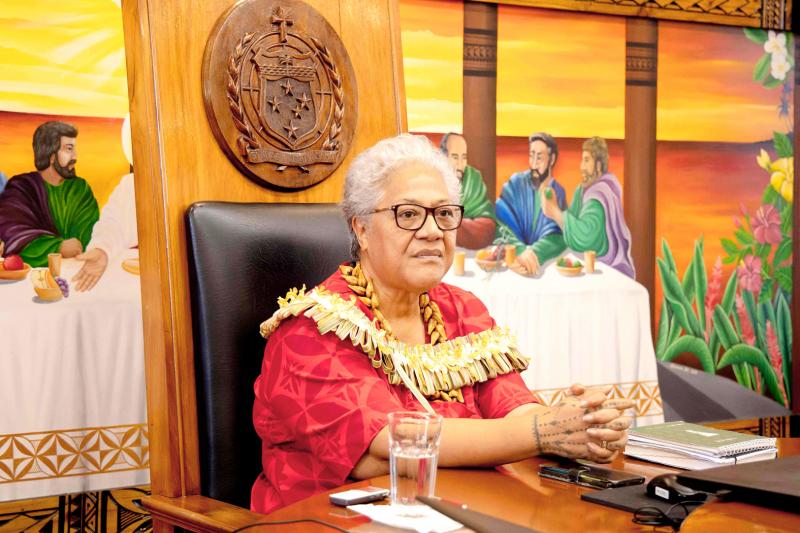
Photo: AFP
“With them, it’s a real and present circumstance — the water is gaining ground on them,” she said on Monday, adding that violent cyclones were becoming more common across the south Pacific.
Major storms “used to be every 50 to 60 years, now it’s becoming every two to three years,” she said. “For us, we’ve noticed the impact on our coastal areas, and about 70 percent of our country is settled on the coast.”
In a wide-ranging interview, Mata’afa also discussed the geopolitical rivalry between China and the US in the Pacific, her disappointment at neighboring Australia’s climate stance and the implications of her groundbreaking election victory, but front of her mind was the 26th edition of the UN Climate Change Conference of the Parties — COP26 — which is scheduled to begin in Glasgow in November.
The summit is to involve negotiators from 196 nations, the biggest climate conference since landmark talks in Paris in 2015.
Mata’afa said it was crucial that participants honor the ambitious goal set in Paris to limit global warming to 1.5°C compared with preindustrial levels.
To do that, she said carbon-emitting nations needed to prioritize saving the planet over economic growth.
“It’s not rocket science,” she said. “The Pacific was sort of a lone voice in the debate for a very long time, but I think the science advisers have now brought the world’s thinking towards that.”
The 64-year-old admitted her frustration at regional heavyweight Australia, which refuses to adopt a net-zero emissions target while remaining one of the world’s largest exporters of fossil fuels.
“When you’re working as a collective, as we do in the Pacific, Australia is a part of that,” she said. “It is a frustrating element, but that’s the reality of our lives, you can’t always agree.”
She also bristled at suggestions by some in Australia that Samoa did not understand the risks posed by forging close relations with China, which is seeking to expand its influence in the Pacific.
“What they were saying was we weren’t as well nuanced about how you have relationships with these big countries,” she said. “We’ve been independent since 1962, so we’ve been around the block. I think we understand quite well what our relationships are, just as Australia has its own relationships.”
Mata’afa said her new government had no intention of changing its diplomatic recognition of Beijing and that it recognizes the “one China” policy, although she remained open to trade with Taiwan.
She played down the impact of canceling a Beijing-bankrolled port project agreed to by her predecessor, saying that it was only at the feasibility stage when canned and would have no bearing on Samoa’s “mature” relationship with China.
Quizzed on rivalries between China and the US in the region, Mata’afa said that she was comfortable dealing with both powers to pursue Samoa’s best interests.
“In the geopolitical context, the reality of small countries is that we have to navigate our way through these larger countries and the issues they prioritize,” she said.
Mata’afa has been a long-time advocate for women’s rights and expressed hope her groundbreaking election win would signal a change of attitudes in the Pacific, which has one of the lowest rates of female parliamentary representation in the world.
“For gender role modeling, I’ve always believed that any women who achieved in whatever sector, once that happens other girls and women see that it can be done,” she said. “It’s significant in that sense.”

An American scientist convicted of lying to US authorities about payments from China while he was at Harvard University has rebuilt his research lab in Shenzhen, China, to pursue technology the Chinese government has identified as a national priority: embedding electronics into the human brain. Charles Lieber, 67, is among the world’s leading researchers in brain-computer interfaces. The technology has shown promise in treating conditions such as amyotrophic lateral sclerosis and restoring movement in paralyzed people. It also has potential military applications: Scientists at the Chinese People’s Liberation Army have investigated brain interfaces as a way to engineer super soldiers by boosting
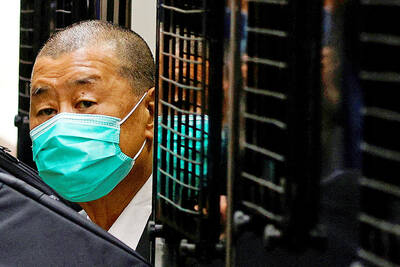
Jailed media entrepreneur Jimmy Lai (黎智英) has been awarded Deutsche Welle’s (DW) freedom of speech award for his contribution to Hong Kong’s pro-democracy movement. The German public broadcaster on Thursday said Lai would be presented in absentia with the 12th iteration of the award on June 23 at the DW Global Media Forum in Bonn. Deutsche Welle director-general Barbara Massing praised the 78-year-old founder of the now-shuttered news outlet Apple Daily for standing “unwaveringly for press freedom in Hong Kong at great personal risk.” “With Apple Daily, he gave journalists a platform for free reporting and a voice to the democracy movement in
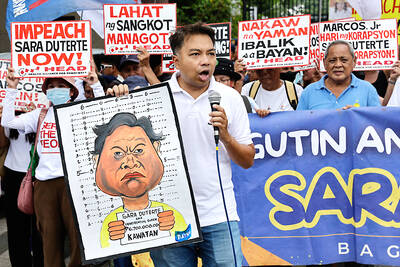
PHILIPPINE COMMITTEE: The head of the committee that made the decision said: ‘If there is nothing to hide, there is no reason to hide, there is no reason to obstruct’ A Philippine congressional committee on Wednesday ruled that there was “probable cause” to impeach Philippine Vice President Sara Duterte after hearing allegations of unexplained wealth, misuse of state funds and threats to have the president assassinated. The unanimous decision of the 53-member committee in the Philippine House of Representatives sends the two impeachment complaints to deliberations and voting by the entire lower chamber, which has more than 300 lawmakers. The complaints centered on Duterte’s alleged illegal use and mishandling of intelligence funds from the vice president’s office, and from her time as education secretary under Philippine President Ferdinand Marcos Jr. Duterte and the

Burmese President Min Aung Hlaing yesterday cut all prisoners’ sentences by one-sixth, a blanket measure that a source close to deposed leader Aung San Suu Kyi said would further shorten her detention. Aung San Suu Kyi has been sequestered since a 2021 military coup, but the senior member of her dissolved National League for Democracy (NLD) party said that while her term had been reduced, her remaining sentence is still unclear. “We also don’t know exactly how many years she has left,” the source told reporters, speaking on condition of anonymity for security reasons. The military toppled Aung San Suu Kyi’s elected government


 RSS
RSS