


Senegal’s Institut Pasteur of Dakar (IPD) has reached a deal with US company MedInstill for the bottling of COVID-19 vaccines, an EU document shows, marking a step to becoming a fully-fledged maker of vaccines against the novel coronavirus for Africa.
The EU is a major financial backer of the project, which aims to enable the institute to manufacture 300 million vaccine doses per year and reduce Africa’s reliance on imported vaccines.
However, the institute has yet to secure a partnership with a COVID-19 vaccine patent holder to produce doses.
African countries have so far received a tiny portion of COVID-19 shots produced globally, as wealthy nations have bought most of the output.
South Africa’s Aspen Pharmacare, which produces the Johnson & Johnson COVID-19 vaccine, is Africa’s only COVID-19 vaccine producer.
“IPD plans in a first phase to work on fill & finish and only later to carry out full production,” the internal EU document seen by Reuters said. “At the moment, partnerships have been signed with U.S. firm MedInstill for the fill & finish, and with Belgian company Univercells for the development of the active substance.”
The document was produced by the bloc’s diplomatic delegation in Dakar.
MedInstill declined to comment on the deal. IPD did not respond to a request for comment.
Backers of the project last month announced that a new plant in Senegal to manufacture COVID-19 vaccines would produce 25 million doses per month by the end of next year.
The EU document said that the plant is expected to begin production at the end of the second quarter of next year.
A decision on what type of COVID-19 vaccine would be produced has not yet been made, the document said, adding that a major risk for the project would be difficulties linked to the selection of the vaccine technology.
The document said that two options are being assessed more closely at the moment: a partnership with German drugmaker BioNTech for the production of its messenger ribonucleic acid (mRNA) COVID-19 vaccine, which was jointly developed with US firm Pfizer, or a new partnership deal with Univercells for the production of a viral vector COVID-19 vaccine that the Belgian firm is developing with Italy’s ReiThera.
Alternatively the institute might produce an mRNA COVID-19 vaccine that Univercells is trying to develop through its unit Quantoom Biosciences.
BioNTech declined to comment and Univercells did not respond to requests for comment.
The document said that “in theory,” other holders of COVID-19 vaccine patents could be interested in making their shots in Senegal, citing AstraZeneca and Johnson & Johnson.
Only vaccines that have already been approved by a major drugs regulator, such as the European Medicines Agency, or are prequalified by the WHO can be chosen for production in Senegal, the document said.
Univercells’ potential vaccines are still being trialed and have no authorization yet.
The institute is the only facility in West Africa currently producing a vaccine — a yellow fever shot — that is prequalified by the WHO, which requires manufacturers to meet strict international standards.
There are currently fewer than 10 African manufacturers that produce vaccines against any disease, in Egypt, Morocco, Senegal, South Africa and Tunisia.
The EU has said it wants to back the development of vaccine production hubs in at least three African countries, including Senegal and South Africa.

Kouri Richins, a Utah mother who published a children’s book about grief after the death of her husband is to serve a life sentence for his murder without the possibility of parole, a judge ruled on Wednesday. Richins was convicted in March of aggravated murder for lacing a cocktail given to her husband, Eric Richins, with five times the lethal dose of fentanyl at their home near Park City in 2022. A jury also found her guilty of four other felonies, including insurance fraud, forgery and attempted murder for trying to poison her husband weeks earlier on Feb. 14, 2022, with a
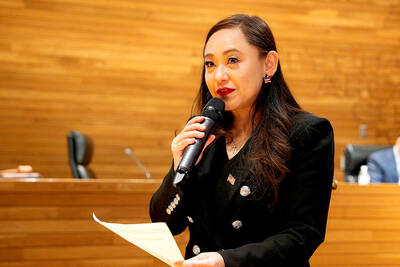
‘PERSONAL MISTAKES’: Eileen Wang has agreed to plead guilty to the felony, which comes with a maximum sentence of 10 years in federal prison A southern California mayor has agreed to plead guilty to acting as an illegal agent for the Chinese government and has resigned from her city position, officials said on Monday. Eileen Wang (王愛琳), mayor of Arcadia, was charged last month with one count of acting in the US as an illegal agent of a foreign government. She was accused of doing the bidding of Chinese officials, such as sharing articles favorable to Beijing, without prior notification to the US government as required by law. The 58-year-old was elected in November 2022 to a five-person city council, from which the mayor is selected

DELA ROSA CASE: The whereabouts of the senator, who is wanted by the ICC, was unclear, while President Marcos faces a political test over the senate situation Philippine authorities yesterday were seeking confirmation of reports that a top politician wanted by the International Criminal Court (ICC) had fled, a day after gunfire rang out at the Philippine Senate where he had taken refuge fearing his arrest. Senator Ronald “Bato” dela Rosa, the former national police chief and top enforcer of former Philippine president Rodrigo Duterte’s “war on drugs,” has been under Senate protection and is wanted for crimes against humanity, the same charges Duterte is accused of. “Several sources confirmed that the senator, Senator Bato, is no longer in the Senate premises, but we are still getting confirmation,” Presidential
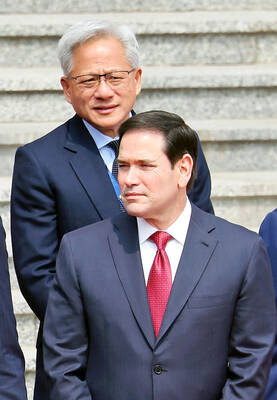
HELP DENIED? The US Department of State said that the Cuban leadership refuses to allow the US to provide aid to Cubans, ‘who are in desperate need of assistance’ US Secretary of State Marco Rubio on Wednesday said that Cuba’s leadership must change, as Washington renewed an offer of US$100 million in aid if the communist nation agrees to cooperate. Cuba has been suffering severe economic tumult led by an energy shortage that plunged 65 percent of the country into darkness on Tuesday. Cuba’s leaders have blamed US sanctions, but Rubio, a Cuban American and critic of the government established by Fidel Castro, said the system was to blame, including corruption by the military. “It’s a broken, nonfunctional economy, and it’s impossible to change it. I wish it were different,” he told


 RSS
RSS