


Nervous laughter breaks out in Myanmar’s eastern jungle as a young man training to overthrow the military junta is knocked backward by the kick of a rifle he has just fired at a target painted on a tree.
Waiting behind him for their turn with the weapon are others who have fled the cities and reappeared in rebel-held jungle territory, now training for combat against the regime.
“We had never heard the sound of gunshots,” Min — not his real name — said at the training camp hidden in the thickly-forested hills of Karen state along the border with Thailand.
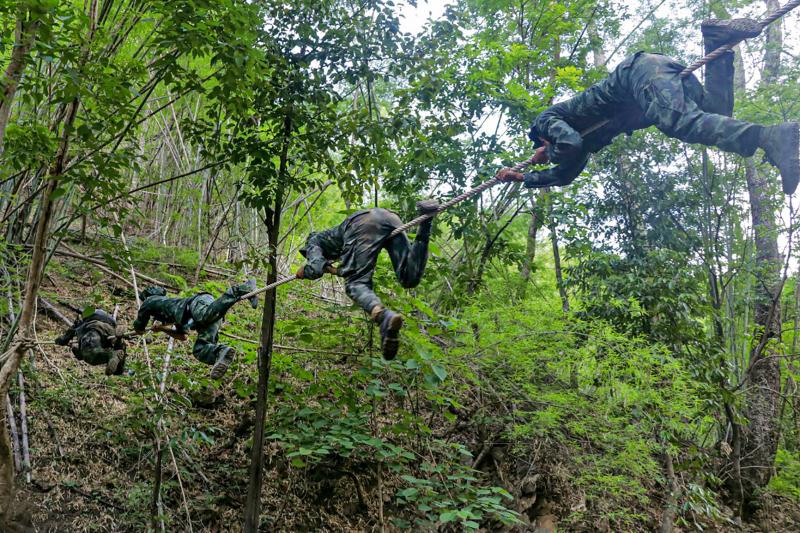
Photo: AFP
However, four months after the military ousted civilian leader Burmese State Counselor Aung San Suu Kyi and unleashed a brutal crackdown on dissent that has killed hundreds, the 23-year-old is now “very used” to the sound.
He has also been convinced of their power. It is gunshots — not protests — that “will end the military dictatorship in our country,” he said.
Many protesters of the military coup share Min’s anger and resolve.
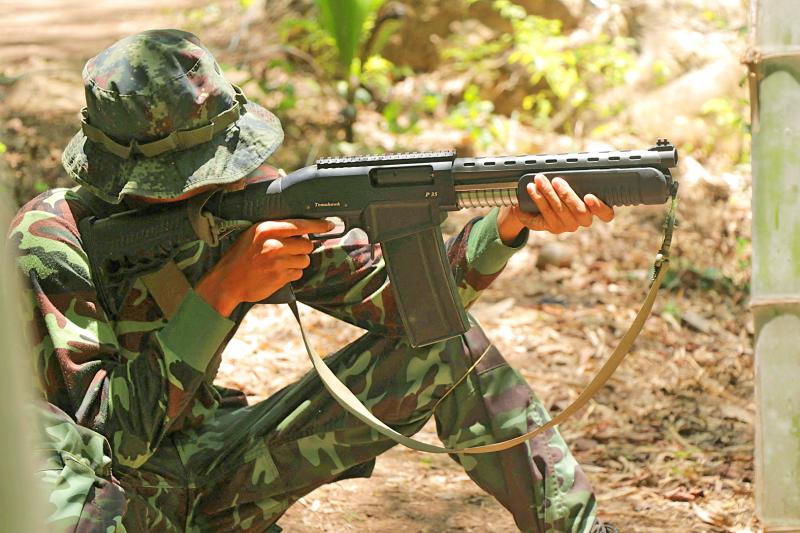
Photo: AFP
Reliable estimates are hard to come by, but analysts suspect hundreds of people have trekked into insurgent-held areas to receive crash courses in combat.
Celebrity beauty queen Htar Htar Htet last month posted a photograph on Facebook showing her dressed in black combat fatigues and carrying an assault rifle.
“The time has come to fight back,” wrote the gymnastics instructor, who represented Myanmar in the first Miss Grand International beauty pageant in Thailand.
However, the odds are stacked against them in any confrontation with one of Southeast Asia’s most battle-hardened and brutal militaries. The Burmese armed forces have waged almost constant war against insurgent groups since the nation’s independence from Britain in 1948.
An open fight is likely to end in a “bloodbath,” said David Mathieson, an analyst formerly based in the nation.
A day in the Karen boot camp starts before dawn. Volunteers are trained in jungle tactics — crossing muddy streams by shimmying along a rope, taking cover in the undergrowth and carrying injured comrades to safety.
In their downtime they rest on wooden beds and gaze at their smartphones.
Their instructors are members of the Karen National Union, one of more than 20 ethnic rebel groups in Myanmar that have an often fractious relationship with each other.
Some groups have condemned the military coup and offered shelter to dissidents after the junta’s lethal crackdown on early mass protests in the cities.
The Karen National Union has hosted boot camps in its stronghold along the border with Thailand, although a spokesperson declined to comment when asked how many protesters it had trained.
“All the sessions are very difficult, but we are learning hard,” Min said.
Target practice takes place on a makeshift range, with enemy soldiers represented by a square of white paint.
Resources are limited, with volunteers wearing flip flops instead of combat boots.
One volunteer sits cross-legged and loads shells carefully into a magazine, the Arsenal soccer club badge on his shorts hinting at his abandoned civilian life.
“I wanted to encourage the people who are still protesting against the military not to give up and to keep this revolution going,” Khine — not her real name — said at the camp. “We will help you in some way and please keep your strength until we win.”
However, Mathieson questioned how effective rebel tactics born in the mountains and jungles would be when it comes to confronting the junta in towns and cities.
While the training “might be a maturing experience for you personally, it’s not going to transform you into an urban warfare operator,” he said.
Short-term training was also unlikely to instil the discipline and toughness needed to go toe-to-toe with the military, he added.
“I think there will be a lot of hotheads and hormones,” Mathieson said. “It could be a recipe for chaos.”
However, in the hidden camp, the young protesters were nonetheless resolute.
“We will end the military dictatorship, root it out,” Min said. “We have decided to give our lives, our bones and our blood for this, to finish them off.”

An American scientist convicted of lying to US authorities about payments from China while he was at Harvard University has rebuilt his research lab in Shenzhen, China, to pursue technology the Chinese government has identified as a national priority: embedding electronics into the human brain. Charles Lieber, 67, is among the world’s leading researchers in brain-computer interfaces. The technology has shown promise in treating conditions such as amyotrophic lateral sclerosis and restoring movement in paralyzed people. It also has potential military applications: Scientists at the Chinese People’s Liberation Army have investigated brain interfaces as a way to engineer super soldiers by boosting

Indonesian police have arrested 13 people after shocking images of alleged abuse against small children at a daycare center went viral, sparking outrage across the nation, officials said on Monday. Police on Friday last week raided Little Aresha, a daycare center in Yogyakarta on Java island, following a report from a former employee. CCTV footage circulating on social media showed children, most younger than two, lying on the floor wearing only diapers, their hands and feet bound with rags. The police have confirmed that the footage is authentic. Police said they also found 20 children crammed into a room just 3m by 3m. “So

Jailed media entrepreneur Jimmy Lai (黎智英) has been awarded Deutsche Welle’s (DW) freedom of speech award for his contribution to Hong Kong’s pro-democracy movement. The German public broadcaster on Thursday said Lai would be presented in absentia with the 12th iteration of the award on June 23 at the DW Global Media Forum in Bonn. Deutsche Welle director-general Barbara Massing praised the 78-year-old founder of the now-shuttered news outlet Apple Daily for standing “unwaveringly for press freedom in Hong Kong at great personal risk.” “With Apple Daily, he gave journalists a platform for free reporting and a voice to the democracy movement in
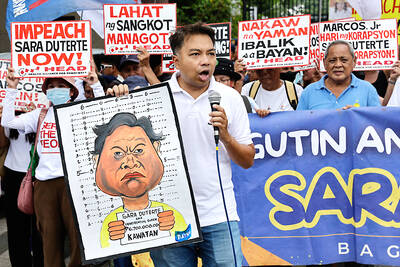
PHILIPPINE COMMITTEE: The head of the committee that made the decision said: ‘If there is nothing to hide, there is no reason to hide, there is no reason to obstruct’ A Philippine congressional committee on Wednesday ruled that there was “probable cause” to impeach Philippine Vice President Sara Duterte after hearing allegations of unexplained wealth, misuse of state funds and threats to have the president assassinated. The unanimous decision of the 53-member committee in the Philippine House of Representatives sends the two impeachment complaints to deliberations and voting by the entire lower chamber, which has more than 300 lawmakers. The complaints centered on Duterte’s alleged illegal use and mishandling of intelligence funds from the vice president’s office, and from her time as education secretary under Philippine President Ferdinand Marcos Jr. Duterte and the


 RSS
RSS