


Hong Kongers are seeking innovative ways to commemorate the victims of China’s Tiananmen Square Massacre after authorities banned an annual vigil and vowed to stamp out any protests on the anniversary today.
Discussion of tanks and troops quelling democracy protesters in Beijing on June 4, 1989, is all but forbidden in mainland China and there is heavy censorship of the images from the crackdown so well known in the rest of the world.
However, in Hong Kong the date has been remembered with huge candlelight vigils in Victoria Park for the past three decades.

Photo: AP
Last year’s vigil was banned for the first time because of the COVID-19 pandemic, but thousands of people defied police and rallied anyway.
This year’s vigil has been banned again, ostensibly because of the pandemic.
Officials have also warned that the National Security Law could be wielded against Tiananmen mourners.
So Hong Kongers are getting creative.
Local artist Kacey Wong (黃國才) has collected hundreds of spent candle stubs from previous vigils and plans to give them to residents tonight.
“It is time to redistribute them to the people of Hong Kong so they can collect them, preserve them and put them in a safe place,” Wong told reporters.
Wong has previously turned the candles into artwork, but will give them away this year at two stores of local clothing brand Chickeeduck, which sells pro-democracy merchandise.
“Each burned candle contains a person’s mourning toward those who sacrificed themselves in pursuit of democracy, as well as one’s longing for democracy, a mix of complex emotions,” Wong said. “It’s a testimony of hope... I hope they can continue to shine the way towards freedom and democracy.”
Historically, the Tiananmen vigil candles are lit at 8:09pm — representing 1989.
A vigil organiser, former Hong Kong legislator Albert Ho (何俊仁) — who is serving a prison term — said that Hong Kongers could light candles or shine mobile phone lights in their local neighborhoods.
“We can regard the whole of Hong Kong as Victoria Park,” he told the South China Morning Post before he was sentenced last week for attending previous democracy protests.
Social media presents another avenue.
Artist Tozer Pak (白雙全) has called on residents to write the numbers six and four — representing June 4 — on light switches to mark Tiananmen every time they turn them on.
“Guard the truth and refuse to forget,” Pak wrote on Facebook.

An American scientist convicted of lying to US authorities about payments from China while he was at Harvard University has rebuilt his research lab in Shenzhen, China, to pursue technology the Chinese government has identified as a national priority: embedding electronics into the human brain. Charles Lieber, 67, is among the world’s leading researchers in brain-computer interfaces. The technology has shown promise in treating conditions such as amyotrophic lateral sclerosis and restoring movement in paralyzed people. It also has potential military applications: Scientists at the Chinese People’s Liberation Army have investigated brain interfaces as a way to engineer super soldiers by boosting

Indonesian police have arrested 13 people after shocking images of alleged abuse against small children at a daycare center went viral, sparking outrage across the nation, officials said on Monday. Police on Friday last week raided Little Aresha, a daycare center in Yogyakarta on Java island, following a report from a former employee. CCTV footage circulating on social media showed children, most younger than two, lying on the floor wearing only diapers, their hands and feet bound with rags. The police have confirmed that the footage is authentic. Police said they also found 20 children crammed into a room just 3m by 3m. “So
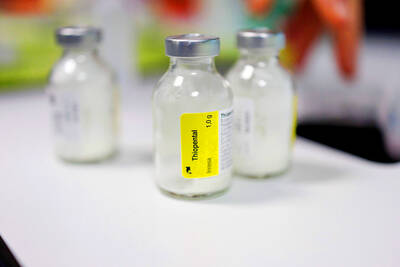
A grieving mother has ended her life at a clinic in Switzerland four years after the death of her only child. Wendy Duffy, 56, a physically healthy woman, died at the Pegasos clinic in Basel after struggling to cope with the death of her 23-year-old son, Marcus. The former care worker, from the West Midlands, England, had previously attempted to take her own life. The case comes as assisted dying would not become law in England and Wales after proposed legislation, branded “hopelessly flawed” by opponents, ran out of time. Ruedi Habegger, the founder of Pegasos, described Duffy’s death as
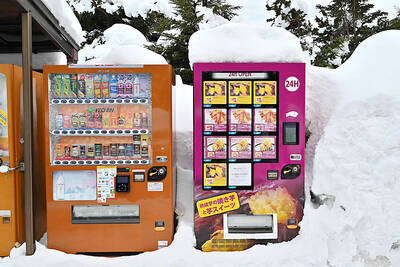
From post offices and parks to stations and even the summit of Mount Fuji, Japan’s vending machines are ubiquitous, but with the rapid pace of inflation cooling demand for their drinks, operators are being forced to rethink the business. Last month beverage giant DyDo Group Holdings announced it would remove about 20,000 vending machines — about 7 percent of their stock nationwide — by January next year, to “reconstruct a profitable network.” Pokka Sapporo Food & Beverage, based in Nagoya, also said last month it would sell its 40,000-machine operation to Osaka-based Lifedrink Co. “The strength of the vending machine


 RSS
RSS