


An unusually high number of manatees died in Florida in the first five months of this year, environmental groups said, blaming it in part on resurgent algal blooms contaminating and destroying food sources.
The 749 fatalities recorded to May 21 surpassed the 637 deaths recorded in the whole of last year, the Florida Fish and Wildlife Conservation Commission said.
The total is on course to exceed the high of 804, set in 2018.
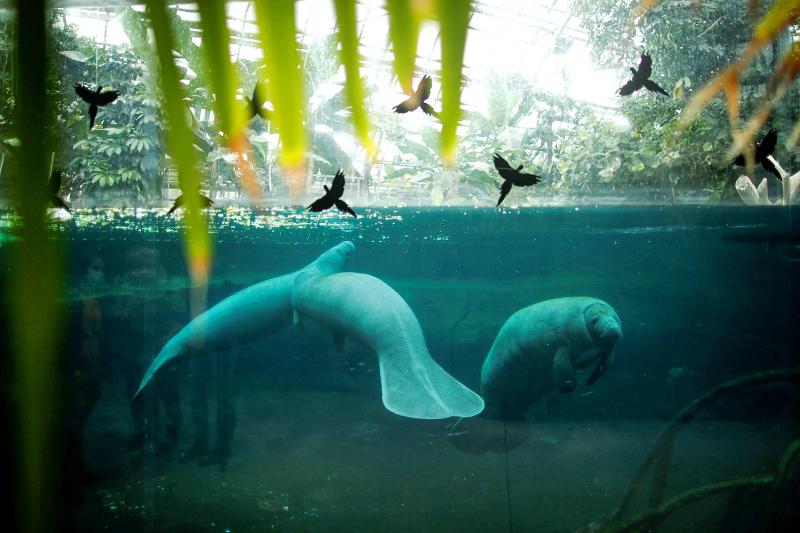
Photo: Reuters
The dying off of substantial areas of seagrass, the preferred food source of manatees, has caused starvation.
The situation has been exacerbated by the recurrence of inland blue-green algal blooms and phytoplankton blooms in Florida waterways.
Offshore, the discharge of toxic wastewater into Tampa Bay from the abandoned Piney Point fertilizer plant and the return of the red tide algal blooms have poisoned waters.
The commission said that 12 manatee deaths so far this year were from confirmed or suspected red tide blooms, but that the real figure could be far higher because not every dead manatee is necropsied.
In the Indian River Lagoon, an inland estuary that as many as one-third of the estimated remaining 7,500 manatees visit each year, 58 percent of the seagrass has disappeared since 2009, the St Johns River Water Management District said.
The commission said that too much nutrient runoff, specifically nitrogen and phosphorus, is either killing the seagrass outright or forming blooms that block sunlight.
“The vast majority of the once 80,000 acres of seagrass within the Indian River Lagoon have been lost to a continuing series of harmful algal blooms, which have themselves been caused by decades of human nutrient pollution from wastewater and runoff that continues unabated to this day,” Bob Graham, a former Florida governor and cofounder of Save the Manatee, said in an opinion piece in the Tampa Bay Times.
Meanwhile, the Center for Biological Diversity said that it was concerned over a March study that showed traces of pesticides in more than 55 percent of the manatees tested.
“Our beloved chubby sea cows are dodging boat strikes, reeling from red tide and starving in the Indian River Lagoon because of water pollution,” the center’s Florida director Jaclyn Lopez said. “It’s heartbreaking to add chronic glyphosate exposure to the list of factors threatening manatee survival.”
Graham said that the US Fish and Wildlife Service “dropped the ball” in 2019, when it changed the conservation status of manatees from endangered to threatened.
“They listened to anti-manatee groups and prematurely took manatees off the endangered species list over the objections of scientists and thousands of Americans who understood that the manatees’ future was not secure, but in fact could get much worse,” Graham said.
The service “should admit its mistake and relist the manatee as an endangered species,” he said.

‘CROSSING THE LINE’: China’s embassy in Seoul criticized US Forces Korea Commander General Xavier Brunson, asking if his ‘hostile’ remarks were authorized by Washington South Korea and the US are in talks over recent public remarks by the commander of US Forces Korea, Seoul’s presidential office said yesterday, after the comments drew sharp criticism from China. In a recent podcast interview, US Forces Korea Commander General Xavier Brunson described South Korea as “the dagger in the heart of Asia” from China’s east coast, prompting the Chinese embassy in Seoul to say that he had “truly crossed the line.” The interview came amid growing speculation that Washington might seek to expand the role of US Forces Korea in countering the growing regional influence of China, a key

Through the noise of rushing papers and whirring belts at a print factory in Kyoto, two creators watch their photo essay come to life in broadsheet form — part of an effort to win new audiences in the age of artificial intelligence (AI). Despite the decline of the publishing industry, self-publication and handmade “zine” magazines are growing in popularity in Japan, reflecting the nation’s enduring love of paper in the digital era. While speaking to Agence France-Presse at the plant, his hands black with ink, one of the creators, Kazuma Obara, said: “I think [paper] is a medium that engages all five

Australian researchers have trained lab-grown brain cells on a silicon computer chip to play the 1990s shooter game Doom and said they are just scratching the surface of what the neurons could be capable of doing. It is the science-fiction work of biotech boffins at Cortical Labs, who researched and developed the technology that harnesses the workings of the brain’s networking system. Each so-called “biological computer” contains about 200,000 living human brain cells, grown from stem cells that were harvested from blood donations. Having mastered the simple computer game Pong, where a paddle is moved up and down to send a ball
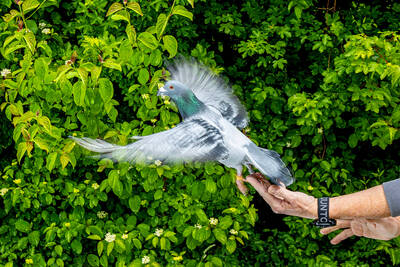
A surprising gut feeling may help pigeons find their way home. Animals use various techniques to navigate, including following the stars and remembering key landmarks. Birds, fish and turtles orient themselves using Earth’s magnetic field as a compass, but it is not yet clear how exactly they do this. Pigeons are a well-known group of frequent flyers that can traverse hundreds of kilometers in a single day. For thousands of years, humans have used them to carry news, notes and military messages. Scientists have long tried to untangle how pigeons travel without getting lost. Some think the birds detect magnetic cues using light-sensitive


 RSS
RSS