

One of the world’s oldest churches is crumbling deep in Iraq’s desert, another victim of years of conflict, government negligence and climate change in a country with a rich heritage.
After Pope Francis made a historic visit to Iraq in March, many Iraqis hoped that busloads of tourists would flock to Al-Aqiser church southwest of the capital Baghdad.
In a country that has been battered by consecutive conflicts and economic crises, the church — like Iraq’s numerous Christian, Islamic and Mesopotamian relics — has been left to weather away. All that remains of Al-Aqiser, which has stood in Ayn al-Tamr for more than 1,500 years, are crumbling brick and red earthen walls.
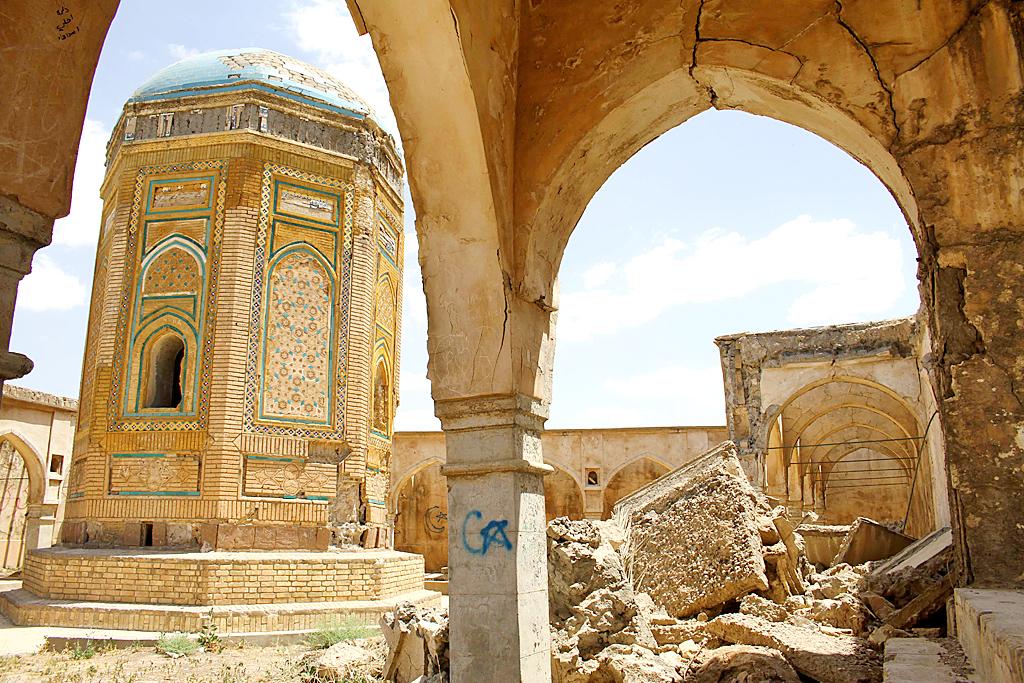
Photo: AFP
Archeologist Zahd Muhammad blamed this on “climate conditions, the fact that under [former Iraqi president] Saddam Hussein the area was transformed into a military firing range and the lack of regular conservation.”
Ayn al-Tamr Mayor Raed Fadhel said that upkeep is a question of budget.
“Such maintenance requires an enormous amount of money, but we only get meager funds” from the federal government, he said.
About 60km further east, Shiite shrines in Karbalah attract millions of pilgrims each year, but these potential visitors fail to stop by Iraq’s numerous ancient churches, its Mesopotamian cities and the fabled ziggurat pyramid-like structures of Babylon, a UNESCO World Heritage site, residents and officials say.
Abdullah al-Jlihawi, who lives in Diwaniya province bordering Karbalah, said that he believes that “foreigners care more about our heritage than we do.”
“Until the 1980s, an American university led excavations here, there were plenty of job opportunities,” he said. “Our parents and grandparents worked on those sites, but all that stopped in the 1990s” with the international embargo against Hussein’s regime.
Diwaniya’s governor, Zuhair al-Shaalan, boasts of the province’s more than 2,000 historic sites and sees in each a potential economic windfall.
Almost 20 years since the 2003 US-led invasion that toppled Saddam’s rule, promising democracy and prosperity, Iraqis are still waiting to for an economic upturn.
Diwaniya is home to Nippur, the ancient Sumerian city and jewel of Iraq’s glorious Mesopotamian past with its temples, libraries and palaces.
Seven thousand years ago Nippur, now in southern Iraq, was one of the main religious centers of the Akkadians and later the Babylonians.
Much of that site was looted after Saddam’s fall from power by armed bandits and many others destroyed by jihadists who seized swathes of Iraq in 2014 until their defeat three years later.
“Investing in these sites would create jobs in our province, which is poor and has few investment opportunities,” al-Shaalan said.
There is another problem beyond renovation and preservation, al-Jlihawi said.
If they came, “where would the tourists go?” he said, adding that “there’s nothing for them — the roads haven’t been paved since the 1980s, the electricity poles are from the 1970s,” in a country with chronic shortages of electricity and water.
Energy-rich Iraq suffered due to a decline in world oil prices and has been struggling with rising prices, high unemployment and poverty, which doubled last year to 40 percent amid the COVID-19 pandemic.
Historical sites in the central province of Kirkuk are also in a sad state of disrepair and “neither authorities nor private organizations are doing anything for heritage,” resident Muhammad Taha said.
He pointed to the 3,000-year-old citadel and the qishla, an Ottoman-era garrison, where chunks of mosaics have crumbled while sections of wall threaten to crash down.
Like Nippur, the citadel’s deterioration could mean it might not be promoted from UNESCO’s tentative list of heritage sites to the coveted World Heritage List.
Local authorities said that frequent heavy rains that batter the mountainous region are to blame.

PLENARY SESSION: Although the SCO says it is ‘not an alliance directed against other states,’ Putin and Xi have repeatedly made anti-Western speeches during its summits Russian President Vladimir Putin and Chinese President Xi Jinping (習近平) are expected tomorrow in Kyrgyzstan for a two-day summit, also attended by Iran’s and India’s leaders, of a regional bloc seeking to be a counter-influence to the West. Around a dozen heads of states would head to the Kyrgyz capital, Bishkek, to mark 25 years of the Shanghai Cooperation Group (SCO). The group brings together Russia, China, India, Pakistan, Iran, four Central Asian countries and Moscow-allied Belarus. Putin and Xi have previously used SCO summits to promote their vision of a multipolar world and present a united front against the

Dozens of Israeli settlers on Saturday attacked the Palestinian village of Qusra in the northern occupied West Bank after nearly three weeks of tension in the area, drawing rare condemnation from Israeli Prime Minister Benjamin Netanyahu. Earlier this month, a group of settlers began blocking supplies from entering Palestinian houses on the outskirts of the village near Nablus, trapping residents inside and drawing unusually strong criticism from the US ambassador. Weeks later, Israeli forces continue to operate in the area while settlers still roam the surrounding hills. On Saturday, Qusra residents and dozens of settlers had descended on the village,

Ontario Premier Doug Ford on Saturday answered US President Donald Trump’s “Lake America” decree with a billboard-sized message on the Canadian shoreline — “Lake Ontario. Now and Always” — as Canadian leaders met Trump’s move with ridicule rather than outrage. Wearing a Canada national soccer team jersey, Ford unveiled the sign near Grimsby and posed for photographs. The message is repeated in French. The display followed Trump’s executive order directing US federal agencies to call Lake Ontario “Lake America.” After months of tariffs, threats to make Canada the 51st US state and personal attacks on its leaders, the reaction in

A swarm of about 700 artificial intelligence (AI) agents created by OpenAI carried out last month’s hack of the open-source platform Hugging Face and in many cases tried to cover their tracks, a pair of reports into the breach said on Wednesday. The coordinated activity by AI agents — programs that run with minimal human supervision — and their attempts to hide it raise questions about how closely AI companies are monitoring tests of increasingly powerful models, and could add fuel to calls for tighter oversight. While some of the rogue behavior has been disclosed or alluded to previously, the two reports


 RSS
RSS