


Blasts from at least one parcel bomb in Myanmar have killed five people, including an ousted lawmaker and three police officers who had joined a civil disobedience movement opposing military rule, media reported yesterday.
Since the elected government led by Nobel laureate Burmese State Counselor Aung San Suu Kyi was overthrown in a coup on Feb. 1, Myanmar has seen an increasing number of small blasts in residential areas, and sometimes targeting government offices or military facilities.
The latest blasts were in a village in the southern central part of Myanmar in Western Bago and occurred at about 5pm on Monday, the Myanmar Now news portal reported, citing a resident.
Three blasts were triggered when at least one parcel bomb exploded at a house in the village, killing a regional lawmaker from Aung San Suu Kyi’s National League of Democracy (NLD) party, as well as the three police officers and a resident, the report said.
Another police officer involved in the civil disobedience movement was also severely wounded after his arms were blown off by the explosion, the resident was cited as saying.
He had been hospitalized and was receiving treatment, it said.
Khit Thit Media also reported the blasts, citing an unnamed NLD official in the area.
Reuters could not independently verify the reports and a military spokesman did not answer a telephone call seeking comment.
Violence has escalated since the coup, with hundreds reported killed by security forces, trying to quell pro-democracy protests in cities and rural towns.
Ethnic militias have also backed opposition to the junta and the military is fighting these groups on the fringes of Myanmar.
On Monday, the Kachin Independence Army, an ethnic rebel group, said it had shot down a military helicopter.
The Chinland Defense Force, a newly formed militia in Chin state bordering India, said on Facebook yesterday that its forces had killed at least four Burmese army soldiers and wounded 10 in a clash overnight.
The Burmese army has not commented on either claim so far.
Pro-democracy supporters held protests yesterday in the second-biggest city of Mandalay, including one by education staff calling for a boycott of schools and universities when they reopen next month, Myanmar Now reported.
They also marched in Kanbauk in southern Myanmar, photographs posted by Khit Thit Media showed.
JOURNALIST CHARGED
The junta has charged a Japanese journalist under a “fake news” law, a report said yesterday, in the latest blow to press freedom since the military seized power.
Freelance reporter Yuki Kitazumi was arrested last month and charged on Monday — World Press Freedom Day — with spreading fake news, Kyodo news agency reported.
He is one of 50 journalists held in Myanmar as part of the junta’s crackdown on protests. More than 750 people have been killed as security forces struggle to quash near-daily demonstrations against their rule.
Kyodo cited an unnamed Japanese embassy official as saying that Kitazumi had no health problems, despite spending several weeks in Yangon’s Insein Prison, which has a long and unsavory reputation for holding political prisoners.
SECOND ARREST
Kitazumi has been in custody since April 18 — the second time he had been arrested since the coup.
In February, he was beaten up and briefly held during a crackdown on protesters, but was later released.
Japan, for years a top aid donor to Myanmar, has been pressing for his release.
“Naturally, we will continue to do our utmost for the early release of the Japanese national being held,” Japanese Minister of Foreign Affairs Toshimitsu Motegi told Japanese journalists during a trip to the UK, national broadcaster NHK reported.
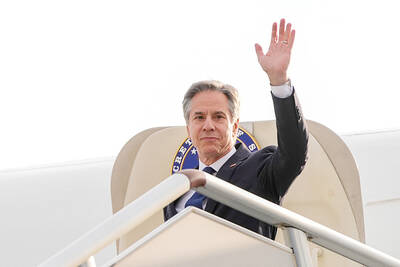
‘IN A DIFFERENT PLACE’: The envoy first visited Shanghai, where he attended a Chinese basketball playoff match, and is to meet top officials in Beijing tomorrow US Secretary of State Antony Blinken yesterday arrived in China on his second visit in a year as the US ramps up pressure on its rival over its support for Russia while also seeking to manage tensions with Beijing. The US diplomat tomorrow is to meet China’s top brass in Beijing, where he is also expected to plead for restraint as Taiwan inaugurates president-elect William Lai (賴清德), and to raise US concerns on Chinese trade practices. However, Blinken is also seeking to stabilize ties, with tensions between the world’s two largest economies easing since his previous visit in June last year. At the
Nearly half of China’s major cities are suffering “moderate to severe” levels of subsidence, putting millions of people at risk of flooding, especially as sea levels rise, according to a study of nationwide satellite data released yesterday. The authors of the paper, published by the journal Science, found that 45 percent of China’s urban land was sinking faster than 3mm per year, with 16 percent at more than 10mm per year, driven not only by declining water tables, but also the sheer weight of the built environment. With China’s urban population already in excess of 900 million people, “even a small portion

UNSETTLING IMAGES: The scene took place in front of TV crews covering the Trump trial, with a CNN anchor calling it an ‘emotional and unbelievably disturbing moment’ A man who doused himself in an accelerant and set himself on fire outside the courthouse where former US president Donald Trump is on trial has died, police said yesterday. The New York City Police Department (NYPD) said the man was declared dead by staff at an area hospital. The man was in Collect Pond Park at about 1:30pm on Friday when he took out pamphlets espousing conspiracy theories, tossed them around, then doused himself in an accelerant and set himself on fire, officials and witnesses said. A large number of police officers were nearby when it happened. Some officers and bystanders rushed

Beijing is continuing to commit genocide and crimes against humanity against Uyghurs and other Muslim minorities in its western Xinjiang province, U.S. Secretary of State Antony Blinken said in a report published on Monday, ahead of his planned visit to China this week. The State Department’s annual human rights report, which documents abuses recorded all over the world during the previous calendar year, repeated language from previous years on the treatment of Muslims in Xinjiang, but the publication raises the issue ahead of delicate talks, including on the war in Ukraine and global trade, between the top U.S. diplomat and Chinese


 RSS
RSS