


Neither a permanent mark nor a paper transfer: a New York start-up has created the first tattoos that fully disappear after a while, aiming to open the body inking market to new clientele.
“It’s going to fade so I’m not too concerned,” Abigail Glasgow said with a mischievous look in her eye, as the first letter of her fiance’s name is tattooed on her forearm.
For years, amateur tattoo artists around the world — mainly in Asia — have offered “semi-permanent” tattoos, claiming that using vegetable ink and less penetration of the skin would cause them to disappear eventually.
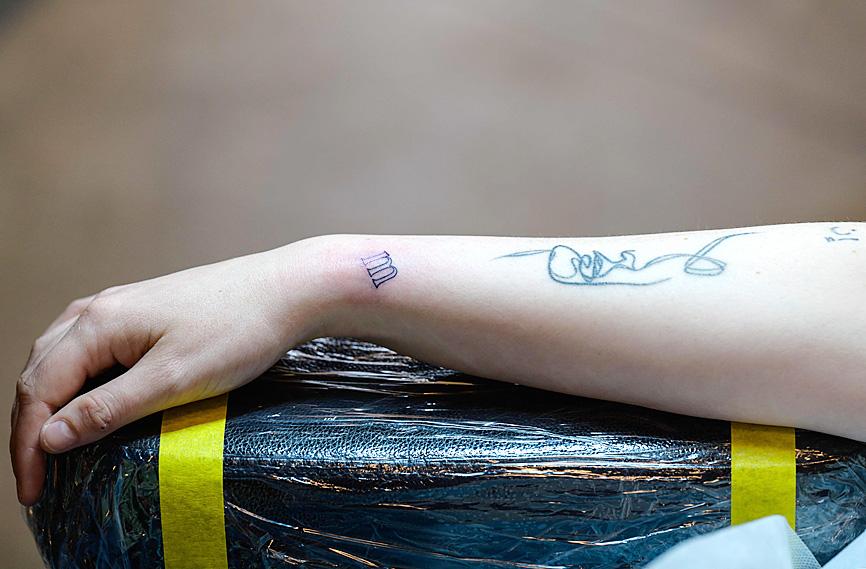
Photo: AFP
However, in practice, the tattoos tend only to deteriorate, without vanishing completely and often causing lesions, to the point that several professional tattooists have sounded the alarm.
After six years of development, the company Ephemeral has created an ink composed of biodegradable polymers that dissolves naturally between nine and 15 months after the same inking process as a conventional tattoo.
Josh Sakhai, one of the three cofounders of Ephemeral, was a student at New York University when he wanted to get a permanent tattoo, but was “too scared” because of how his Iranian-origin family might react.
So he set out to create a temporary tattoo made of ink that fades. The endeavor required 50 different formulations before he found the right one, a number of which Sakhai tested on himself.
Jokingly describing himself as a “guinea pig,” Sakhai pointed to several places on his arms where he said he used to have tattoos.
Sakhai developed the formula in a laboratory in Milford, Connecticut, in collaboration with dermatologists. They only used products approved by the US’ Food and Drug Administration regulator.
Sakhai assures that, like permanent tattoos, the ephemeral tattoos do not dilute or blur sporadically over time. Instead, the lines remain crisp and the designs fade evenly, he said.
The Ephemeral tattoo parlor opened in the Williamsburg area of Brooklyn at the end of last month. For now, only black ink is available, but other colors are expected.
“What we’re doing is we’re opening up the possibility of tattoos for a whole new clientele that previously wasn’t getting a permanent tattoo,” Sakhai said.
The ephemeral tattoo, which costs between US$175 and US$450, can be a step toward people deciding to get a permanent tattoo, the young entrepreneur said.
“This really expands the possibilities for the traditional community,” he said.
Ephemeral has recruited tattoo artists that are more used to inking permanent designs, such as 29-year-old Marissa Boulay, who draws the “M” on Glasgow’s forearm, which also features permanent tattoos.
“I can be more playful,” Glasgow said. “I can decide more off the cuff what I want to do” in terms of design and location.
It is also an opportunity for her to test out a flower design to see whether she likes it enough to get it done permanently.
Tattoos, once associated with society’s rebels, are increasingly mainstream among millennials. About 40 percent of 18-to-34-year olds in the US have at least one tattoo, a 2019 study by the Nielsen Institute showed.
“We’re not trying to change anything. We’re just embracing the changes that are happening,” said Boulay, an 11-year tattoo industry veteran who is covered in tattoos herself.
“I think tattoos are about self-expression and art, and I think we’re just trying to make it easier for more people to have that experience,” she added.

Through the noise of rushing papers and whirring belts at a print factory in Kyoto, two creators watch their photo essay come to life in broadsheet form — part of an effort to win new audiences in the age of artificial intelligence (AI). Despite the decline of the publishing industry, self-publication and handmade “zine” magazines are growing in popularity in Japan, reflecting the nation’s enduring love of paper in the digital era. While speaking to Agence France-Presse at the plant, his hands black with ink, one of the creators, Kazuma Obara, said: “I think [paper] is a medium that engages all five

‘ABSURD MISTAKE’: The election commission said that there had been a failure to anticipate turnout after 14 polling stations ran short of ballot papers South Korean riot police yesterday cleared protesters from a Seoul polling station after a 35-hour blockade sparked by a shortage of ballot papers during local elections earlier this week. Wednesday’s election was the first nationwide vote since South Korean President Lee Jae-myung took office following the ouster of Yoon Suk-yeol over his short-lived martial law declaration. Lee’s ruling Democratic Party swept most races, but failed to flip the crucial Seoul mayoral seat. The South Korean National Election Commission apologized, blaming a failure to anticipate turnout after 14 polling stations in Seoul ran short of ballot papers. Some polling stations stayed open until 10pm to

Australian researchers have trained lab-grown brain cells on a silicon computer chip to play the 1990s shooter game Doom and said they are just scratching the surface of what the neurons could be capable of doing. It is the science-fiction work of biotech boffins at Cortical Labs, who researched and developed the technology that harnesses the workings of the brain’s networking system. Each so-called “biological computer” contains about 200,000 living human brain cells, grown from stem cells that were harvested from blood donations. Having mastered the simple computer game Pong, where a paddle is moved up and down to send a ball

France experienced its hottest spring on record, the French weather service said on Tuesday, after an exceptional early heat wave that also broke highs for the season in England and Wales. Meteo-France said the average nationwide temperature over March to May was 13.8°C — about 1.7°C above the norm, and surpassing records set in 2011 and 2020. “The warmest spring since records began in 1900,” it said in a bulletin. All three months were warmer than average, but the onset of an “unprecedented heatwave” late last month pushed the mercury to highs typically seen at the height of the summer. “Our country had never


 RSS
RSS