


A new state-produced musical set in Xinjiang inspired by Hollywood blockbuster La La Land has hit China’s cinemas, portraying a rural idyll of ethnic cohesion devoid of repression, mass surveillance and even the Islam of its majority Uighur population.
China is on an elaborate public relations offensive to rebrand the region where the US says “genocide” has been inflicted on the Uighurs and other Muslim minorities.
As allegations of slavery and forced labor inside Xinjiang’s cotton industry draw renewed global attention, inside China, Beijing is curating a very different narrative for the troubled region.
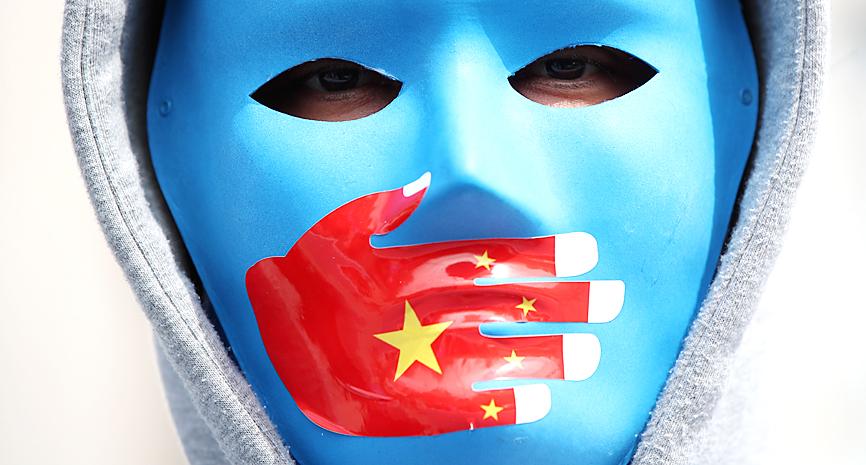
Photo: EPA-EFE
Rap songs, photographic exhibitions and a musical — The Wings of Songs (歌聲的翅膀) — are leading the cultural reframing of the region, while a legion of celebrities have seemingly unprompted leaped to the defense of Xinjiang’s tarnished textile industry.
Beijing denies all allegations of abuses and has instead recast Xinjiang as a haven of social cohesion and economic renewal that has turned its back on years of violent extremism thanks to benevolent state intervention.
The movie, whose release was reportedly delayed by a year, focuses on three men from different ethnic groups dreaming of the big time as they gather musical inspiration across cultures in the snow-capped mountains and desertscapes of the vast region.
State-run Global Times reported that overseas blockbusters such as La La Land have “inspired Chinese studios” to produce their own domestic hits.
However, the musical omits the surveillance cameras and security checks that blanket Xinjiang.
Also noticeably absent are references to Islam — despite more than half of the population of Xinjiang being Muslim — and there are no mosques or women in veils.
In one scene, a leading character, a well-shaven Uighur, toasts with a beer in his hand.
At least 1 million Uighurs and other mostly Muslim groups have been held in camps in Xinjiang, according to right groups, where authorities are also accused of forcibly sterilizing women and imposing forced labor.
That has enraged Beijing, which at first denied the existence of the camps and then defended them as training programs.
Last month, China swiftly closed down the Clubhouse app, an audio platform where uncensored discussions briefly flowered including on Xinjiang, with Uighurs giving unvarnished accounts of life to attentive Han Chinese guests.
The public relations push on Xinjiang aims at controlling the narrative for internal consumption, says Larry Ong, a senior analyst at US-based consultancy SinoInsider.
Beijing “knows that a lie repeated a thousand times becomes truth,” he said.
To many Chinese, that messaging appears to be working.
“I have been to Xinjiang and the film is very realistic,” one moviegoer said after seeing The Wings of Songs in Beijing.
“People are happy, free and open,” he said, declining to give his name.
Last week, celebrities, tech brands and state media — whipped up by outrage on China’s tightly controlled social media — piled in on several global fashion brands who have raised concerns over forced labor and refused to source cotton from Xinjiang. Sweden’s H&M was hit the worst.
The pushback has taken on a pop culture edge, with a rap released this week castigating “lies” by the “Western settlers” about cotton from the region, while state broadcaster CGTN is set to release a documentary on the unrest that prompted the Beijing crackdown.
It is impossible to gain unfettered access to Xinjiang, with foreign media shadowed by authorities on visits.

Kouri Richins, a Utah mother who published a children’s book about grief after the death of her husband is to serve a life sentence for his murder without the possibility of parole, a judge ruled on Wednesday. Richins was convicted in March of aggravated murder for lacing a cocktail given to her husband, Eric Richins, with five times the lethal dose of fentanyl at their home near Park City in 2022. A jury also found her guilty of four other felonies, including insurance fraud, forgery and attempted murder for trying to poison her husband weeks earlier on Feb. 14, 2022, with a

DELA ROSA CASE: The whereabouts of the senator, who is wanted by the ICC, was unclear, while President Marcos faces a political test over the senate situation Philippine authorities yesterday were seeking confirmation of reports that a top politician wanted by the International Criminal Court (ICC) had fled, a day after gunfire rang out at the Philippine Senate where he had taken refuge fearing his arrest. Senator Ronald “Bato” dela Rosa, the former national police chief and top enforcer of former Philippine president Rodrigo Duterte’s “war on drugs,” has been under Senate protection and is wanted for crimes against humanity, the same charges Duterte is accused of. “Several sources confirmed that the senator, Senator Bato, is no longer in the Senate premises, but we are still getting confirmation,” Presidential

HELP DENIED? The US Department of State said that the Cuban leadership refuses to allow the US to provide aid to Cubans, ‘who are in desperate need of assistance’ US Secretary of State Marco Rubio on Wednesday said that Cuba’s leadership must change, as Washington renewed an offer of US$100 million in aid if the communist nation agrees to cooperate. Cuba has been suffering severe economic tumult led by an energy shortage that plunged 65 percent of the country into darkness on Tuesday. Cuba’s leaders have blamed US sanctions, but Rubio, a Cuban American and critic of the government established by Fidel Castro, said the system was to blame, including corruption by the military. “It’s a broken, nonfunctional economy, and it’s impossible to change it. I wish it were different,” he told

Myanmar yesterday published a parliamentary bill proposing the death sentence for those who detain or violently coerce people into working in online scam centers. Internet fraud factories have flourished in Myanmar, part of Southeast Asia’s scam economy, targeting Internet users worldwide with romance and cryptocurrency investment cons. The multibillion-dollar black market attracts many willing employees, but repatriated foreigners have also reported being trafficked to sites in Myanmar and tortured by scam center operators. The draft legislation would allow capital punishment for “violence, torture, unlawful arrest and detention, or cruel treatment against another person for the purpose of forcing them to commit online scams.” The


 RSS
RSS