


Senegal’s opposition has called for a fresh rally in the capital Dakar on Saturday, days after the arrest of a rival to the president sparked the West African nation’s worst unrest in years.
At least five people were killed in clashes between opposition supporters and security forces, which were sparked on Wednesday last week by the arrest of opposition leader Ousmane Sonko, a government critic popular with young people.
The violence, which the opposition has said claimed 11 lives, came as a shock in a country that is usually seen as a haven of stability in an otherwise volatile region.
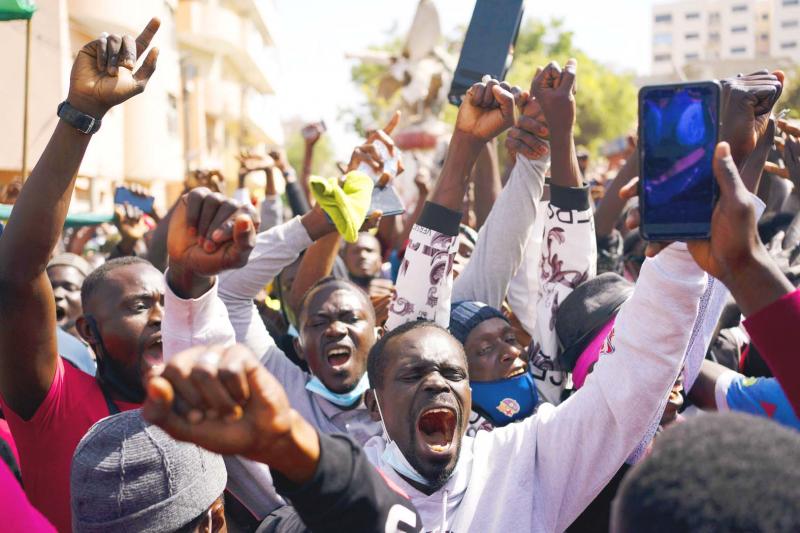
Photo: AP
Tensions only began to ease on Monday after a court freed Sonko from detention.
The 46-year-old was nonetheless also charged with rape, in a case that he claims was trumped up to smear him.
On Tuesday, an opposition collective that includes Sonko’s Pastef Party called for a peaceful demonstration in Dakar on Saturday, to press for the release of what it termed “political prisoners.”
The collective known as the Movement for Defence of Democracy, or M2D, also called for a day of mourning tomorrow, urging people to wear white to commemorate dead protesters.
On Tuesday, parts of Dakar where protesters had hurled stones at police and torched vehicles returned to calm, although military vehicles remained in position in the government quarter.
“I think things are going to calm down because Sonko has been released. He was unjustly arrested,” said Grace Baramoto, a 37-year-old housewife who stayed home for two days to avoid the turmoil.
Sonko came third in the 2019 presidential election and is considered a contender to replace Senegalese President Macky Sall in 2024.
However, his political future was last month thrown into doubt after a beauty salon employee accused him of raping her.
Then, on Wednesday last week, Sonko was arrested on charges of disturbing public order, after his supporters clashed with police while he was making his way to court for the rape case.
The government’s move sparked a violent backlash that saw protesters clash with police and loot supermarkets, highlighting long-simmering grievances over living standards and inequality in the poor nation.
Military vehicles and police squadrons flooded Dakar on Monday ahead of Sonko’s court hearing, which had been postponed, and thousands of protesters rallied on a central square in the seaside city.
Speaking after his release, Sonko said: “The revolution has already started and nobody can stop it.”
He urged Senegalese to keep demonstrating, saying that protests should be “much larger,” but also peaceful.
Addressing the situation on Monday evening, Sall appealed to protesters to “avoid the logic of confrontation that leads to the worst.”
The courts should be left to do their job “in all independence,” he added.
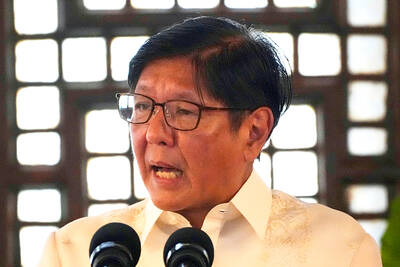
NO EXCUSES: Marcos said his administration was acting on voters’ demands, but an academic said the move was emotionally motivated after a poor midterm showing Philippine President Ferdinand Marcos Jr yesterday sought the resignation of all his Cabinet secretaries, in a move seen as an attempt to reset the political agenda and assert his authority over the second half of his single six-year term. The order came after the president’s allies failed to win a majority of Senate seats contested in the 12 polls on Monday last week, leaving Marcos facing a divided political and legislative landscape that could thwart his attempts to have an ally succeed him in 2028. “He’s talking to the people, trying to salvage whatever political capital he has left. I think it’s

Polish presidential candidates offered different visions of Poland and its relations with Ukraine in a televised debate ahead of next week’s run-off, which remains on a knife-edge. During a head-to-head debate lasting two hours, centrist Warsaw Mayor Rafal Trzaskowski, from Polish Prime Minister Donald Tusk’s governing pro-European coalition, faced the Eurosceptic historian Karol Nawrocki, backed by the right-wing populist Law and Justice party (PiS). The two candidates, who qualified for the second round after coming in the top two places in the first vote on Sunday last week, clashed over Poland’s relations with Ukraine, EU policy and the track records of their
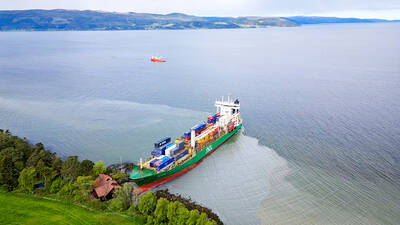
UNSCHEDULED VISIT: ‘It’s a very bulky new neighbor, but it will soon go away,’ said Johan Helberg of the 135m container ship that run aground near his house A man in Norway awoke early on Thursday to discover a huge container ship had run aground a stone’s throw from his fjord-side house — and he had slept through the commotion. For an as-yet unknown reason, the 135m NCL Salten sailed up onto shore just meters from Johan Helberg’s house in a fjord near Trondheim in central Norway. Helberg only discovered the unexpected visitor when a panicked neighbor who had rung his doorbell repeatedly to no avail gave up and called him on the phone. “The doorbell rang at a time of day when I don’t like to open,” Helberg told television

‘A THREAT’: Guyanese President Irfan Ali called on Venezuela to follow international court rulings over the region, whose border Guyana says was ratified back in 1899 Misael Zapara said he would vote in Venezuela’s first elections yesterday for the territory of Essequibo, despite living more than 100km away from the oil-rich Guyana-administered region. Both countries lay claim to Essequibo, which makes up two-thirds of Guyana’s territory and is home to 125,000 of its 800,000 citizens. Guyana has administered the region for decades. The centuries-old dispute has intensified since ExxonMobil discovered massive offshore oil deposits a decade ago, giving Guyana the largest crude oil reserves per capita in the world. Venezuela would elect a governor, eight National Assembly deputies and regional councilors in a newly created constituency for the 160,000


 RSS
RSS