


NASA scientists on Friday presented striking early images from the picture-perfect landing of the Mars rover Perseverance, including a selfie of the six-wheeled vehicle dangling just above the surface of the Red Planet moments before touchdown.
The color photograph, likely to become an instant classic among memorable images from the history of spaceflight, was snapped by a camera mounted on the rocket-powered “sky crane” descent-stage just above the rover as the car-sized space vehicle was being lowered on Thursday to Martian soil.
The image was unveiled by mission managers during an online news briefing Webcast from NASA’s Jet Propulsion Laboratory (JPL) near Los Angeles less than 24 hours after the landing.
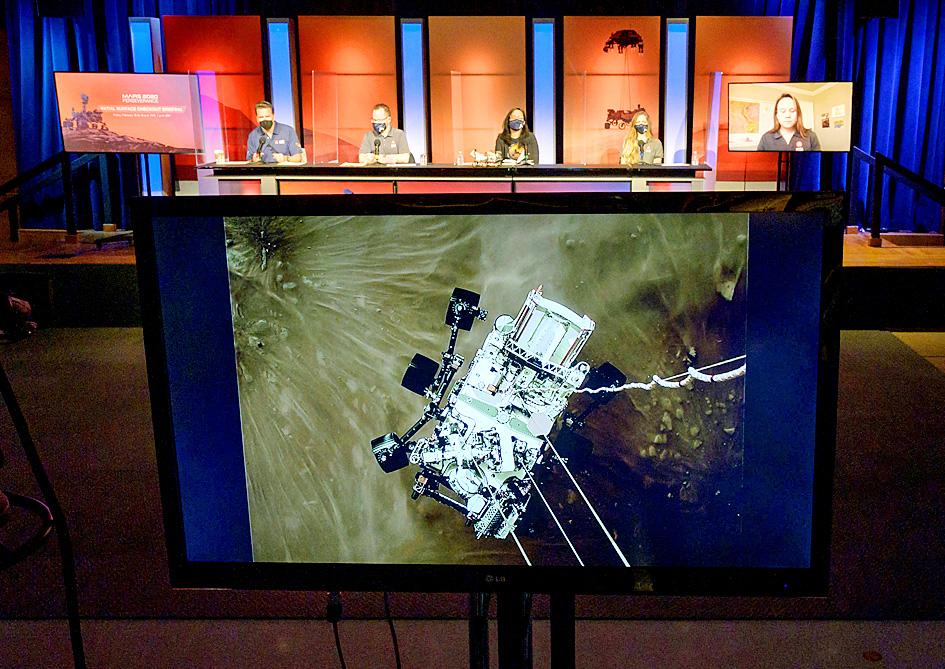
Photo: Bill INGALLS / AFP
The picture, looking down on the rover, shows the entire vehicle suspended from three cables unspooled from the sky crane, along with an “umbilical” communications cord. Swirls of dust kicked up by the crane’s rocket thrusters are also visible.
Seconds later, the rover was gently planted on its wheels, its tethers were severed, and the sky crane — its job completed — flew off to crash a safe distance away, although not before photos and other data collected during the descent were transmitted to the rover for safekeeping.
The image of the dangling science lab, striking for its clarity and sense of motion, marks the first such close-up photo of a spacecraft landing on Mars, or any planet beyond Earth.
“This is something we’ve never seen before,” Aaron Stehura, a deputy lead for the mission’s descent and landing team, describing himself and colleagues as “awe-struck” when first viewing the image.
Adam Steltzner, chief engineer for the Perseverance project at JPL, said he found the image instantly iconic, comparable to the shot of Apollo 11 astronaut Buzz Aldrin standing on the moon in 1969, or the Voyager 1 probe’s images of Saturn in 1980.
He said the viewer is connected with a landmark moment representing years of work by thousands of individuals.
“You are brought to the surface of Mars. You’re sitting there, 7m off the surface of the rover looking down,” he said. “It’s absolutely exhilarating, and it is evocative of those other images from our experience as human beings moving out into our solar system.”
The image was taken at the very end of the so-called “seven minutes of terror” descent sequence that brought Perseverance from the top of Mars’ atmosphere, traveling at about 19,000kph, to a gentle touchdown on the floor of a vast basin called the Jezero Crater.
Next week, NASA hopes to present more photos and video — some possibly with audio — taken by all six cameras affixed to the descending spacecraft, showing more of the sky crane maneuvers, as well as the supersonic parachute deployment that preceded it.
Pauline Hwang, strategic mission manager, said the rover itself “is doing great and is healthy on the surface of Mars, and continues to be highly functional and awesome.”
The vehicle landed about 2km from tall cliffs at the base of an ancient river delta carved into the corner of the crater billions of years ago, when Mars was warmer, wetter and presumably hospitable to life.
Scientists said the site is ideal for pursuing Perseverance’s primary objective — searching for fossilized traces of microbial life preserved in sediments believed to have been deposited around the delta and the long-vanished lake it once fed.
Samples of rock drilled from the Martian soil are to be stored on the surface for eventual retrieval and delivery to Earth by two future robotic missions to the Red Planet, as early as 2031.
Another color photo published on Friday, captured moments after the rover’s arrival, shows a rocky expanse of terrain around the landing site and what appear to be the delta cliffs in the distance.
The mission’s surface team would spend the coming days and weeks unfastening, unfurling and testing the vehicle’s robot arm, communication antennae and other equipment, aligning instruments and upgrading the rover’s software, Hwang said.
She said it would be about nine “sols,” or Martian days, before the rover is ready for its first test spin.
One of Perseverance’s tasks before embarking on its search for signs of microbial life will be to deploy a miniature helicopter it carried to Mars for an unprecedented extraterrestrial test flight.
Hwang said that effort was still about two months away.

Four contenders are squaring up to succeed Antonio Guterres as secretary-general of the UN, which faces unprecedented global instability, wars and its own crushing budget crisis. Chile’s Michelle Bachelet, Argentina’s Rafael Grossi, Costa Rica’s Rebeca Grynspan and Senegal’s Macky Sall are each to face grillings by 193 member states and non-governmental organizations for three hours today and tomorrow. It is only the second time the UN has held a public question-and-answer, a format created in 2016 to boost transparency. Ultimately the five permanent members of the UN’s top body, the Security Council, hold the power, wielding vetoes over who leads the
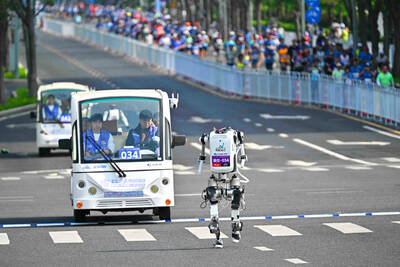
A humanoid robot that won a half-marathon race for robots in Beijing on Sunday ran faster than the human world record in a show of China’s technological leaps. The winner from Honor, a Chinese smartphone maker, completed the 21km race in 50 minutes and 26 seconds, said a WeChat post by the Beijing Economic-Technological Development Area, also known as Beijing E-Town, where the race began. That was faster than the human world record holder, Ugandan Jacob Kiplimo, who finished the same distance in about 57 minutes in March at the Lisbon road race. The performance by the robot marked a significant step forward

An earthquake registering a preliminary magnitude of 7.7 off northern Japan on Monday prompted a short-lived tsunami alert and the advisory of a higher risk of a possible mega-quake for coastal areas there. The Cabinet Office and the Japan Meteorological Agency said there was a 1% chance for a mega-quake, compared to a 0.1% chance during normal times, in the next week or so following the powerful quake near the Chishima and Japan trenches. Officials said the advisory was not a quake prediction but urged residents in 182 towns along the northeastern coasts to raise their preparedness while continuing their daily lives. Prime
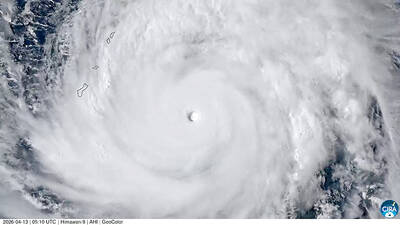
HAZARDOUS CONDITION: The typhoon’s sheer size, with winds extending 443km from its center, slowed down the ability of responders to help communities, an official said The US Coast Guard was searching for six people after losing contact with their disabled boat off the coast of Guam following Typhoon Sinlaku. The crew of the 44m dry cargo vessel, the US-registered Mariana, on Wednesday notified the coast guard that the boat had lost its starboard engine and needed assistance, Petty Officer 3rd Class Avery Tibbets said yesterday. The coast guard set up a one-hour communication schedule with the vessel, but lost contact on Thursday. A Coast Guard HC-130 Hercules aircraft was launched to search for the six people on board, but it had to return to Guam because of


 RSS
RSS