


Encroaching sands have left little evidence that the Omani village of Wadi al-Murr ever existed, but former inhabitants and curious visitors are coming to rediscover the hamlet engulfed by the desert.
Salem al-Arimi, originally from the area, looked out nostalgically over the expanse.
According to local elders, “all the houses in the village were invaded by the sand that assailed them 30 years ago, forcing the inhabitants to leave their homes,” he said.
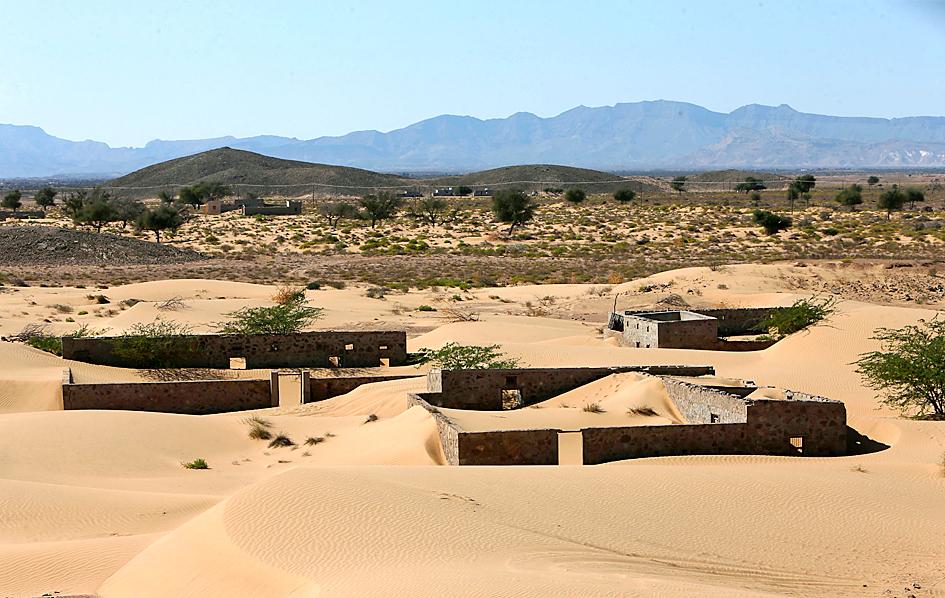
Photo: AFP
Building tops and sections of stone wall emerge here and there, bearing witness to those who once lived here.
Deserts are expanding all over the world, pushed on by climate change, and affected populations have few weapons to fight back.
Wadi al-Murr’s inhabitants, who mostly relied on pastoral activities, had to give up their village, swelling the ranks of those migrating to towns and cities.
Located at the bottom of a valley nearly 400km southwest of the capital, Muscat, Wadi al-Murr is cut off from main roads and only reachable via a long, rough track.
Its isolation, including from the electricity and water grids, contributed to its slide into obscurity.
However, that has not prevented erstwhile residents from returning to visit, along with trekking enthusiasts who take desert hikes in the region.
Mohammed al-Ghanbousi, a former inhabitant, said the moving dunes had re-exposed some dwellings after they were covered by sand.
This phenomenon has prompted “nostalgic people to visit the village, whose structures still stand because they are built from stone,” he said.
“The village has recently been included in trekking tours and also attracts photography enthusiasts,” he added.
A mosque within the village, which in its heyday had about 30 houses and 150 inhabitants, is one building that has resurfaced.
Mohammed al-Alaoui said that when his mother learned that some homes had reappeared, she asked him to take her back.
“She often wants to go, and she likes to be there while she relates her memories of the old days, and sheds a few tears,” he said.
Rashed al-Ameri was among the Omani tourists who have come to discover the hamlet swallowed by the desert.
He traveled from Sur, hundreds of kilometers away, with two friends who were also keen to see Wadi al-Murr.
Oman, which is trying to diversify its oil-reliant economy, is seeking to develop its tourism industry — capitalizing on its rich heritage, scenic coasts and stunning mountain geography.
The sultanate attracted 3 million foreign tourists in 2019, but like almost everywhere else, the COVID-19 pandemic reduced visitors to a trickle last year.
Al-Ameri is among those who believe Wadi al-Murr could easily be included on Oman’s tourist trail.
“What amazed me was that the force of nature could erase an entire village,” he said. “And what’s more amazing is how this place, with its old walls, resists these assaults.”

‘CROSSING THE LINE’: China’s embassy in Seoul criticized US Forces Korea Commander General Xavier Brunson, asking if his ‘hostile’ remarks were authorized by Washington South Korea and the US are in talks over recent public remarks by the commander of US Forces Korea, Seoul’s presidential office said yesterday, after the comments drew sharp criticism from China. In a recent podcast interview, US Forces Korea Commander General Xavier Brunson described South Korea as “the dagger in the heart of Asia” from China’s east coast, prompting the Chinese embassy in Seoul to say that he had “truly crossed the line.” The interview came amid growing speculation that Washington might seek to expand the role of US Forces Korea in countering the growing regional influence of China, a key

Through the noise of rushing papers and whirring belts at a print factory in Kyoto, two creators watch their photo essay come to life in broadsheet form — part of an effort to win new audiences in the age of artificial intelligence (AI). Despite the decline of the publishing industry, self-publication and handmade “zine” magazines are growing in popularity in Japan, reflecting the nation’s enduring love of paper in the digital era. While speaking to Agence France-Presse at the plant, his hands black with ink, one of the creators, Kazuma Obara, said: “I think [paper] is a medium that engages all five

Australian researchers have trained lab-grown brain cells on a silicon computer chip to play the 1990s shooter game Doom and said they are just scratching the surface of what the neurons could be capable of doing. It is the science-fiction work of biotech boffins at Cortical Labs, who researched and developed the technology that harnesses the workings of the brain’s networking system. Each so-called “biological computer” contains about 200,000 living human brain cells, grown from stem cells that were harvested from blood donations. Having mastered the simple computer game Pong, where a paddle is moved up and down to send a ball

France experienced its hottest spring on record, the French weather service said on Tuesday, after an exceptional early heat wave that also broke highs for the season in England and Wales. Meteo-France said the average nationwide temperature over March to May was 13.8°C — about 1.7°C above the norm, and surpassing records set in 2011 and 2020. “The warmest spring since records began in 1900,” it said in a bulletin. All three months were warmer than average, but the onset of an “unprecedented heatwave” late last month pushed the mercury to highs typically seen at the height of the summer. “Our country had never


 RSS
RSS