


Ayna Garayeva, a teacher in the capital of authoritarian and secretive Turkmenistan, began taking extra sanitary measures in her classroom when the government issued new COVID-19 guidelines in August.
As well as standard COVID-19 precautions like temperature checks for students, she started fumigating her classroom with the smoke of a herb beloved by the ex-Soviet country’s leader.
“We are following the instructions as they are laid out,” 42-year-old Garayeva said.
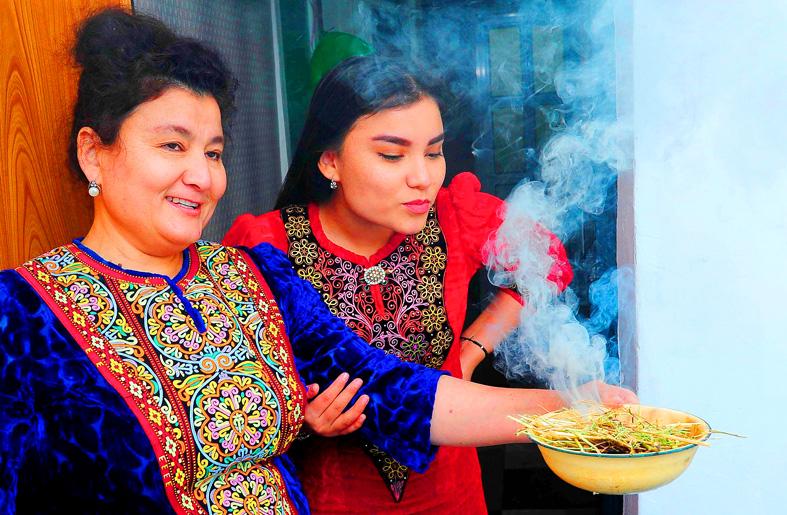
Photo: AFP
In tightly controlled Turkmenistan, which still insists that it has no COVID-19 cases, the pandemic has led to a boom in a herb whose Turkmen name translates as “medicine for a hundred illnesses.”
Wild rue — known locally as yuzerlik — has for millennia been popular in North Africa, the Middle East and Central Asia as a panacea for sickness and ill fortune.
Turkmen President Gurbanguly Berdimuhamedov, a strongman leader and former dentist, has gone a step further. In March, he ordered wild rue burning on a “systematic level,” trumpeting its bacteria and infection-killing qualities.
At the same time, authorities continued to hold mass events and deter citizens from wearing masks.
Since the diktat, the cost of a wild rue bundle has grown fivefold to 5 manats (US$1.43).
In neighboring Uzbekistan, Bakhrom Almatov, Chief Doctor of the Republican Center of State Sanitary-Epidemiology Surveillance, said that the herb has “no direct effect” on viruses, despite having healthy properties.
“After use, many people start sneezing. When they sneeze, the body expels dust that has fallen into it,” Almatov told local media.
The WHO declined to comment on wild rue specifically, but said that traditional medicine in many countries “is often an important health resource with many applications.”
Berdimuhamedov joins the leader of Madagascar, who gained notoriety for promoting a scientifically unproven herbal virus remedy at home and abroad. Herbal remedies have been widely used during the COVID-19 pandemic in countries with struggling public health systems, like Yemen and Sierra Leone.
Yet Berdimuhamedov’s approach to the pandemic changed after the WHO visited in July. The delegation stopped short of dismissing his boast that the country had zero cases, a claim now only shared by North Korea and a handful of island states.
The WHO recommended that Turkmenistan adopt measures as if COVID-19 “were already circulating.”
WHO Europe Director Hans Kluge tweeted weeks later that the group had “expressed serious concern about [a rise] in #COVID19 negative pneumonia” during a teleconference with Berdimuhamedov.
Kluge said that the Turkmen government agreed to allow the WHO to sample COVID-19 tests and send them to WHO laboratories.
Since the July visit, non-food shops and restaurants across Turkmenistan have been shuttered and mask-wearing regime was put in place to counter “dust” and unspecified “pathogens.”
However, Turkmenistan has yet to cooperate with the WHO’s request for confirmatory testing.

Kouri Richins, a Utah mother who published a children’s book about grief after the death of her husband is to serve a life sentence for his murder without the possibility of parole, a judge ruled on Wednesday. Richins was convicted in March of aggravated murder for lacing a cocktail given to her husband, Eric Richins, with five times the lethal dose of fentanyl at their home near Park City in 2022. A jury also found her guilty of four other felonies, including insurance fraud, forgery and attempted murder for trying to poison her husband weeks earlier on Feb. 14, 2022, with a
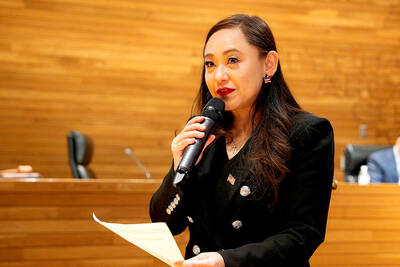
‘PERSONAL MISTAKES’: Eileen Wang has agreed to plead guilty to the felony, which comes with a maximum sentence of 10 years in federal prison A southern California mayor has agreed to plead guilty to acting as an illegal agent for the Chinese government and has resigned from her city position, officials said on Monday. Eileen Wang (王愛琳), mayor of Arcadia, was charged last month with one count of acting in the US as an illegal agent of a foreign government. She was accused of doing the bidding of Chinese officials, such as sharing articles favorable to Beijing, without prior notification to the US government as required by law. The 58-year-old was elected in November 2022 to a five-person city council, from which the mayor is selected

DELA ROSA CASE: The whereabouts of the senator, who is wanted by the ICC, was unclear, while President Marcos faces a political test over the senate situation Philippine authorities yesterday were seeking confirmation of reports that a top politician wanted by the International Criminal Court (ICC) had fled, a day after gunfire rang out at the Philippine Senate where he had taken refuge fearing his arrest. Senator Ronald “Bato” dela Rosa, the former national police chief and top enforcer of former Philippine president Rodrigo Duterte’s “war on drugs,” has been under Senate protection and is wanted for crimes against humanity, the same charges Duterte is accused of. “Several sources confirmed that the senator, Senator Bato, is no longer in the Senate premises, but we are still getting confirmation,” Presidential
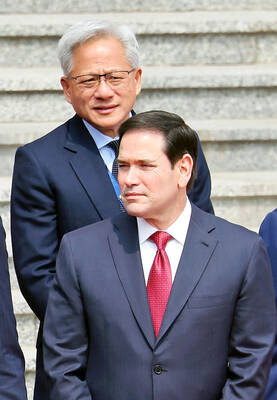
HELP DENIED? The US Department of State said that the Cuban leadership refuses to allow the US to provide aid to Cubans, ‘who are in desperate need of assistance’ US Secretary of State Marco Rubio on Wednesday said that Cuba’s leadership must change, as Washington renewed an offer of US$100 million in aid if the communist nation agrees to cooperate. Cuba has been suffering severe economic tumult led by an energy shortage that plunged 65 percent of the country into darkness on Tuesday. Cuba’s leaders have blamed US sanctions, but Rubio, a Cuban American and critic of the government established by Fidel Castro, said the system was to blame, including corruption by the military. “It’s a broken, nonfunctional economy, and it’s impossible to change it. I wish it were different,” he told


 RSS
RSS