


Tristan da Cunha, an island with 245 permanent residents, is creating a marine protection zone to safeguard endangered rockhopper penguins, yellow-nosed albatross and other wildlife in an area of the South Atlantic three times the size of the UK.
The government of the British overseas territory, which calls itself the most remote inhabited island on Earth, on Friday said that fishing and other “extractive activities” would be banned from 627,247km2 of ocean around Tristan da Cunha and the archipelago’s three other major islands.
The sanctuary would be the biggest “no-take zone” in the Atlantic Ocean and the fourth biggest anywhere in the world, protecting fish that live in the waters and tens of millions of seabirds that feed on them, the territory said.
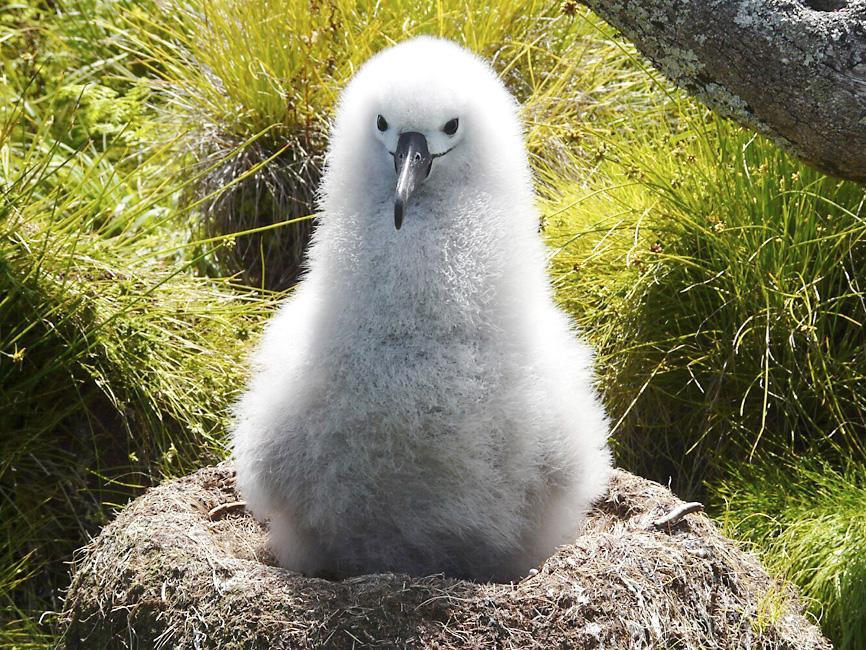
Photo: AP
The isolated area, roughly equidistant between South Africa and Argentina, supports 85 percent of the endangered northern rockhopper penguins, 11 species of whales and dolphins, and most of the world’s sub-Antarctic fur seals, according to the Pew Bertarelli Ocean Legacy Project.
“Our life on Tristan da Cunha has always been based around our relationship with the sea, and that continues today,” James Glass, the territory’s chief islander, said in a statement. “That’s why we’re fully protecting 90 percent of our waters, and we’re proud that we can play a key role in preserving the health of the oceans.”
The zone would become part of the UK’s Blue Belt Program, which is providing £27 million (US$35.63 million) to promote marine conservation in the country’s overseas territories.
The initiative has now protected 11.1 million square kilometers of marine environment, or 1 percent of the world’s oceans, British Prime Minister Boris Johnson’s office said.
The waters around Tristan da Cunha serve as a feeding ground for the critically endangered Tristan albatross and endangered yellow-nosed albatross.
The islands are also home to several species of land birds that live nowhere else, including the Wilkins bunting, the UK’s rarest bird, and the Inaccessible rail, the world’s smallest flightless bird, according to the Royal Society for the Protection of Birds.
The Pew Bertarelli project, which promotes the creation of marine reserves, said that it would help Tristan da Cunha protect its waters with technology that uses real-time data to evaluate ocean conditions and human activity such as fishing.
The project is a joint venture of the Pew Charitable Trusts and the Bertarelli Foundation.
“This small community is responsible for one of the biggest conservation achievements of 2020,” said Beccy Speight, chief executive of the Royal Society for the Protection of Birds. “This will protect one of the most pristine marine environments on the planet.”

An American scientist convicted of lying to US authorities about payments from China while he was at Harvard University has rebuilt his research lab in Shenzhen, China, to pursue technology the Chinese government has identified as a national priority: embedding electronics into the human brain. Charles Lieber, 67, is among the world’s leading researchers in brain-computer interfaces. The technology has shown promise in treating conditions such as amyotrophic lateral sclerosis and restoring movement in paralyzed people. It also has potential military applications: Scientists at the Chinese People’s Liberation Army have investigated brain interfaces as a way to engineer super soldiers by boosting
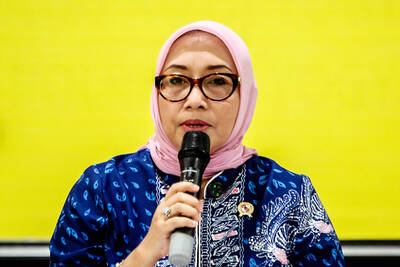
Indonesian police have arrested 13 people after shocking images of alleged abuse against small children at a daycare center went viral, sparking outrage across the nation, officials said on Monday. Police on Friday last week raided Little Aresha, a daycare center in Yogyakarta on Java island, following a report from a former employee. CCTV footage circulating on social media showed children, most younger than two, lying on the floor wearing only diapers, their hands and feet bound with rags. The police have confirmed that the footage is authentic. Police said they also found 20 children crammed into a room just 3m by 3m. “So
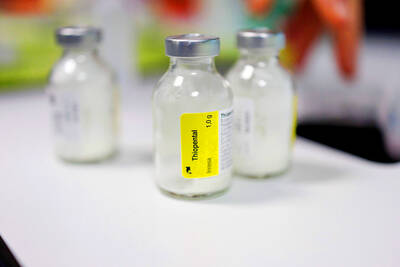
A grieving mother has ended her life at a clinic in Switzerland four years after the death of her only child. Wendy Duffy, 56, a physically healthy woman, died at the Pegasos clinic in Basel after struggling to cope with the death of her 23-year-old son, Marcus. The former care worker, from the West Midlands, England, had previously attempted to take her own life. The case comes as assisted dying would not become law in England and Wales after proposed legislation, branded “hopelessly flawed” by opponents, ran out of time. Ruedi Habegger, the founder of Pegasos, described Duffy’s death as

From post offices and parks to stations and even the summit of Mount Fuji, Japan’s vending machines are ubiquitous, but with the rapid pace of inflation cooling demand for their drinks, operators are being forced to rethink the business. Last month beverage giant DyDo Group Holdings announced it would remove about 20,000 vending machines — about 7 percent of their stock nationwide — by January next year, to “reconstruct a profitable network.” Pokka Sapporo Food & Beverage, based in Nagoya, also said last month it would sell its 40,000-machine operation to Osaka-based Lifedrink Co. “The strength of the vending machine


 RSS
RSS