


In his unsuccessful campaign for re-election, US President Donald Trump repeatedly warned that a victory for US president-elect Joe Biden would be a win for China and that Beijing would “own America.”
Despite that rhetoric, there is little to suggest Beijing will find Biden a soft alternative to Trump, who dramatically shifted the US narrative to confront the world’s second-largest economy in his final year in power.
Even before Trump took office, the last Democratic administration of then-US president Barack Obama and then-US vice president Biden had significantly hardened its attitude toward China.
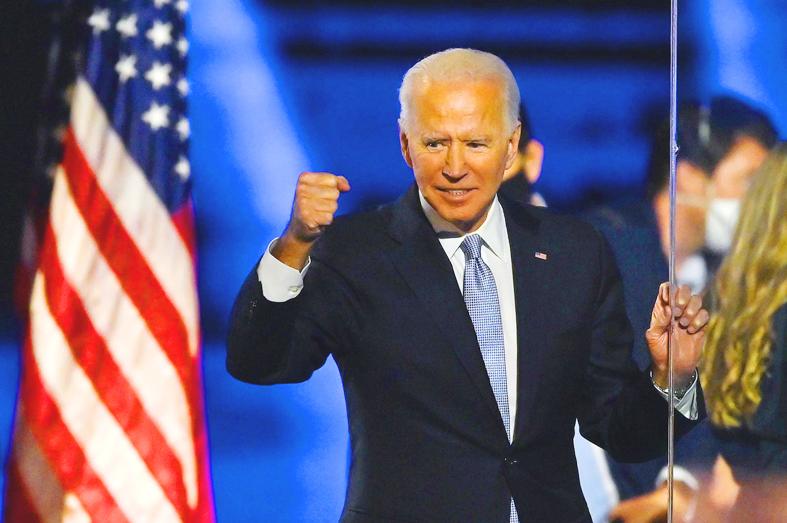
Photo: AFP
Biden has not laid out a detailed China strategy, but all indications are that he will continue the tough approach to Beijing.
However, diplomats, analysts and former officials who advised the Biden campaign expect a more measured tone after Trump’s hip-fired threats, and an emphasis on “strategic competition” rather than outright confrontation.
That said, Biden has at times gone even further than the outgoing US president in attacking China.
He has referred to Chinese President Xi Jinping (習近平) as a “thug” and vowed to lead an international campaign to “pressure, isolate and punish China.”
His campaign has also labeled China’s actions against Muslims in Xinjiang “genocide” — a step further than current policy, with significant implications if that designation is formalized.
“The United States does need to get tough with China,” Biden said in an article published in March as the COVID-19 pandemic took hold.
“The most effective way to meet that challenge is to build a united front of US allies and partners to confront China’s abusive behaviors and human rights violations,” he said.
In the same sentence, Biden also wrote of seeking “to cooperate with Beijing on issues where our interests converge, such as climate change, non-proliferation and global health security.”
Reconciling those aims would be the key challenge, with the potential to touch off the sort of disputes between hard-liners and pragmatists seen in the Trump administration.
“There are going to be big debates,” said a former senior Obama administration official who worked closely with Biden in the past.
“You will have folks in the Biden team who will say China represents a systemic threat to the United States and we have to treat them as such, and there will be pragmatists saying: ‘We’re in the middle of a pandemic, climate change is accelerating, we have to work with them.’”
Whereas the outgoing administration’s tendency has often seemed to be to launch unilateral attacks on Beijing and then to browbeat allies and partners into supporting them, Biden would aim to engage allies at the outset and reassert US leadership via international institutions Trump disdained.
Top Biden advisers told reporters that he would immediately consult with key allies before deciding on the future of tariffs on China, seeking “collective leverage” to strengthen his hand.
“A Biden administration’s China policy will be more predictable and strategic,” said Wendy Cutler, a former US diplomat and trade negotiator.
“The days of advisers scrambling to implement what they learn through presidential tweets will be in the past. The days of throwing one sanction after another at the wall and seeing what sticks without a strategic framework will be over as well,” she said.
While analysts said much of the detail of China policy would depend on who Biden names to key positions, the focus on rebuilding bruised alliances would be a fundamental tenet.
Contenders for top positions and Biden himself have said that to work, the approach must be underpinned by domestic investment to ensure a US competitive edge over China in key technologies such as quantum computing, artificial intelligence and 5G.
Michele Flournoy, a hawkish contender for US secretary of defense, has said that the economic damage caused by the pandemic mean US defense budgets would be flattened or worse, while stressing the need for US forces to be able and willing to carry through on any deterrent threat.
“If the US military had the capability to credibly threaten to sink all of China’s military vessels, submarines, and merchant ships in the South China Sea within 72 hours, Chinese leaders might think twice before, say, launching a blockade or invasion of Taiwan,” she wrote in the June edition of Foreign Affairs.

‘CROSSING THE LINE’: China’s embassy in Seoul criticized US Forces Korea Commander General Xavier Brunson, asking if his ‘hostile’ remarks were authorized by Washington South Korea and the US are in talks over recent public remarks by the commander of US Forces Korea, Seoul’s presidential office said yesterday, after the comments drew sharp criticism from China. In a recent podcast interview, US Forces Korea Commander General Xavier Brunson described South Korea as “the dagger in the heart of Asia” from China’s east coast, prompting the Chinese embassy in Seoul to say that he had “truly crossed the line.” The interview came amid growing speculation that Washington might seek to expand the role of US Forces Korea in countering the growing regional influence of China, a key

SEEKING ORDER: Rodrigo Paz said that ‘anyone who wants to destroy the nation will have to deal with this president and the full force of the constitution’ Bolivian President Rodrigo Paz on Wednesday said that the nation was at a “breaking point” after nearly a month of protests that have caused shortages of food, fuel and medicine. Paz, who took office six months ago amid the worst economic crisis there in four decades, is battling a groundswell of fury over his policies. The political capital, La Paz, has been besieged by low-income workers and members of the indigenous majority calling for his resignation. “The country needs order and is reaching breaking point,” the 58-year-old said at a public event in La Paz, renewing his appeal for dialogue. On Tuesday, the Bolivian

Through the noise of rushing papers and whirring belts at a print factory in Kyoto, two creators watch their photo essay come to life in broadsheet form — part of an effort to win new audiences in the age of artificial intelligence (AI). Despite the decline of the publishing industry, self-publication and handmade “zine” magazines are growing in popularity in Japan, reflecting the nation’s enduring love of paper in the digital era. While speaking to Agence France-Presse at the plant, his hands black with ink, one of the creators, Kazuma Obara, said: “I think [paper] is a medium that engages all five

Australian researchers have trained lab-grown brain cells on a silicon computer chip to play the 1990s shooter game Doom and said they are just scratching the surface of what the neurons could be capable of doing. It is the science-fiction work of biotech boffins at Cortical Labs, who researched and developed the technology that harnesses the workings of the brain’s networking system. Each so-called “biological computer” contains about 200,000 living human brain cells, grown from stem cells that were harvested from blood donations. Having mastered the simple computer game Pong, where a paddle is moved up and down to send a ball


 RSS
RSS