


A mathematician who tamed a nightmarish family of equations that behave so badly they make no sense has won the most lucrative prize in academia.
Martin Hairer, an Austrian-British researcher at Imperial College London, is the winner of the annual Breakthrough prize for mathematics, an annual US$3 million award that has come to rival the Nobels in terms of kudos and prestige.
Hairer landed the prize for his work on stochastic analysis, a field that describes how random effects turn the maths of things like stirring a cup of tea, the growth of a forest fire, or the spread of a water droplet that has fallen on a tissue into a fiendishly complex problem.
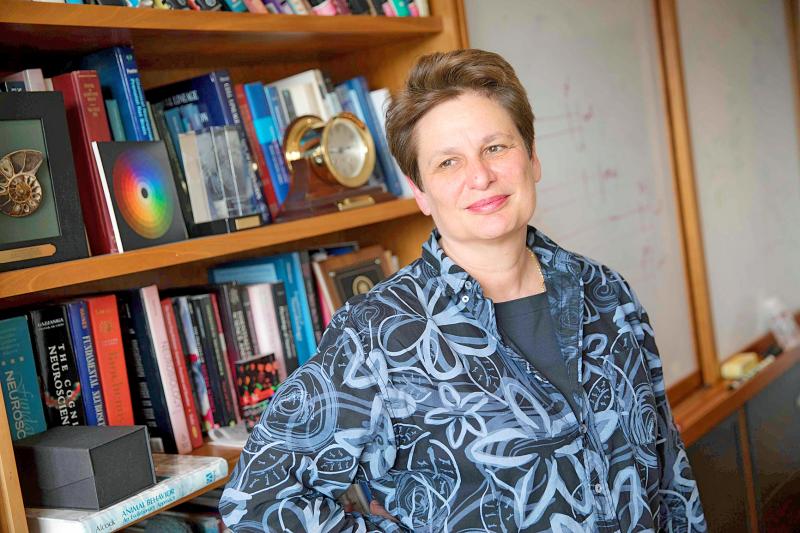
Photo: AFP
His major work, a 180-page treatise that introduced the world to “regularity structures,” so stunned his colleagues that one suggested it must have been transmitted to Hairer by a more intelligent alien civilization.
Hairer, who rents a London apartment with his wife, fellow Imperial mathematician Li Xuemei (李雪梅), heard he won the prize in a Skype call while the UK was still in lockdown.
“It was completely unexpected,” he said. “I didn’t think about it at all, so it was a complete shock. We couldn’t go out or anything, so we celebrated at home.”
The award is one of several Breakthrough prizes announced by a foundation set up by the Israeli-Russian investor Yuri Milner and Facebook CEO Mark Zuckerberg.
A committee of previous recipients chooses the winners who are all leading lights in mathematics and the sciences.
Other winners announced on Thursday include a Hong Kong scientist, Dennis Lo (盧煜明), who was inspired by a 3D Harry Potter movie to develop a test for genetic mutations in DNA shed by fetuses, and a team of physicists whose experiments revealed that if extra dimensions of reality exist, they are curled up smaller than a third of a hair’s width.
Yet another winner, Catherine Dulac at Harvard University, has overturned misconceptions around parenthood by showing that the neural circuits for maternal and paternal behavior are found in both males and females.
Hairer grew up in Geneva, Switzerland, where he soon established himself as a rare talent.
His entry for a school science competition became Amadeus — “the Swiss army knife of sound editing” — now used in updated form by music producers and games designers. He still maintains the software as a sideline to his academic work.
After dallying with physics at university, Hairer moved into mathematics. The realization that ideas in theoretical physics can be overturned and swiftly consigned to the dustbin did not appeal.
“I wouldn’t really want to put my name to a result that could be superseded by something else three years later,” he said. “In mathematics, if you obtain a result then that is it. It’s the universality of mathematics, you discover absolute truths.”
Hairer’s expertise lies in stochastic partial differential equations, a branch of mathematics that describes how randomness throws disorder into processes, such as the movement of wind in a wind tunnel or the creeping boundary of a water droplet landing on a tissue. When the randomness is strong enough, solutions to the equations get out of control.
“In some cases, the solutions fluctuate so wildly that it is not even clear what the equation meant in the first place,” he said.
With the invention of regularity structures, Hairer showed how the infinitely jagged noise that threw his equations into chaos could be reframed and tamed. When he published the theory in 2014, it made an immediate splash.
“Like everyone else, I was amazed to see a theory like this, worked out in detail from scratch, with few precedents,” said Jeremy Quastel, a mathematician at the University of Toronto who first mused on the extraterrestrial provenance of the theory.
While his peers roundly consider Hairer a genius, he says mathematics can be infuriating.
“Most of the time it doesn’t work out. As pretty much every single graduate student in mathematics can attest, during your PhD you probably spend two-thirds of your time getting stuck and banging your head against a wall,” he said.
Hairer’s windfall has yet to land in his bank account, but when it does, his life will change.
“We moved to London somewhat recently, three years ago, and we are still renting. So it might be time to buy a place to live,” he said.

Kouri Richins, a Utah mother who published a children’s book about grief after the death of her husband is to serve a life sentence for his murder without the possibility of parole, a judge ruled on Wednesday. Richins was convicted in March of aggravated murder for lacing a cocktail given to her husband, Eric Richins, with five times the lethal dose of fentanyl at their home near Park City in 2022. A jury also found her guilty of four other felonies, including insurance fraud, forgery and attempted murder for trying to poison her husband weeks earlier on Feb. 14, 2022, with a

DELA ROSA CASE: The whereabouts of the senator, who is wanted by the ICC, was unclear, while President Marcos faces a political test over the senate situation Philippine authorities yesterday were seeking confirmation of reports that a top politician wanted by the International Criminal Court (ICC) had fled, a day after gunfire rang out at the Philippine Senate where he had taken refuge fearing his arrest. Senator Ronald “Bato” dela Rosa, the former national police chief and top enforcer of former Philippine president Rodrigo Duterte’s “war on drugs,” has been under Senate protection and is wanted for crimes against humanity, the same charges Duterte is accused of. “Several sources confirmed that the senator, Senator Bato, is no longer in the Senate premises, but we are still getting confirmation,” Presidential

HELP DENIED? The US Department of State said that the Cuban leadership refuses to allow the US to provide aid to Cubans, ‘who are in desperate need of assistance’ US Secretary of State Marco Rubio on Wednesday said that Cuba’s leadership must change, as Washington renewed an offer of US$100 million in aid if the communist nation agrees to cooperate. Cuba has been suffering severe economic tumult led by an energy shortage that plunged 65 percent of the country into darkness on Tuesday. Cuba’s leaders have blamed US sanctions, but Rubio, a Cuban American and critic of the government established by Fidel Castro, said the system was to blame, including corruption by the military. “It’s a broken, nonfunctional economy, and it’s impossible to change it. I wish it were different,” he told

Nauru said it would hold a referendum to change its official name, described as a colonial relic from a time when “foreign tongues” mangled the native language. Nauru would change its name to Naoero to “more faithfully honor our nation’s heritage, our language and our identity,” Nauruan President David Adeang said in a statement on Tuesday. The Pacific island nation’s native language is Dorerin Naoero, which is spoken by the vast majority of its approximately 10,000 inhabitants. “Nauru emerged because Naoero could not be properly pronounced by foreign tongues, and was changed not by our choice, but for convenience,” the government said in


 RSS
RSS