


When Bangladeshi authorities prepared to enforce a nationwide lockdown in late March, three friends fretted: How would rickshaw drivers, factory workers and other working poor people survive?
With only 20,000 takas (US$236) in hand, their challenge was to channel resources from the generous haves to the desperate have-nots. They started making appeals for money.
The first response came from Bangladeshi cricket star Shakib Al Hasan, who donated 2 million takas). With that, they began distributing food packs in impoverished neighborhoods in Dhaka.
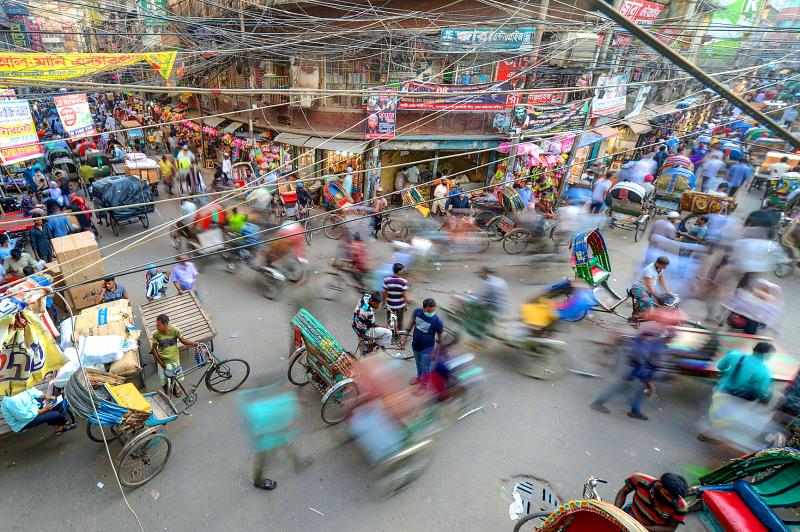
Photo: AFP
Eventually, they succeeded in bringing about 120 organizations and business houses under one umbrella for their aid campaign, Mission Save Bangladesh. Their work has since expanded to helping families fighting cancer and to arranging supplies of masks and sanitizers.
“People are so generous. They responded to our calls from their hearts,” said Imran Kadir, who founded the campaign with friends Tajdin Hasan and Imtiaz Halim.
Kadir spoke with The Associated Press as he and other volunteers visited a cancer hospital in Dhaka to distribute food packs.
“We started distributing food packs in impoverished neighborhoods in Dhaka with the initial funds that came from the Shakib Al Hasan,” said Kadir, 32. “Slowly we expanded our reach outside the capital city.”
Bangladesh’s leading exporter, the garment industry, has been hit hard by the pandemic, and so have its 4 million low-paid workers.
The industry reports that more than US$3 billion in orders have been canceled or suspended.
The Bangladeshi development agency BRAC said the incomes of about 51 percent of the nation’s rickshaw drivers, 58 percent of factory workers, 66 percent of hotel and restaurant workers, and 62 percent of day laborers in non-agricultural sectors have been reduced to zero since the lockdown began.
Businesses have reopened, but the recovery would take time.
Many companies channeled money from their corporate social responsibility funds to Mission Save Bangladesh.
“Till now we have raised about US$230,000. This is very inspiring,” Kadir said.
The group provided food packs to about 13,000 families and another 60,000 individuals. It provided an ambulance to a group to help families cremate or bury people who died of COVID-19.
In a cancer hospital in Dhaka, volunteers brought food packages for two weeks for the patients, most of whom came from villages.
Abdullah Biswas, a father of a cancer patient in a specialized cancer hospital in Dhaka, was happy to get food packs.
“We came here from Shariatpur,” an area that flooded this year, Biswas said. “We are in serious financial crisis. This aid will help us a lot.”
Slum dwellers were similarly thrilled to receive aid from the volunteers.
“We are delighted. As we are out of work, we have been facing a lot of difficulties to survive with our children,” said Nurjahan Begum, a resident of a slum in Dhaka’s Kalabagn area.
“We pray for the well-being of the aid givers and hope to get more help. We will give them blessings as long as we are alive,” she said.

An American scientist convicted of lying to US authorities about payments from China while he was at Harvard University has rebuilt his research lab in Shenzhen, China, to pursue technology the Chinese government has identified as a national priority: embedding electronics into the human brain. Charles Lieber, 67, is among the world’s leading researchers in brain-computer interfaces. The technology has shown promise in treating conditions such as amyotrophic lateral sclerosis and restoring movement in paralyzed people. It also has potential military applications: Scientists at the Chinese People’s Liberation Army have investigated brain interfaces as a way to engineer super soldiers by boosting
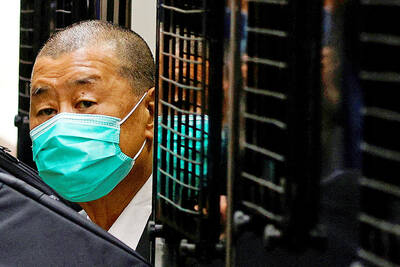
Jailed media entrepreneur Jimmy Lai (黎智英) has been awarded Deutsche Welle’s (DW) freedom of speech award for his contribution to Hong Kong’s pro-democracy movement. The German public broadcaster on Thursday said Lai would be presented in absentia with the 12th iteration of the award on June 23 at the DW Global Media Forum in Bonn. Deutsche Welle director-general Barbara Massing praised the 78-year-old founder of the now-shuttered news outlet Apple Daily for standing “unwaveringly for press freedom in Hong Kong at great personal risk.” “With Apple Daily, he gave journalists a platform for free reporting and a voice to the democracy movement in
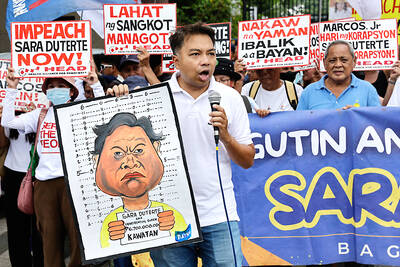
PHILIPPINE COMMITTEE: The head of the committee that made the decision said: ‘If there is nothing to hide, there is no reason to hide, there is no reason to obstruct’ A Philippine congressional committee on Wednesday ruled that there was “probable cause” to impeach Philippine Vice President Sara Duterte after hearing allegations of unexplained wealth, misuse of state funds and threats to have the president assassinated. The unanimous decision of the 53-member committee in the Philippine House of Representatives sends the two impeachment complaints to deliberations and voting by the entire lower chamber, which has more than 300 lawmakers. The complaints centered on Duterte’s alleged illegal use and mishandling of intelligence funds from the vice president’s office, and from her time as education secretary under Philippine President Ferdinand Marcos Jr. Duterte and the
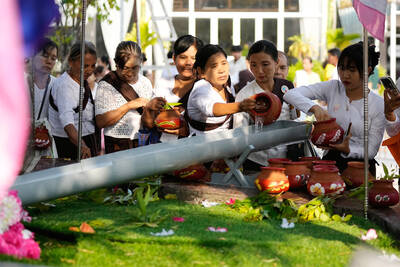
Burmese President Min Aung Hlaing yesterday cut all prisoners’ sentences by one-sixth, a blanket measure that a source close to deposed leader Aung San Suu Kyi said would further shorten her detention. Aung San Suu Kyi has been sequestered since a 2021 military coup, but the senior member of her dissolved National League for Democracy (NLD) party said that while her term had been reduced, her remaining sentence is still unclear. “We also don’t know exactly how many years she has left,” the source told reporters, speaking on condition of anonymity for security reasons. The military toppled Aung San Suu Kyi’s elected government


 RSS
RSS