


French satirical weekly Charlie Hebdo, the target of a massacre by Muslim gunmen in 2015, on Tuesday said it was republishing controversial cartoons of the Prophet Mohammed to mark this week’s start of the trial of alleged accomplices to the attack.
The cover of yesterday’s new issue has a dozen cartoons mocking Mohammed, reproducing images that sparked protests when first published and a debate about the limits of freedom of speech.
“We will never lie down. We will never give up,” magazine director Laurent Sourisseau wrote in an accompanying editorial.
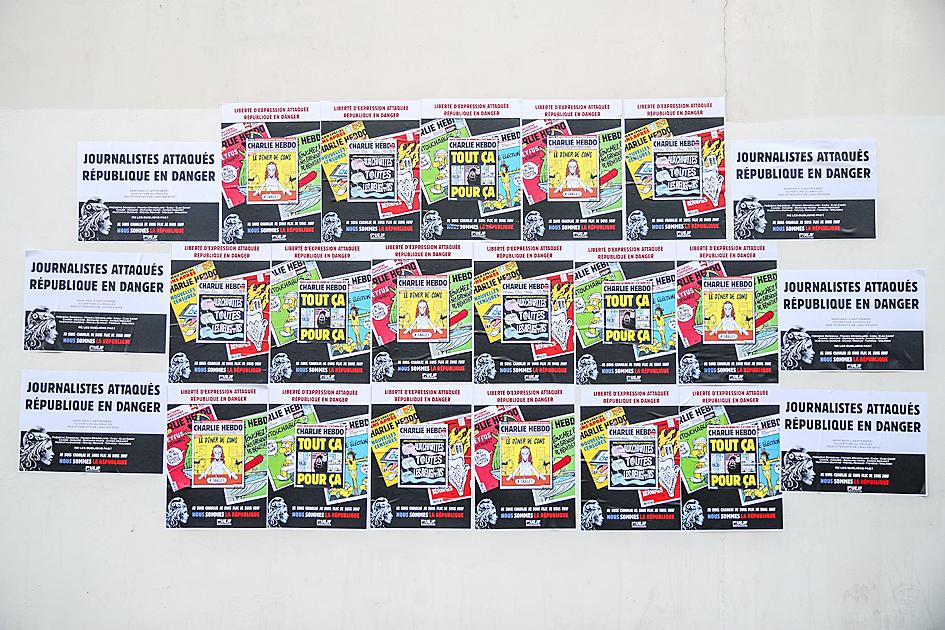
Photo: EPA-EFE
“The hatred that struck us is still there and, since 2015, it has taken the time to mutate, to change its appearance, to go unnoticed and to quietly continue its ruthless crusade,” Sourisseau wrote.
Twelve people, including some of France’s most celebrated cartoonists, were killed on Jan. 7, 2015, when brothers Said and Cherif Kouachi went on a gun rampage at the magazine’s offices in Paris.
The perpetrators were killed in the wake of the massacre, but 14 alleged accomplices in the attacks, which also targeted a Jewish supermarket, went on trial in Paris yesterday.
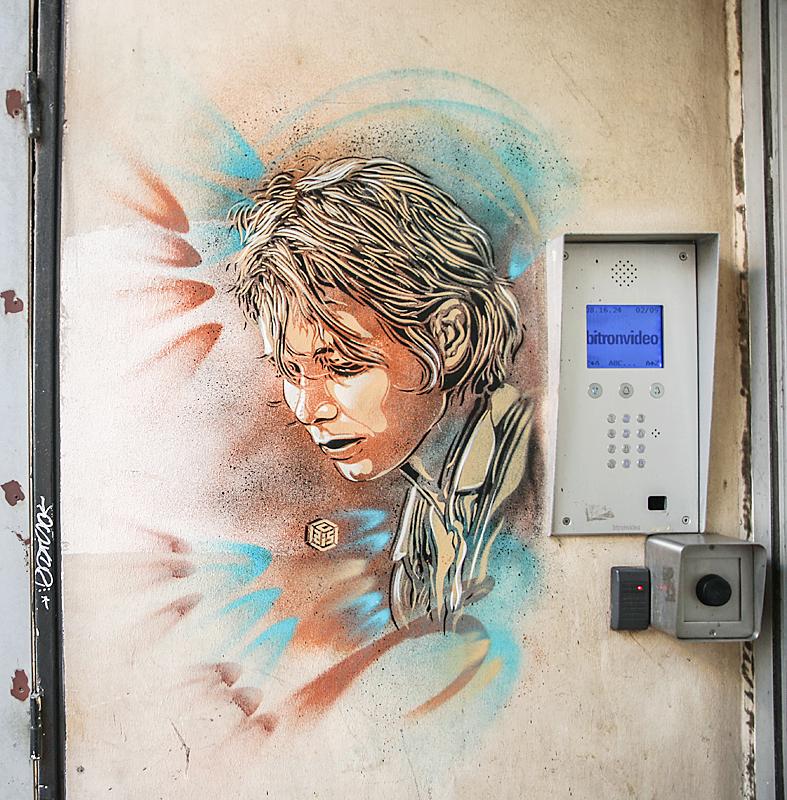
Photo: EPA-EFE
The latest Charlie Hebdo cover shows a dozen cartoons first published by Danish daily Jyllands-Posten in 2005 and then reprinted by the French weekly in 2006, provoking outrage across the Muslim world.
In the center of the cover is a cartoon of Mohammed that was drawn by cartoonist Jean Cabut, known as Cabu, one of those killed in the massacre.
“All of this, just for that,” the front-page headline says.
The issue was available at newstands in France just as the trial got under way.
The editorial team wrote that now was the right time to republish the cartoons and “essential” as the trial opens.
“We have often been asked since January 2015 to print other caricatures of Mohammed,” it said.
“We have always refused to do so, not because it is prohibited — the law allows us to do so — but because there was a need for a good reason to do it, a reason which has meaning and which brings something to the debate,” it said.
Former Charlie Hebdo director Philippe Val hailed the decision as a “remarkable idea” for defending freedom of thought and expression in the face of “terror.”
French Council of Muslim Worship president Mohammed Moussaoui urged people to “ignore” the cartoons, while condemning violence.
“The freedom to caricature is guaranteed for all, the freedom to love or not to love [the caricatures] as well. Nothing can justify violence,” he told reporters.
The Pakistani Ministry of Foreign Affairs said that the republication of the cartoons was “deeply offensive.”
“Such a deliberate act to offend the sentiments of billions of Muslims cannot be justified as an exercise in press freedom or freedom of expression,” it said in a statement.
French President Emmanuel Macron, speaking from the Lebanese capital, Beirut, paid tribute to the victims of the attack on Charlie Hebdo, and defended the “freedom to blaspheme” and criticise in France.
It is not up to a French president to weigh in on editorial decisions, he said.
However, “with freedom of expression comes the duty to not have hate speech,” he said, referring to social media and not Charlie Hebdo’s caricatures.
The suspects, whose trial began at 8am, are accused of providing logistical support to the killers.
The trial had been delayed several months with most French courtrooms closed amid the COVID-19 pandemic.
The court in Paris will sit until Nov. 10 and, in a first for a terror trial, proceedings will be filmed for archival purposes given public interest.
National anti-terror prosecutor Jean-Francois Ricard dismissed the idea that it was just “little helpers” going on trial since the three gunmen were now dead.
“It is about individuals who are involved in the logistics, the preparation of the events, who provided means of financing, operational material, weapons, a residence,” he told France Info radio on Monday.
‘IN A DIFFERENT PLACE’: The envoy first visited Shanghai, where he attended a Chinese basketball playoff match, and is to meet top officials in Beijing tomorrow US Secretary of State Antony Blinken yesterday arrived in China on his second visit in a year as the US ramps up pressure on its rival over its support for Russia while also seeking to manage tensions with Beijing. The US diplomat tomorrow is to meet China’s top brass in Beijing, where he is also expected to plead for restraint as Taiwan inaugurates president-elect William Lai (賴清德), and to raise US concerns on Chinese trade practices. However, Blinken is also seeking to stabilize ties, with tensions between the world’s two largest economies easing since his previous visit in June last year. At the
Nearly half of China’s major cities are suffering “moderate to severe” levels of subsidence, putting millions of people at risk of flooding, especially as sea levels rise, according to a study of nationwide satellite data released yesterday. The authors of the paper, published by the journal Science, found that 45 percent of China’s urban land was sinking faster than 3mm per year, with 16 percent at more than 10mm per year, driven not only by declining water tables, but also the sheer weight of the built environment. With China’s urban population already in excess of 900 million people, “even a small portion

UNSETTLING IMAGES: The scene took place in front of TV crews covering the Trump trial, with a CNN anchor calling it an ‘emotional and unbelievably disturbing moment’ A man who doused himself in an accelerant and set himself on fire outside the courthouse where former US president Donald Trump is on trial has died, police said yesterday. The New York City Police Department (NYPD) said the man was declared dead by staff at an area hospital. The man was in Collect Pond Park at about 1:30pm on Friday when he took out pamphlets espousing conspiracy theories, tossed them around, then doused himself in an accelerant and set himself on fire, officials and witnesses said. A large number of police officers were nearby when it happened. Some officers and bystanders rushed

Beijing is continuing to commit genocide and crimes against humanity against Uyghurs and other Muslim minorities in its western Xinjiang province, U.S. Secretary of State Antony Blinken said in a report published on Monday, ahead of his planned visit to China this week. The State Department’s annual human rights report, which documents abuses recorded all over the world during the previous calendar year, repeated language from previous years on the treatment of Muslims in Xinjiang, but the publication raises the issue ahead of delicate talks, including on the war in Ukraine and global trade, between the top U.S. diplomat and Chinese


 RSS
RSS