


A US-Israeli delegation left Abu Dhabi on Tuesday after a visit aimed at charting the relationship between the United Arab Emirates (UAE) and the Jewish state after their landmark deal to establish diplomatic ties.
The UAE and Israel are expected to sign the US-brokered accord, Israel’s first with a Gulf nation and only its third with an Arab state, at the White House in coming weeks.
White House adviser Jared Kushner led the delegation, which arrived in the Emirati capital on Monday on the first-ever commercial flight from Tel Aviv.
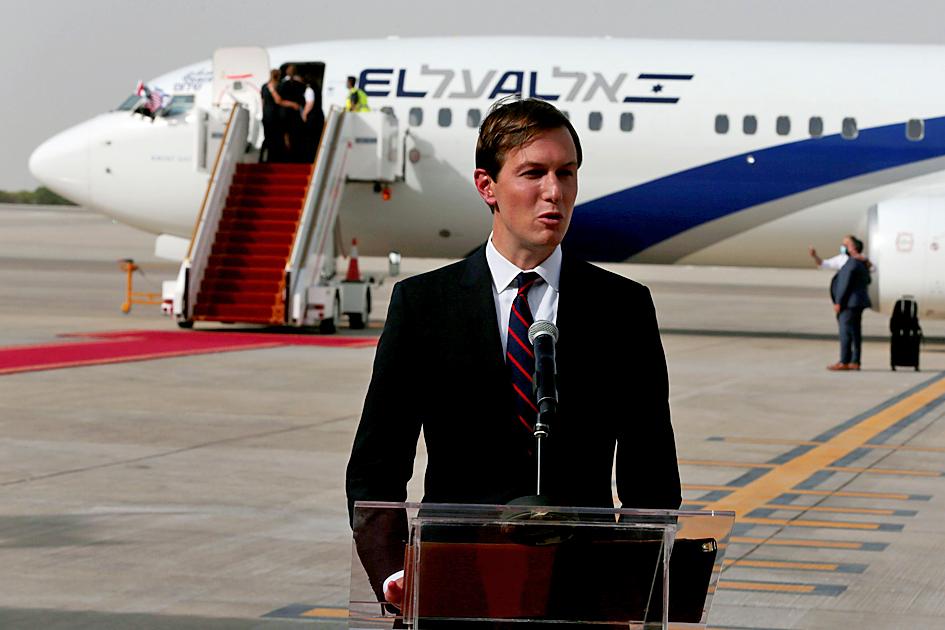
Photo: Reuters
The Israeli press celebrated the direct flight, laden with symbolism, which in another breakthrough was also allowed to cross the airspace of Saudi Arabia.
“The flight of peace” ran the front-page headline of top-selling Yediot Aharonot daily, saying that “no matter how we look at it ... this is a fascinating historic event.”
The US is on a diplomacy drive to push more Arab nations to strike deals with Israel.
Kushner said he hoped another would emerge soon.
“Let’s hope it’s months” as opposed to years, he said when asked by the Emirates News Agency when he expected a breakthrough, adding it was “logical” that all 22 Arab states could one day follow suit.
Palestinians have condemned the deal as a stab in the back by a major Arab player while they still lack a state of their own.
Iran has been scathing in its criticism.
Iranian Supreme leader Ayatollah Ali Khamenei wrote on Twitter on Tuesday that “the UAE betrayed the world of Islam, the Arab nations, the region’s countries, and Palestine.”
Before leaving on Tuesday, Kushner visited a UAE air base where the US operates F-35 stealth jets — the thorniest issue in the establishment of ties, which was motivated in part by a move to combine forces against Iran.
Israel has denied reports that the deal hinges on the sale of US F-35s to the UAE.
Israeli Prime Minister Benjamin Netanyahu has said that he opposes a move that could blunt the strategic edge of the Jewish state.
Kushner on Monday said that the US could maintain that edge “while also advancing our military relationship with the United Arab Emirates” and that the issue would be discussed further in the coming weeks.
The national security advisers of the two nations, Israel’s Meir Ben-Shabbat and the UAE’s Sheikh Tahnoun bin Zayed, joined Kushner for the talks on cooperation between the two highly developed Middle East economies.
During the visit they discussed cooperation in investment, finance, health, space exploration, civil aviation, foreign policy and tourism and culture.
Israel and the UAE on Tuesday signed their first protocol in banking and finance, according to Netanyahu’s office.
“We will soon announce additional agreements in aviation, tourism, trade and others,” he said in a statement.
Israel also said that the two sides on Tuesday held their first meeting on the “possibility of the mutual opening of embassies,” and that direct commercial flights between the Jewish state and the UAE would probably begin this year.
“It wouldn’t be a surprise if by the end of 2020 there will be direct flights between Israel and the UAE,” Israeli Ministry of Foreign Affairs spokesman Lior Haiat told the English Web site of al-Arabiya, a Saudi-owned broadcaster.
Kushner headed to Bahrain on Tuesday, a week after a visit by US Secretary of State Mike Pompeo.
He met with Bahraini King Hamad bin Isa Al Khalifa, who said that stability in the region relied on Saudi Arabia, according to the Bahrain News Agency.
Kushner later met Saudi Arabian Crown Prince Mohammad bin Salman in Saudi Arabia’s northwest Neom region.
The pair discussed “the need to resume negotiations between the Palestinian and Israeli sides to achieve a just and lasting peace,” the Saudi Press Agency said.
They also discussed how to bolster the US-Saudi Arabia partnership “in all fields” to boost regional and international security and stability.

Crowds in Bangladesh are flocking to snap photographs with an unlikely social media star — an albino buffalo with flowing blond hair nicknamed “Donald Trump” that is due to be sacrificed within days. Owner Zia Uddin Mridha, 38, said his brother named the 700kg bull over its flowing helmet of hair resembling the signature look of the US president. “My younger brother picked this name because of the buffalo’s extraordinary hair,” he said at his farm in Narayanganj, just outside the capital, Dhaka. Mridha said that a constant stream of curious visitors — social media fans, onlookers and children — have come throughout

It began as a satirical online project. Now millions of young people in India are flocking to it as an outlet for their frustration. A parody political party called the Cockroach Janta Party, with the insect as its symbol, has exploded across India’s social media by turning absurdist humor into protest. Memes and short videos mocking corruption, joblessness and political dysfunction have flooded social media sites, where millions of users are embracing the cockroach — known for its ability to survive harsh conditions — as a tongue-in-cheek symbol of endurance. The online movement’s rise has been unusually rapid. The Cockroach Janta Party (CJP)

HOTTER: While Indians are accustomed to summer heat, climate change has caused northwestern India to warm faster than other parts of the country, an academic said Roads and markets have emptied during afternoons and some farmers have switched to nighttime work to avoid scorching temperatures as a heat wave grips large parts of India. The India Meteorological Department forecast maximum temperatures for yesterday of about 45°C in the capital, New Delhi, where authorities have opened temporary “cooling zones” to help people cope. The weather department warned that conditions would likely persist across several northern regions in the coming days, with temperatures staying well above seasonal averages. Authorities urged people to stay indoors during the hottest hours and take precautions against heat-related illnesses. India declares a heat wave whenever maximum temperatures

SPEAKING OUT: After Siranudh Scott’s allegations surfaced, celebrities and public figures took to social media to share their own experiences of sexual misconduct and abuse A high-profile alleged sexual abuse case within a wealthy Thai beer brewing family has prompted a wave of painful accounts from survivors of unconnected abuse in the conservative nation. Siranudh Scott, a member of the billionaire Thai family that founded the ubiquitous Singha beer brand, posted an emotional video this month accusing his elder brother Sunit of repeatedly abusing him when he was a teenager. Sunit, who is in his 30s, later denied the allegations in a video posted online, but Singha parent Boonrawd dismissed him from his executive role with the company on Tuesday last week. “I felt I needed to speak


 RSS
RSS