


Beyond the health and economic crises of COVID-19, the global pandemic has the potential to cause political instability and undermine state security across the Pacific, the region’s chief diplomat has warned.
Pacific Islands Forum Secretary-General Meg Taylor said that the region’s economies were struggling with the virus-induced shocks, and a prolonged crisis could worsen existing problems of hunger, poor healthcare and state fragility.
“COVID-19 has exposed and exacerbated systemic and structural imbalances in our systems and societies, underlining the urgency for decisive policy action,” Taylor said.
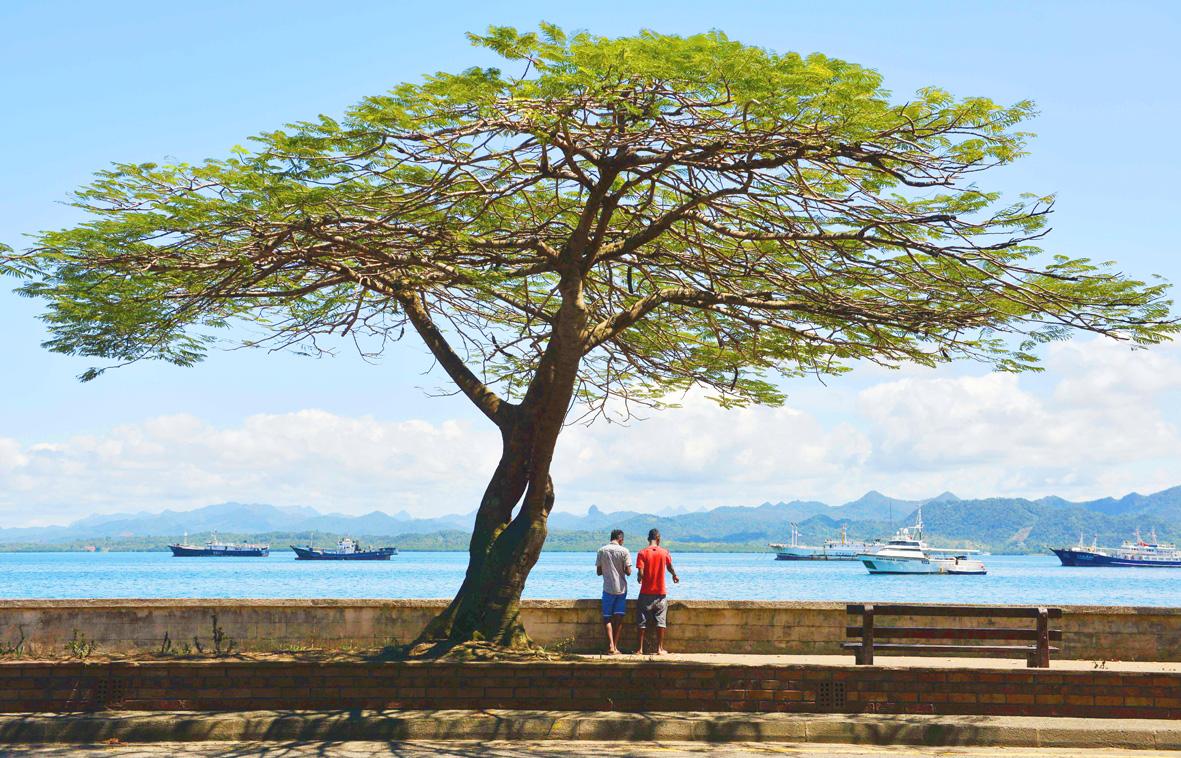
Photo: AFP
“If I look at this from what’s happening within communities and different countries, I think some countries are getting harder hit than others, and I think where we’ve seen unemployment, we’ve seen people really struggle,” she said ahead of a virtual meeting of forum’s economic ministers yesterday.
“We’re seeing in places like Nadi low employment and lots of young mothers and carers with children who do not have sufficient resources to be able to feed themselves,” she said.
Extreme poverty in the region could increase by more than 40 percent, the Australian think tank Devpolicy found.
Taylor said the region was threatened by health, economic and the ongoing climate crises, all of which require decisive action from governments.
A severe virus-related economic fallout threatens the economic, political and social fabric of the region.
In response to questions about COVID-19’s impact on political stability and state fragility, Taylor said: “Do I want to go further and predict that there’s going to be unrest? I would hope that there wouldn’t be. But I think … there may be disruptions. People are afraid of what is happening.”
Government revenues across the Pacific have been devastated by precipitous drops in tourism, and the shutdown of export and import industries.
Most Pacific countries are forecasting economic contractions this year, with recovery not expected until next year or longer.
Among the hardest-hit are tourism-reliant countries such as the Cook Islands, Fiji and Vanuatu, because of border closures and lockdowns, described as “catastrophic.”
Tourism makes up 40 percent of Fiji’s GDP.
The IMF recorded a 99 percent drop in tourist arrivals to the country in May compared with the same month last year.
Fiji’s economy is forecast to decline by 21.7 percent this year, the most of any Pacific nation.
Tourism recovery will largely depend on tourists from Australia and New Zealand, but with the worsening COVID-19 situation in Victoria, Australia’s borders might stay shut for some time.
Remittances, a lifeline for many Pacific households, are also expected to decline by 13 percent, according to the World Bank.
This represents a huge downturn for Samoa, Tonga and the Marshall Islands, where money sent back by overseas workers account for 40 percent of average household income.
There are growing concerns that Pacific governments might use the virus to justify accumulating unsustainable debt.
Fiji has announced a 2 billion Fijian dollar (US$937.2 million) stimulus package, largely financed by loans, pushing its debt to GDP ratio to 83.4 percent.
Similar scenes are being played out across the region, where governments lack the fiscal space or cash reserves to mount a serious response to long-term crises.

‘IN A DIFFERENT PLACE’: The envoy first visited Shanghai, where he attended a Chinese basketball playoff match, and is to meet top officials in Beijing tomorrow US Secretary of State Antony Blinken yesterday arrived in China on his second visit in a year as the US ramps up pressure on its rival over its support for Russia while also seeking to manage tensions with Beijing. The US diplomat tomorrow is to meet China’s top brass in Beijing, where he is also expected to plead for restraint as Taiwan inaugurates president-elect William Lai (賴清德), and to raise US concerns on Chinese trade practices. However, Blinken is also seeking to stabilize ties, with tensions between the world’s two largest economies easing since his previous visit in June last year. At the
Nearly half of China’s major cities are suffering “moderate to severe” levels of subsidence, putting millions of people at risk of flooding, especially as sea levels rise, according to a study of nationwide satellite data released yesterday. The authors of the paper, published by the journal Science, found that 45 percent of China’s urban land was sinking faster than 3mm per year, with 16 percent at more than 10mm per year, driven not only by declining water tables, but also the sheer weight of the built environment. With China’s urban population already in excess of 900 million people, “even a small portion

UNSETTLING IMAGES: The scene took place in front of TV crews covering the Trump trial, with a CNN anchor calling it an ‘emotional and unbelievably disturbing moment’ A man who doused himself in an accelerant and set himself on fire outside the courthouse where former US president Donald Trump is on trial has died, police said yesterday. The New York City Police Department (NYPD) said the man was declared dead by staff at an area hospital. The man was in Collect Pond Park at about 1:30pm on Friday when he took out pamphlets espousing conspiracy theories, tossed them around, then doused himself in an accelerant and set himself on fire, officials and witnesses said. A large number of police officers were nearby when it happened. Some officers and bystanders rushed

Beijing is continuing to commit genocide and crimes against humanity against Uyghurs and other Muslim minorities in its western Xinjiang province, U.S. Secretary of State Antony Blinken said in a report published on Monday, ahead of his planned visit to China this week. The State Department’s annual human rights report, which documents abuses recorded all over the world during the previous calendar year, repeated language from previous years on the treatment of Muslims in Xinjiang, but the publication raises the issue ahead of delicate talks, including on the war in Ukraine and global trade, between the top U.S. diplomat and Chinese


 RSS
RSS