


China yesterday launched its most ambitious Mars mission yet in an attempt to join the US in successfully landing a spacecraft on the planet.
A Long March-5 carrier rocket took off under clear skies at about 12:40pm from Hainan as hundreds of people watched from a beach across the bay from the launch site.
Launch commander Major General Zhang Xueyu (張學宇) announced to cheers in the control room that the rocket was flying normally about 45 minutes later.
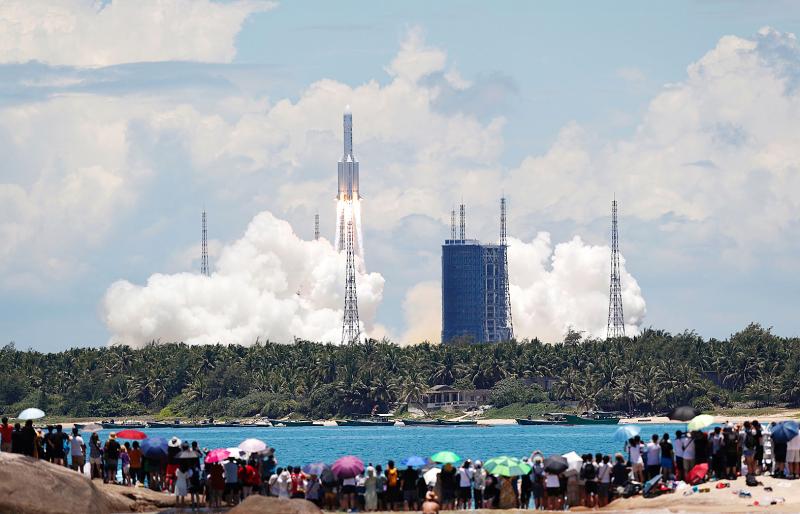
Photo: Reuters
“The Mars rover has accurately entered the scheduled orbit,” Zhang said in brief remarks shown live on state broadcaster China Central Television.
It marked the second flight to Mars this week, after a United Arab Emirates orbiter blasted off on a rocket from Japan on Monday.
The US is aiming to launch Perseverance, its most sophisticated Mars rover ever, from Cape Canaveral, Florida, next week.
China’s tandem spacecraft, which has an orbiter and a rover, is expected to take seven months to reach Mars, like the others.
If all goes well, the Tianwen-1 mission, or “quest for heavenly truth,” is to look for underground water, if it is present, as well as evidence of possible ancient life.
This is not China’s first attempt at Mars. In 2011, a Chinese orbiter accompanying a Russian mission was lost when the spacecraft failed to get out of Earth’s orbit after launching from Kazakhstan, eventually burning up in the atmosphere.
This time, China is going at it alone. It also is fast-tracking, launching an orbiter and rover on the same mission instead of stringing them out.
China’s secretive space program has developed rapidly in recent decades.
Yang Liwei (楊利偉) became the first Chinese astronaut in 2003, and last year, Chang’e-4 became the first spacecraft from any country to land on the far side of the moon.
Conquering Mars would put China in an elite club.
“There is a whole lot of prestige riding on this,” said Dean Cheng, an expert on Chinese aerospace programs at the Heritage Foundation in Washington.
Landing on Mars is notoriously difficult. Only the US has successfully landed a spacecraft on Martian soil, doing it eight times since 1976.
NASA’s InSight and Curiosity rovers still operate today.
Six other spacecraft are exploring Mars from orbit: three American, two European and one from India.
Unlike the two other Mars missions launching this month, China has tightly controlled information about the program — even withholding any name for its rover. National security concerns led the US to curb cooperation between NASA and China’s space program.
In an article published this month in Nature Astronomy, mission chief engineer Wan Weixing (萬衛星) said that Tianwen-1 would slip into orbit around Mars in February next year and look for a landing site on Utopia Planitia — a plain where NASA has detected possible evidence of underground ice.
Wan died in May from cancer.
The landing would then be attempted in April or May, according to the article.
If all goes well, the 240kg golf cart-sized, solar-powered rover is expected to operate for about three months, and the orbiter for two years.

PRECARIOUS RELATIONS: Commentators in Saudi Arabia accuse the UAE of growing too bold, backing forces at odds with Saudi interests in various conflicts A Saudi Arabian media campaign targeting the United Arab Emirates (UAE) has deepened the Gulf’s worst row in years, stoking fears of a damaging fall-out in the financial heart of the Middle East. Fiery accusations of rights abuses and betrayal have circulated for weeks in state-run and social media after a brief conflict in Yemen, where Saudi airstrikes quelled an offensive by UAE-backed separatists. The United Arab Emirates is “investing in chaos and supporting secessionists” from Libya to Yemen and the Horn of Africa, Saudi Arabia’s al-Ekhbariya TV charged in a report this week. Such invective has been unheard of

US President Donald Trump on Saturday warned Canada that if it concludes a trade deal with China, he would impose a 100 percent tariff on all goods coming over the border. Relations between the US and its northern neighbor have been rocky since Trump returned to the White House a year ago, with spats over trade and Canadian Prime Minister Mark Carney decrying a “rupture” in the US-led global order. During a visit to Beijing earlier this month, Carney hailed a “new strategic partnership” with China that resulted in a “preliminary, but landmark trade agreement” to reduce tariffs — but

Chinese President Xi Jinping’s (習近平) purge of his most senior general is driven by his effort to both secure “total control” of his military and root out corruption, US Ambassador to China David Perdue said told Bloomberg Television yesterday. The probe into Zhang Youxia (張又俠), Xi’s second-in-command, announced over the weekend, is a “major development,” Perdue said, citing the family connections the vice chair of China’s apex military commission has with Xi. Chinese authorities said Zhang was being investigated for suspected serious discipline and law violations, without disclosing further details. “I take him at his word that there’s a corruption effort under

China executed 11 people linked to Myanmar criminal gangs, including “key members” of telecom scam operations, state media reported yesterday, as Beijing toughens its response to the sprawling, transnational industry. Fraud compounds where scammers lure Internet users into fake romantic relationships and cryptocurrency investments have flourished across Southeast Asia, including in Myanmar. Initially largely targeting Chinese speakers, the criminal groups behind the compounds have expanded operations into multiple languages to steal from victims around the world. Those conducting the scams are sometimes willing con artists, and other times trafficked foreign nationals forced to work. In the past few years, Beijing has stepped up cooperation


 RSS
RSS