


Organizers of a national workers’ strike have said tens of thousands were set to walk off the job yesterday in more than two dozen US cities to protest systemic racism and economic inequality, which has only worsened during the COVID-19 pandemic.
Dubbed the “Strike for Black Lives,” labor unions, along with social and racial justice organizations from New York City to Los Angeles, were to participate in a range of planned actions.
Where work stoppages were not possible for a full day, participants would either picket during a lunch break or observe moments of silence to honor black lives lost to police violence, organizers said.
“We are ... building a country where Black lives matter in every aspect of society — including in the workplace,” said Ash-Lee Henderson, an organizer with the Movement for Black Lives, a coalition of more than 150 organizations that make up the Black Lives Matter movement.
“The Strike for Black Lives is a moment of reckoning for corporations that have long ignored the concerns of their Black workforce and denied them better working conditions, living wages and healthcare,” said Henderson, who is also co-executive director of the Tennessee-based Highlander Research and Education Center.
Among the strikers were to be essential workers: nursing home employees, janitors and delivery people. Fast food, ride-share and airport workers were also expected to take part in planned events.
The strike continues a global reckoning on race and police brutality set off by the death of George Floyd, a black man who died at the hands of Minneapolis police in late May.
At noon in each US time zone yesterday, workers were expected to take a knee for about eight minutes — the amount of time prosecutors have said a white police officer held his knee on Floyd’s neck.
Strikers are demanding sweeping action by corporations and government to confront systemic racism and economic inequality that limits mobility and career advancement for many black and Hispanic workers, who make up a disproportionate number of those earning less than a living wage.
Specifically, they are calling on corporate leaders and elected government officials to use executive and legislative power to guarantee people of all races can thrive.
That demand includes raising wages and allowing workers to unionize to negotiate better healthcare, sick leave and childcare support.
When the strike was announced on July 8, partnering unions included the Service Employees International Union, the International Brotherhood of Teamsters, the American Federation of Teachers, United Farm Workers and the Fight for $15 and a Union.
Several more worker collectives have since joined, along with social and racial justice groups.
In Manhattan, essential workers were to gather outside of the Trump International Hotel to demand the US Senate and US President Donald Trump pass and sign the HEROES Act.
The legislation, which has been passed by the US House of Representatives, provides protective equipment, essential pay and extended unemployment benefits to workers who have not had the option of working from home during the pandemic.
Organizers said that US Senator Chuck Schumer was expected to rally with workers.
Strikers in Minneapolis, where Floyd was killed on May 25, were to include nursing home and airport workers demanding a US$15-per-hour minimum wage, organizers said.
In Missouri, participants were to rally at McDonald’s locations in St Louis and Ferguson, a key landmark in the protest movement sparked by the death of Michael Brown, a black teenager who was killed by police in 2014.
The Ferguson strikers would also march to a memorial site located on the spot where Brown was shot and killed.

DISPUTED WATERS: The Philippines accused China of building an artificial island on Sabina Shoal, while Beijing said Manila was trying to mislead the global community The Philippine Coast Guard (PCG) is committed to sustaining a presence in a disputed area of the South China Sea to ensure Beijing does not carry out reclamation activities at Sabina Shoal (Xianbin Reef), its spokesperson said yesterday. The PCG on Saturday said it had deployed a ship to Sabina Shoal, where it accused China of building an artificial island, amid an escalating maritime row, adding two other vessels were in rotational deployment in the area. Since the ship’s deployment in the middle of last month, the PCG said it had discovered piles of dead and crushed coral that had been dumped

Experts have long warned about the threat posed by artificial intelligence (AI) going rogue, but a new research paper suggests it is already happening. AI systems, designed to be honest, have developed a troubling skill for deception, from tricking human players in online games of world conquest to hiring humans to solve “prove-you’re-not-a-robot” tests, a team of researchers said in the journal Patterns on Friday. While such examples might appear trivial, the underlying issues they expose could soon carry serious real-world consequences, said first author Peter Park, a postdoctoral fellow at the Massachusetts Institute of Technology specializing in AI existential safety. “These

The most powerful solar storm in more than two decades struck Earth on Friday, triggering spectacular celestial light shows from Tasmania to the UK — and threatening possible disruptions to satellites and power grids as it persists into the weekend. The first of several coronal mass ejections (CMEs) — expulsions of plasma and magnetic fields from the sun — came just after 4pm GMT, according to the US National Oceanic and Atmospheric Administration’s Space Weather Prediction Center. It was later upgraded to an “extreme” geomagnetic storm — the first since the “Halloween Storms” of October 2003 caused blackouts in Sweden and damaged
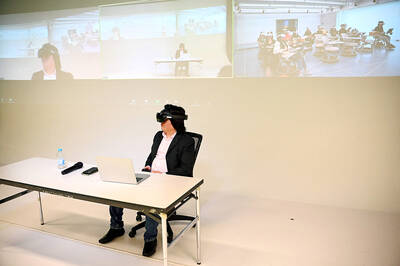
Using virtual-reality (VR) headsets, students at a Hong Kong university travel to a pavilion above the clouds to watch an artificial intelligence (AI)-generated Albert Einstein explain game theory. The students are part of a course at the Hong Kong University of Science and Technology (HKUST) that is testing the use of “AI lecturers” as the AI revolution hits campuses around the world. The mass availability of tools such as ChatGPT has sparked optimism about new leaps in productivity and teaching, but also fears over cheating, plagiarism and the replacement of human instructors. Pan Hui (許彬), a professor of computer science who is leading


 RSS
RSS