


Thousands of Finns have answered a desperate call from farmers to save the summer’s berry harvest, as coronavirus restrictions have kept many of the usual foreign pickers away.
“After 22 years, we have Finnish workers on the strawberry fields again, it’s a very unusual situation,” said Vesa Koivistoinen, owner of Finland’s largest strawberry farm in the southern village of Hollola.
When reporters visited Koivistoinen’s 100 hectare farm two weeks into the strawberry harvest, the large field was dotted with hundreds of people, from teenagers to pensioners, crouching down to pick strawberries then putting them in crates to be weighed and loaded in a truck.
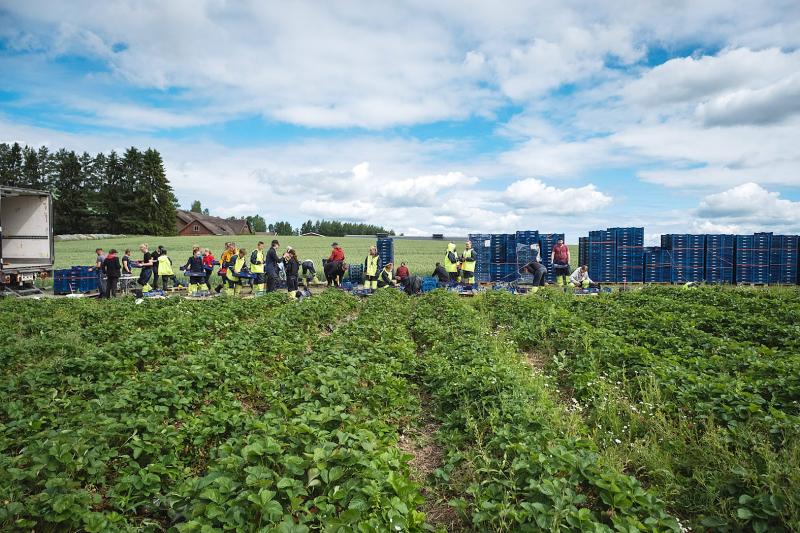
Photo: AFP
To handle the berry harvests, Finland normally needs about 16,000 seasonal workers a year, “who mainly come from abroad,” said Kati Kuula of the agricultural union MTK.
However, when COVID-19 travel restrictions were imposed in the spring, agricultural associations and the government feared a labor shortage and launched a number of recruitment programs.
One of the largest, the government-backed #Seasonwork social media campaign, features a tanned, blonde couple standing proud in a wheat field, and calls for “every available pair of hands” to “secure domestic food on Finnish dinner tables.”
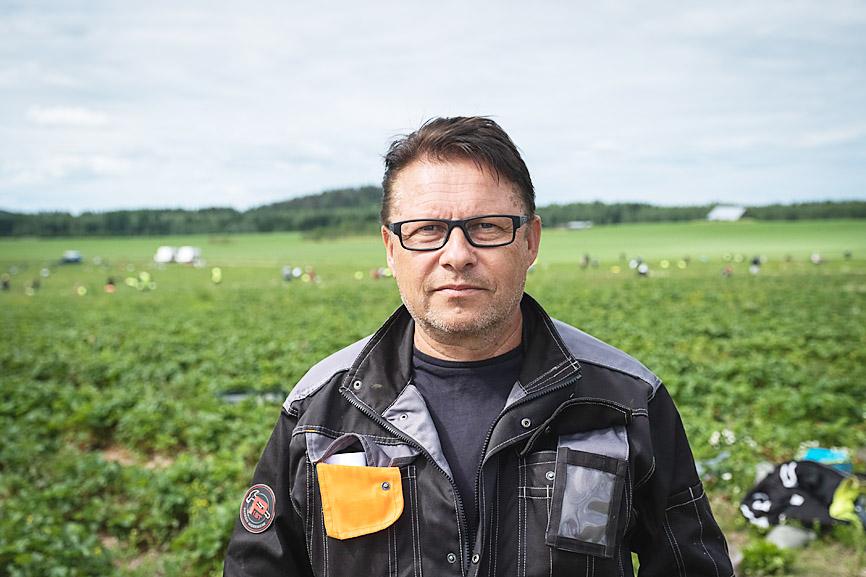
Photo: AFP
So far this year, only a third of the usual workers have arrived from abroad, all from Ukraine, with the rest of the shortfall recruited from within Finland, Kuula said.
Of the 350 Finns employed on Vesa Koivistoinen’s strawberry farm, the majority are students aged 15 to 20, but many others are those made jobless by the coronavirus.
Sari, a 52-year-old masseuse, replied to the job advertisement after her own business dried up during the spring.
“I’m the daughter of a farmer and I was working in strawberry fields when I was young,” she said. “So I knew what to expect.”
Janne Erola, 29, who has worked in a number of seasonal jobs, but never before in fruit-picking, said he intended to stay until the strawberry season ends late next month.
Filling one 7kg crate takes “a bit more than an hour,” Erola said, earning him 1.20 euros (US$1.36) per kilo.
Koivistoinen said that as the Finns are not able to pick as fast as the experienced Ukrainian workers, he has offered them a 10-percent bonus to make it worth their while.
The recruitment efforts and higher salaries have pushed up costs, but Koivistoinen said that he would gladly employ home-grown workers in future, too.
“We wanted to be able to employ Finns because lots of other firms can’t offer summer jobs this year,” Koivistoinen said.
Yet the demanding physical work in the changeable Finnish weather does not appeal to everyone.
“It’s really physical, and it’s quite far from my home,” said 17-year-old Laura, who signed up along with her schoolfriends Senni and Mohammed.
All three are sitting by the side of the field having a break, their fingers red with strawberry juice.
“I actually had a job offer earlier this summer, but then they said they couldn’t take me because of corona,” Mohammed said.
Yet while domestic labor has come to the rescue of Finland’s strawberry harvest, the fate of this year’s crop of bilberries, a cornerstone of Finnish food culture, looks far more precarious.
Every year, Finnish industries from food to cosmetics require 20 million kilos of bilberries — a small, European variety of the blueberry, which is not cultivated in fields but grows abundantly in Finland’s vast forests.
The berries are usually picked by Thai workers brought over for the harvest season in late summer, but the pandemic restrictions mean none will be admitted this year.
Instead, Finland’s social media is awash with posts imploring “every working-age Finn to collect a bucket’s worth of bilberries” to stop the berries going to waste.
Some of the companies which rely on berries have not been assuaged by the potential reach of social media, and have said they would import their bilberries from Poland or Russia this year, warning this could lead to higher prices on the shelves.
ROCKY RELATIONS: The figures on residents come as Chinese tourist numbers drop following Beijing’s warnings to avoid traveling to Japan The number of Chinese residents in Japan has continued to rise, even as ties between the two countries have become increasingly fractious, data released on Friday showed. As of the end of December last year, the number of Chinese residents had increased by 6.5 percent from the previous year to 930,428. Chinese people accounted for 22.6 percent of all foreign residents in Japan, making them by far the largest group, Japanese Ministry of Justice data showed. Beijing has criticized Tokyo in increasingly strident terms since Japanese Prime Minister Sanae Takaichi last year suggested that a military conflict around Taiwan could

A pro-Iran hacking group claimed to breach FBI Director Kash Patel’s personal e-mail inbox and posted some of the contents online. The e-mails provided by the hacking group include travel details, correspondence with leasing agents in Washington and global entry, and loyalty account numbers. The e-mail address the hackers claim to have compromised has been previously tied to Patel’s personal details, and the leaked e-mails contain photos of Patel and others, in addition to correspondence with family members and colleagues. “The FBI is aware of malicious actors targeting Director Patel’s personal email information,” the agency said in a statement on

RIVALRY: ‘We know that these are merely symbolic investigations initiated by China, which is in fact the world’s most profligate disrupter of supply chains,’ a US official said China has started a pair of investigations into US trade practices, retaliating against similar probes by US President Donald Trump’s administration as the superpowers stake out positions before an expected presidential summit in May. The move, announced by the Chinese Ministry of Commerce on Friday, is a direct mirror of steps Trump took to revive his tariff agenda after the US Supreme Court last month struck down some of his duties. “China expresses its strong dissatisfaction and firm opposition to these actions,” a ministry spokesperson said in a statement, referring to the so-called Section 301 investigations initiated on March 11.

When a hiker fell from a 55m waterfall in wild New Zealand bush, rescuers were forced to evacuate the badly hurt woman without her dog, which could not be found. After strangers raised thousands of dollars for a search, border collie Molly was flown to safety by a helicopter pilot who was determined to reunite the pet and the owner. A week earlier, an emergency rescue helicopter found the woman with bruises and lacerations after a fall at a rocky spot at the waterfall on the South Island’s West Coast. She was airlifted on March 24, but they were forced to


 RSS
RSS