


If Hollywood is where dreams are made, Bangkok’s Scala theater for the past 51 years was where Thais immersed themselves in the old-fashioned blockbusters of war, the heart-felt romances and quirky comedies.
Now only the memories will remain. The picture palace in Siam Square, the city’s last standalone big-screen movie theater, on Sunday screened its final offering.
It was a piquant choice, 1988’s Cinema Paradiso, an Oscar-winning Italian film about a bygone movie house in a Sicilian village.
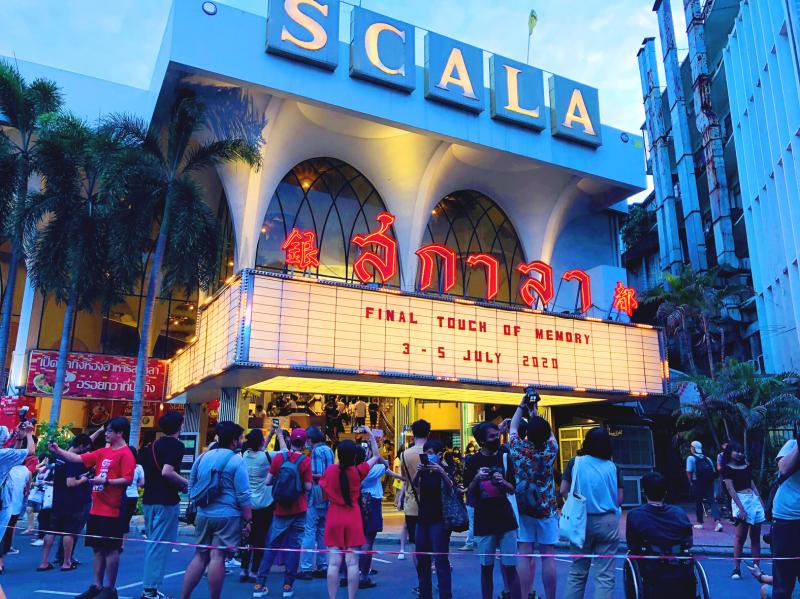
Photo: AP
The Scala’s marquee on opening day in 1969 boasted John Wayne in The Undefeated.
Scala owner Nanta Tansacha wistfully recalled being enthralled even when the venue was still just a set of blueprints that her father showed her.
“I do think it’s a beautiful place, the most beautiful one I ever think that we can ever build. And I think no one will build cinemas like this in the future,” she said in an interview.
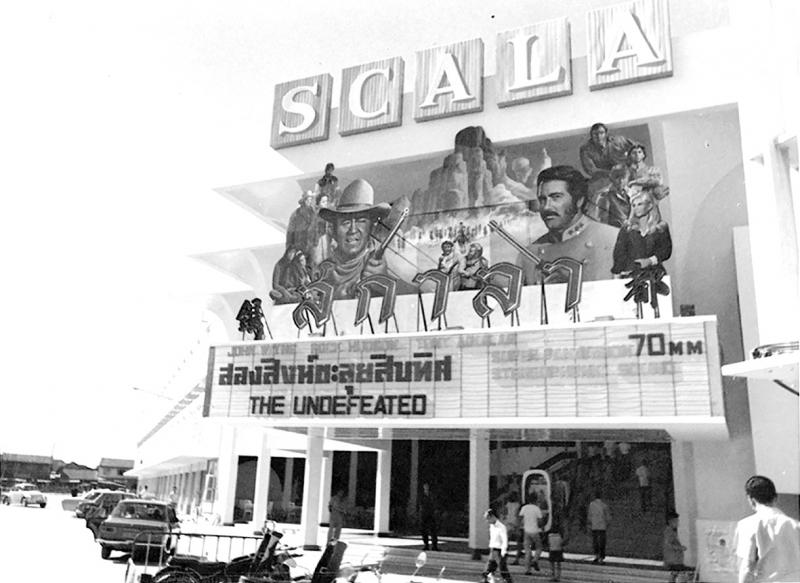
Photo: AP / Scala Theater
Two other theaters once stood nearby, but one burned down during political turmoil in 2010, and the other shut its doors two years ago after being remodeled as a multiplex in its sunset years.
Nanta said COVID-19 was the tipping point for the Scala, whose lease was up at the end of the year anyway. More than two months of a government-ordered shutdown of entertainment places choked off its already modest cash flow.
The economics of the 900-seat, single-screen movie theater limited to five or six showings a day were virtually unsustainable when malls just across the road had smaller theaters, multiple screens and dozens of showings daily.
However, to its fans, the Scala experience was not only about what was projected on the screen.
“I’ve never seen another movie theater like it anywhere in the world,” said Philip Jablon, a US researcher who has documented Southeast Asia’s stand-alone movie theaters in a blog and a book. “Some people call it art deco. I’ve heard it referred to as overwrought rococo. It’s a very unique mix of modernism, modern architecture, combined with very flashy, glitzy, almost vintage style of architecture.”
Its huge, curved screen made it a great place to watch a movie, Jablon said in an online interview.
“It’s got perfect sight lines almost anywhere you sit. It’s just a very unique building, well-designed,” he said.
Moviegoers could meet their friends inside the open-air ground floor, sweep up the curved staircases, and hand over their tickets to neatly uniformed ushers before settling into their seats.
Pattarapon Jitbanchong keeps a collection of old Scala tickets framed on her wall at home.
“Each ticket has a story of its own,” the 42-year-old former makeup artist turned fortuneteller said on Sunday. “What I was doing on the day, who I went with, what I was wearing, who was my boyfriend and who were my friends. When I look at the tickets, the memories flood back.”
Thai Film Archive deputy director Kong Rithdee described the Scala as both an emotional and a historical landmark.
“A lot of people who grew up in Bangkok came to see movies here, so this is a place where there is a lot of collective memory of the people who grew up in Bangkok,” Kong said. “And as a symbol, it’s a place of elegance, it’s a place where cinema is celebrated, whereas in the modern era of multiplexes, cinemas are utilitarian.”
For Scala owner Nanta, the closing is very personal.
“I feel very sad, this is my life. This is my home. This is my house. And this is all my people,” she said, surveying a crowd of movie fans who came to a sort of open house she arranged on Friday.
When they opened the theater, they threw on the lights, and proudly showed it off, she said.
“And when it’s time to close the curtain, I want to close it in style. So that’s why I turn on all the lights. I ask people to come and take photos to get good memories,” Nanta said.
The Scala’s landlord, Chulalongkorn University, has not yet said whether it will tear down this moviegoers’ shrine.
“The idea that that this would be slated for demolition is kind of mind-boggling,” Jablon said. “You know, this type of building just doesn’t exist anymore. So it’s important to hang on to at least one example.”

‘CROSSING THE LINE’: China’s embassy in Seoul criticized US Forces Korea Commander General Xavier Brunson, asking if his ‘hostile’ remarks were authorized by Washington South Korea and the US are in talks over recent public remarks by the commander of US Forces Korea, Seoul’s presidential office said yesterday, after the comments drew sharp criticism from China. In a recent podcast interview, US Forces Korea Commander General Xavier Brunson described South Korea as “the dagger in the heart of Asia” from China’s east coast, prompting the Chinese embassy in Seoul to say that he had “truly crossed the line.” The interview came amid growing speculation that Washington might seek to expand the role of US Forces Korea in countering the growing regional influence of China, a key

Through the noise of rushing papers and whirring belts at a print factory in Kyoto, two creators watch their photo essay come to life in broadsheet form — part of an effort to win new audiences in the age of artificial intelligence (AI). Despite the decline of the publishing industry, self-publication and handmade “zine” magazines are growing in popularity in Japan, reflecting the nation’s enduring love of paper in the digital era. While speaking to Agence France-Presse at the plant, his hands black with ink, one of the creators, Kazuma Obara, said: “I think [paper] is a medium that engages all five

Australian researchers have trained lab-grown brain cells on a silicon computer chip to play the 1990s shooter game Doom and said they are just scratching the surface of what the neurons could be capable of doing. It is the science-fiction work of biotech boffins at Cortical Labs, who researched and developed the technology that harnesses the workings of the brain’s networking system. Each so-called “biological computer” contains about 200,000 living human brain cells, grown from stem cells that were harvested from blood donations. Having mastered the simple computer game Pong, where a paddle is moved up and down to send a ball

France experienced its hottest spring on record, the French weather service said on Tuesday, after an exceptional early heat wave that also broke highs for the season in England and Wales. Meteo-France said the average nationwide temperature over March to May was 13.8°C — about 1.7°C above the norm, and surpassing records set in 2011 and 2020. “The warmest spring since records began in 1900,” it said in a bulletin. All three months were warmer than average, but the onset of an “unprecedented heatwave” late last month pushed the mercury to highs typically seen at the height of the summer. “Our country had never


 RSS
RSS