


The EU’s foreign policy chief yesterday condemned the expulsion of the EU’s ambassador to Venezuela ordered by Venezuelan President Nicolas Maduro and said that the bloc would reciprocate.
“We condemn and reject the expulsion of our ambassador in Caracas. We will take the usual necessary reciprocal measures,” EU High Representative for Foreign Affairs and Security Policy Josep Borrell wrote on Twitter.
Maduro on Monday gave Isabel Brilhante Pedrosa, the head of the EU mission in Caracas, 72 hours to leave the country after the bloc announced sanctions against 11 Venezuelan officials.
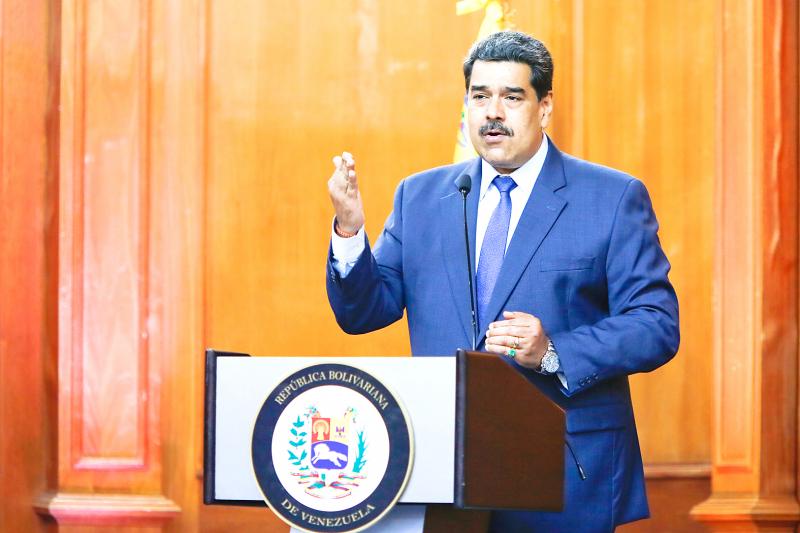
Photo: EPA-EFE
“Who are they to try to impose themselves with threats?” Maduro said. “We will sort it out in 72 hours ... she will be given a plane to leave, but we will arrange our things with the European Union.”
Venezuela’s airspace is closed to commercial airplanes due to the COVID-19 pandemic.
Maduro also accused the EU of getting down on its “knees” to US President Donald Trump, who has taken a hard line against the leftist leader, and copying “erratic policies” against the Latin American nation.
Relations have been tense since 2017, when Venezuela became the first Latin American country to receive sanctions from the EU, including an arms embargo.
Among the officials sanctioned on Monday was Maduro-backed opposition lawmaker Luis Parra, who is contesting the leadership of the opposition-controlled Venezuelan National Assembly with its president, Juan Guaido.
Guaido used his position as head of parliament to challenge Maduro’s authority in January last year by declaring himself acting president after the National Assembly deemed the socialist leader a usurper over his controversial re-election in 2018 in a poll widely branded fraudulent.
Guaido is recognized as his country’s interim president by more than 50 nations, including the US and much of the EU.
However, Parra declared himself National Assembly president in January, while security forces loyal to Maduro prevented Guaido from entering the building for a re-election vote he was widely expected to win.
“Only a negotiated solution between Venezuelans will allow the country to emerge from its deep crisis,” Borrell added in his tweet.

‘IN A DIFFERENT PLACE’: The envoy first visited Shanghai, where he attended a Chinese basketball playoff match, and is to meet top officials in Beijing tomorrow US Secretary of State Antony Blinken yesterday arrived in China on his second visit in a year as the US ramps up pressure on its rival over its support for Russia while also seeking to manage tensions with Beijing. The US diplomat tomorrow is to meet China’s top brass in Beijing, where he is also expected to plead for restraint as Taiwan inaugurates president-elect William Lai (賴清德), and to raise US concerns on Chinese trade practices. However, Blinken is also seeking to stabilize ties, with tensions between the world’s two largest economies easing since his previous visit in June last year. At the

UNSETTLING IMAGES: The scene took place in front of TV crews covering the Trump trial, with a CNN anchor calling it an ‘emotional and unbelievably disturbing moment’ A man who doused himself in an accelerant and set himself on fire outside the courthouse where former US president Donald Trump is on trial has died, police said yesterday. The New York City Police Department (NYPD) said the man was declared dead by staff at an area hospital. The man was in Collect Pond Park at about 1:30pm on Friday when he took out pamphlets espousing conspiracy theories, tossed them around, then doused himself in an accelerant and set himself on fire, officials and witnesses said. A large number of police officers were nearby when it happened. Some officers and bystanders rushed

Beijing is continuing to commit genocide and crimes against humanity against Uyghurs and other Muslim minorities in its western Xinjiang province, U.S. Secretary of State Antony Blinken said in a report published on Monday, ahead of his planned visit to China this week. The State Department’s annual human rights report, which documents abuses recorded all over the world during the previous calendar year, repeated language from previous years on the treatment of Muslims in Xinjiang, but the publication raises the issue ahead of delicate talks, including on the war in Ukraine and global trade, between the top U.S. diplomat and Chinese
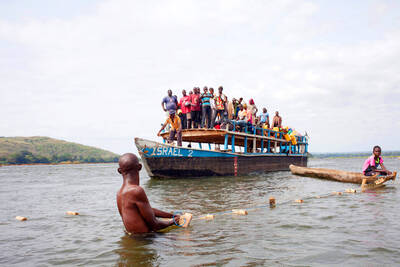
RIVER TRAGEDY: Local fishers and residents helped rescue people after the vessel capsized, while motorbike taxis evacuated some of the injured At least 58 people going to a funeral died after their overloaded river boat capsized in the Central African Republic’s (CAR) capital, Bangui, the head of civil protection said on Saturday. “We were able to extract 58 lifeless bodies,” Thomas Djimasse told Radio Guira. “We don’t know the total number of people who are underwater. According to witnesses and videos on social media, the wooden boat was carrying more than 300 people — some standing and others perched on wooden structures — when it sank on the Mpoko River on Friday. The vessel was heading to the funeral of a village chief in


 RSS
RSS