


Jean Boehme still remembers the number of the Nazi concentration camp block where he lived as a child: 31C.
He went to school in block 33 and recalls that a nearby watchtower was transformed into a makeshift bistro.
Boehme, now 73, grew up on the site of Dachau, the concentration camp just outside Munich, which was liberated 75 years ago today.
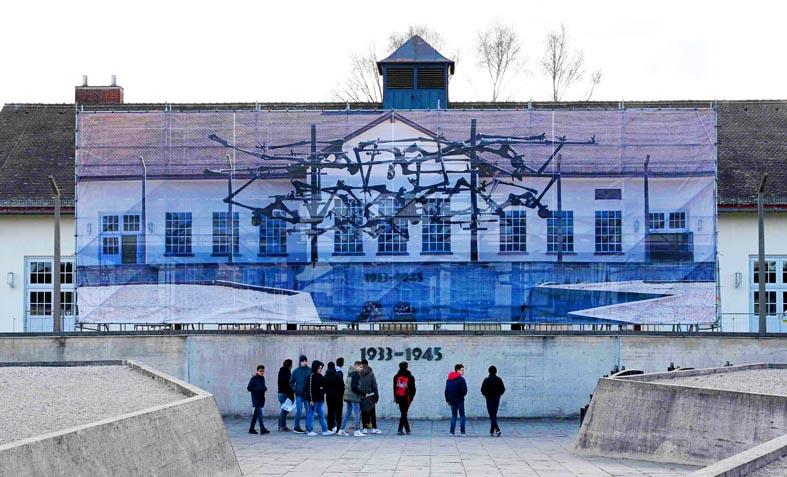
Photo: AFP
Although it remains a less well-known story of the Holocaust, Dachau was one of several Nazi camps that were repurposed after the war.
Faced with a housing shortage elsewhere, the Allied forces and later the new West German government transformed them into barracks and temporary accommodation.
The son of a French woman and a German soldier who had been stationed in France, Boehme was about five years old when he moved into his new home in Dachau, he said.
His father, who had returned home after Germany’s defeat in World War II, persuaded Jean’s mother to join him in the town of Dachau with their two sons.
“What a shock it was for my mother when she arrived and realized we were going to live in a former concentration camp,” Boehme sighed.
Housing was scarce in post-war Germany, where many towns had been partially destroyed.
The former camp at Dachau, which was built in 1933 and served as a model for all the other concentration camps in Europe, was put to use by the local Bavarian government.
It provided temporary housing for refugees, primarily for Germans who had been forced out of territories in Eastern Europe following the defeat of the Third Reich, but also for special cases, such as Jean Boehme’s family.
According to the Dachau memorial center, about 2,300 people lived in the former camp between 1948 and 1965.
“In the beginning, we shared one room, but later we got two rooms,” Boehme said.
The family rarely left the site, which was almost self-sufficient.
“There was a school, a bakery, a grocery, a bar, a doctor, a tannery to provide people with work, a Catholic and a Protestant church. There was even a brothel,” Boehme said.
He and his brother hated school, but spent long hours playing with other refugee children between the camp buildings.
“We just didn’t realize,” he said.
One carefully kept photograph shows Boehme as a child next to one of the lodgings, a shy smile on his face and a dog at his side.
Behind him, laundry airs on a wire strung between two buildings. In another picture, he is sat next to a decorated pine tree — his “first Christmas in Germany.”
Only his mother grasped the gravity of the situation, Boehme said.
“She repeatedly told my father that we had no right to live here, in a former concentration camp,” he said.
Yet the family spent about three years on the site of the camp.
“We were very happy to leave,” said Boehme, who nonetheless went on to live for many years in the town of Dachau.
“When I had visitors, I would take them to see the camp. It was inescapable. I wanted them to see what happened, what this country was capable of,” he added.
Boehme still thinks about his childhood, especially when he reads articles about modern refugees who have recently arrived in Germany.
“When you have to live in crowded conditions where there is not much space, there are always going to be conflicts,” he said.
“That was the case in Dachau, and it is still the case in today’s refugee centers,” he said.
“There is not much left” of his childhood home in Dachau today, Boehme said, though the memories and the trauma remain.
“My mother never recovered from it. She was never happy here. It haunted her until she died,” he said.

An American scientist convicted of lying to US authorities about payments from China while he was at Harvard University has rebuilt his research lab in Shenzhen, China, to pursue technology the Chinese government has identified as a national priority: embedding electronics into the human brain. Charles Lieber, 67, is among the world’s leading researchers in brain-computer interfaces. The technology has shown promise in treating conditions such as amyotrophic lateral sclerosis and restoring movement in paralyzed people. It also has potential military applications: Scientists at the Chinese People’s Liberation Army have investigated brain interfaces as a way to engineer super soldiers by boosting
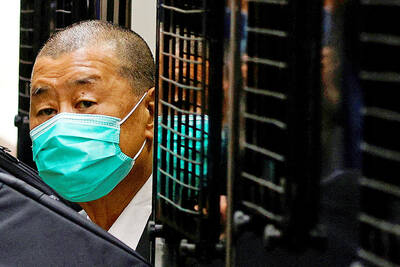
Jailed media entrepreneur Jimmy Lai (黎智英) has been awarded Deutsche Welle’s (DW) freedom of speech award for his contribution to Hong Kong’s pro-democracy movement. The German public broadcaster on Thursday said Lai would be presented in absentia with the 12th iteration of the award on June 23 at the DW Global Media Forum in Bonn. Deutsche Welle director-general Barbara Massing praised the 78-year-old founder of the now-shuttered news outlet Apple Daily for standing “unwaveringly for press freedom in Hong Kong at great personal risk.” “With Apple Daily, he gave journalists a platform for free reporting and a voice to the democracy movement in

PHILIPPINE COMMITTEE: The head of the committee that made the decision said: ‘If there is nothing to hide, there is no reason to hide, there is no reason to obstruct’ A Philippine congressional committee on Wednesday ruled that there was “probable cause” to impeach Philippine Vice President Sara Duterte after hearing allegations of unexplained wealth, misuse of state funds and threats to have the president assassinated. The unanimous decision of the 53-member committee in the Philippine House of Representatives sends the two impeachment complaints to deliberations and voting by the entire lower chamber, which has more than 300 lawmakers. The complaints centered on Duterte’s alleged illegal use and mishandling of intelligence funds from the vice president’s office, and from her time as education secretary under Philippine President Ferdinand Marcos Jr. Duterte and the
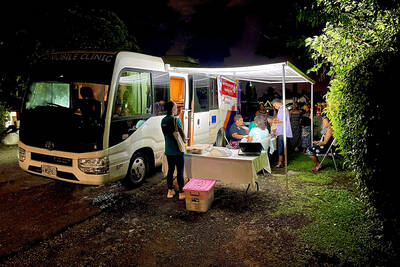
As evening falls in Fiji’s capital, a steady stream of people approaches a makeshift clinic that is a first line of defense against one of the world’s fastest-growing HIV epidemics. In the South Pacific nation — a popular tourist destination of just under a million people — more than 2,000 new HIV cases were recorded last year, a 26 percent increase from 2024. The government has declared an HIV outbreak and described it as a national crisis. “It’s spreading like wildfire,” said Siteri Dinawai, 46, who came to be tested. The Moonlight Clinic, a converted minibus parked in a suburban cul-de-sac in Suva, is


 RSS
RSS