


Whispered insults, social isolation and lost opportunities — Morn Chear is channeling the stigma he has endured since he lost both of his hands a decade ago into artwork that highlights the hardships of Cambodia’s disabled.
At 20, he was electrocuted in a construction accident and both his hands developed gangrene, pushing doctors to amputate them below the elbow.
“I was depressed. I did not know what I could do to earn money to feed my family,” he said, describing the shock he felt when he woke up from surgery.
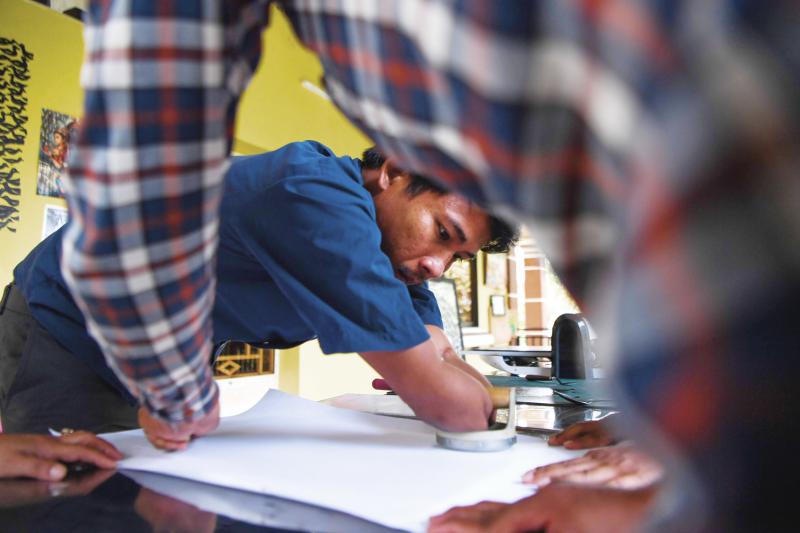
Photo: AFP
Ten years later, Chear has found his place at an arts collective based in Siem Reap, where he specializes in linocut block printing — a technique rarely used in Cambodia.
Open Studio Cambodia represent several contemporary artists, selling their pieces out of an airy studio in the heart of a city famed for the Buddhist Angkor Wat temple complex.
Linocut block printing requires chiseling a scene into a block of linoleum and applying ink on the print — a challenge for Chear.
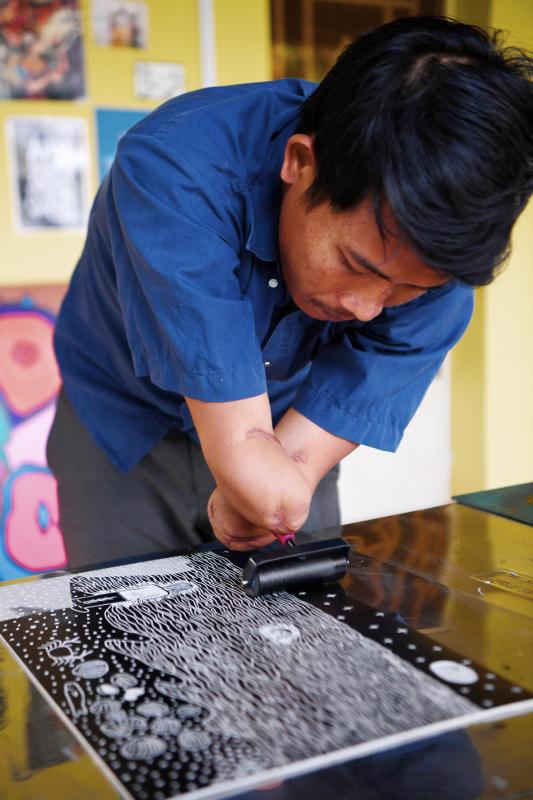
Photo: AFP
“Most of my works are all about my real stories,” he said, gesturing at a piece that features himself sitting in a hammock as others walk toward a pagoda.
Chear remembers clear as day how his friends snubbed him.
“Don’t call him to come with us. He is handicapped — it’s embarrassing,” he said, recalling their whispers.
Cambodia has undergone significant changes in the past two decades, with cities such as Siem Reap and its capital, Phnom Penh, developing at a breakneck pace to satisfy a growing tourist and export-reliant economy.
However, health and education remain sticking points and for people with disabilities, access is even more of a challenge.
A survey released last year by the Cambodian Disabled People’s Organisation found that 60 percent of the country’s disabled live below the poverty line.
Government officials said that 310,000 of the country’s 16 million people have disabilities, although the number is likely higher as many fall through the cracks.
Discrimination is rife, with Cambodians seeing the disabled as street beggars or a burden to their families.
For Chear, the social isolation from once-friendly peers was the most cutting.
After his return home, he was nicknamed A-Kambot by villagers — a derogatory Khmer word for those with physical disabilities, which “pierced” him deeply and made him question whether life was worth living.
Relief came for Chear in 2015 when he was recruited into a non-profit group’s training program. It taught him contemporary dance, drawing, computer skills and even some English.
Working with Open Studio Cambodia in 2018 seemed a natural move, as it fueled his drive to use art to persuade the public to see those with disabilities as capable people.
“Some people who looked down on me in the past have become friendly again,” Chear said, adding that his work has been displayed in the US and France.
However, as billions worldwide have been forced to remain at home due to the COVID-19 pandemic, he is reminded of the social isolation he endured right after he lost his arms.
“I hope we will overcome it,” he said from his home in Kampot Province, as the workshop has been temporarily closed. “If I can’t make art, I don’t know what I can do.”

SPEAKING OUT: After Siranudh Scott’s allegations surfaced, celebrities and public figures took to social media to share their own experiences of sexual misconduct and abuse A high-profile alleged sexual abuse case within a wealthy Thai beer brewing family has prompted a wave of painful accounts from survivors of unconnected abuse in the conservative nation. Siranudh Scott, a member of the billionaire Thai family that founded the ubiquitous Singha beer brand, posted an emotional video this month accusing his elder brother Sunit of repeatedly abusing him when he was a teenager. Sunit, who is in his 30s, later denied the allegations in a video posted online, but Singha parent Boonrawd dismissed him from his executive role with the company on Tuesday last week. “I felt I needed to speak

A Hong Kong astronaut is to join a Chinese space mission for the first time as part of a three-person crew launching today, as Beijing edges closer to its goal of landing people on the moon. The Tiangong space station — crewed by teams of three astronauts that are typically rotated every six months — is the crown jewel of China’s space program, boosted by billions in state investment in a bid to catch up with the US and Russia. The Shenzhou-23 mission is to blast off at 11:08pm from the Jiuquan Satellite Launch Center in northwestern China, carrying three astronauts to

SEEKING ORDER: Rodrigo Paz said that ‘anyone who wants to destroy the nation will have to deal with this president and the full force of the constitution’ Bolivian President Rodrigo Paz on Wednesday said that the nation was at a “breaking point” after nearly a month of protests that have caused shortages of food, fuel and medicine. Paz, who took office six months ago amid the worst economic crisis there in four decades, is battling a groundswell of fury over his policies. The political capital, La Paz, has been besieged by low-income workers and members of the indigenous majority calling for his resignation. “The country needs order and is reaching breaking point,” the 58-year-old said at a public event in La Paz, renewing his appeal for dialogue. On Tuesday, the Bolivian
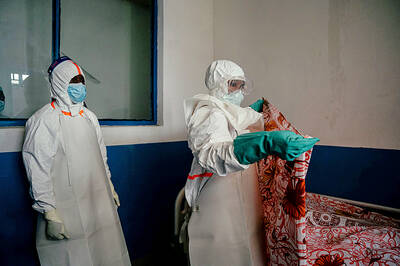
UPGRADED ALERT: The risk inside DR Congo is now considered ‘very high,’ while neighboring countries face a ‘high’ threat as the outbreak continues, the WHO said Ebola is spreading faster than responders can track it in eastern Congo, where health workers managed to follow up with barely one in five identified contacts in a single day. Authorities in the Democratic Republic of the Congo (DR Congo) reported 83 confirmed infections, 746 suspected cases and 1,603 identified contacts as of Thursday, but health workers were able to follow up on only 342 contacts that day — about 21 percent of the total under monitoring — data released by the DR Congo Ministry of Public Health on Friday showed. The figures suggest the response is falling behind the outbreak itself,


 RSS
RSS