


Social media anger from Chinese nationalists over a Thai Internet model’s comments has set off a regional storm uniting pro-democracy campaigners against pro-Beijing cyberwarriors, with insults and mocking memes flying back and forth.
The quarrel, which has seen Southeast Asian Internet users join forces with those in Taiwan and Hong Kong, has highlighted old tensions between China and its smaller neighbors fanned by the emergence of the novel coronavirus.
Political analysts and activists said the online row, which started at the weekend, was unique in volume and regional spread at a time when ever more of life has been forced online.
“This is the first transnational geopolitical Twitter war Thais have engaged in,” Prajak Kongkirati of Bangkok’s Thammasat University said.
“We see people questioning China’s actions and influence... The celebrity issue is the tip of the iceberg,” Kongkirati said.
The dispute began after Internet model Weeraya Sukaram, known as Nnevvy online, was accused of sharing a Thai Twitter message questioning whether COVID-19 originated in a Chinese laboratory.
Furious Chinese netizens then said she had once appeared to suggest, in a post on Instagram, that Taiwan was not part of China.
Weeraya did not respond to requests for comment and neither of the messages was visible on her accounts.
Further fuelling the fire, Chinese accounts then accused Weeraya’s boyfriend, Vachirawat Cheevaari, of having once liked a post that identified Hong Kong as a country.
Despite his apology, they called for a boycott of his hit TV show.
Comments on Twitter were mostly posted in Chinese, Thai and English, though some were in Malay and Filipino.
In the face of the pro-China barrage, support rallied for the Thai celebrities from anti-Beijing activists and politicians — including Hong Kong pro-democracy campaigner Joshua Wong (黃之鋒) and a Taiwan mayor.
Wong posted a photo watching Vachirawat’s show and urged Hong Kong to “stand with our freedom-loving Thai friends.”
“Perhaps we can build a new kind of pan-Asian solidarity that opposes all forms of authoritarianism!” he wrote.
Thai pro-democracy student activist Netiwit Chotiphatphaisal said he and Wong had been in touch and that Thais were uneasy over growing Chinese influence since a 2014 coup in Thailand, whose leader, Prayuth Chan-ocha, won a disputed election last year.
“The hashtag provided an opportunity to speak up,” Netiwit said.
Meanwhile, some users in the Philippines took on the hashtag to attack Chinese action in the disputed South China Sea.
The Chinese Ministry of Foreign Affairs did not respond to a request for comment on the implications of the social media quarrel.
Twitter is blocked in China and only accessible for those using virtual private networks or with official approval.
Social media consultancy Drone Emprit found that automated bot accounts were using the #Nnevvy hashtag, but it did not say where they came from.
Reuters found that several pro-China accounts had been created in the past few days and only contained comments on the dispute.
“While #Nnevvy started off as an intense overnight Twitter war between Thailand and China, it’s now turned into meaningful diplomatic engagement with Hong Kong and Taiwan,” Tracy Beattie of the Australian Strategic Policy Institute said.
Insults from Chinese nationalists against Thailand’s government and king were laughed off by Thai campaigners who themselves attack the administration as undemocratic. The king has faced unprecedented online criticism recently, despite a penalty of up to 15 years in jail for anyone insulting him.
The Thai government is aware of the social media battle between Thai and Chinese accounts and has urged Thai Internet users to express themselves within reason, deputy government spokeswoman Ratchada Thanadirek said.
Thai posters, using one well-known Internet meme, labeled a menacing character as Chinese people trying to hurt Thai people’s feelings by insulting their country. A nonchalant character was described as Thai people who have been insulting their country for years.
Thai users mocked China for authoritarian rule and likened Chinese President Xi Jinping (習近平) to Winnie the Pooh — a comparison that is banned in China.
“Thailand is poor, but China is Pooh,” one viral tweet read.
On a lighter note, another meme celebrated Thailand, Hong Kong and Taiwan as a “Milk Tea Alliance,” because of a shared fondness for the iced drink.

When a hiker fell from a 55m waterfall in wild New Zealand bush, rescuers were forced to evacuate the badly hurt woman without her dog, which could not be found. After strangers raised thousands of dollars for a search, border collie Molly was flown to safety by a helicopter pilot who was determined to reunite the pet and the owner. A week earlier, an emergency rescue helicopter found the woman with bruises and lacerations after a fall at a rocky spot at the waterfall on the South Island’s West Coast. She was airlifted on March 24, but they were forced to

CONFIDENCE BOOSTER: ’After parkour ... you dare to do a lot of things that you think only young people can do,’ a 67-year-old parkour enthusiast said In a corner of suburban Singapore, Betty Boon vaults a guardrail, crawls underneath a slide, executes forward shoulder rolls and scales a steep slope, finishing the course to applause. “Good job,” the 69-year-old’s coach cheers. This is “geriatric parkour,” where about 20 retirees learned to tackle a series of relatively demanding exercises, building their agility and enjoying a sense of camaraderie. Boon, an upbeat grandmother, said learning parkour has aided her confidence and independence as she ages. “When you’re weak, you will be dependent on someone,” she said after sweating it out with her parkour classmates in suburban Toa Payoh,
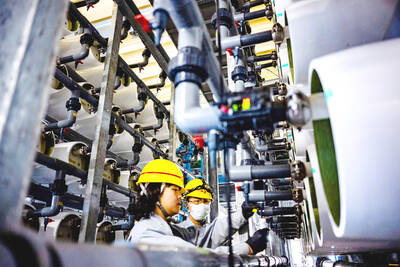
HIGH HOPES: The power source is expected to have a future, as it is not dependent on the weather or light, and could be useful for places with large desalination facilities A Japanese water plant is harnessing the natural process of osmosis to generate renewable energy that could one day become a common power source. The possibility of generating power from osmosis — when water molecules pass from a less salty solution to a more salty one — has long been known. However, actually generating energy from that has proved more complicated, in part due the difficulty of designing the membrane through which the molecules pass. Engineers in Fukuoka, Japan, and their private partners think they might have cracked it, and have opened what is only the world’s second osmotic power plant. It generates
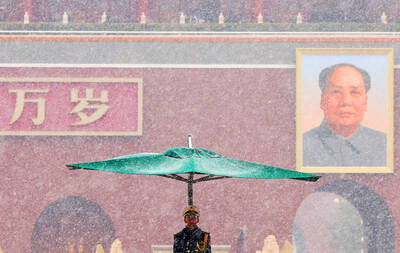
Chinese dissident artist Gao Zhen (高兟), famous for making provocative satirical sculptures of former Chinese leader Mao Zedong (毛澤東), was tried on Monday over accusations of “defaming national heroes and martyrs,” his wife and a rights group said. Gao, 69, who was detained in 2024 during a visit from the US, faces a maximum three-year prison sentence, said his wife, Zhao Yaliang (趙雅良), and Shane Yi, a researcher at the Chinese Human Rights Defenders group which operates outside the nation. The closed-door, one-day trial took place at Sanhe City People’s Court in Hebei Province neighboring the capital, Beijing, and ended without a


 RSS
RSS