


A tiger at New York’s Bronx Zoo has tested positive for COVID-19, the institution said on Sunday, and is believed to have contracted the virus from a caretaker who was asymptomatic at the time.
The four-year-old Malayan tiger named Nadia, along with her sister Azul, two Amur tigers and three African lions, developed dry coughs and are expected to fully recover, the Wildlife Conservation Society, which runs the city’s zoos, said in a statement.
“We tested the cat out of an abundance of caution and will ensure any knowledge we gain about COVID-19 will contribute to the world’s continuing understanding of this novel coronavirus,” the statement said.
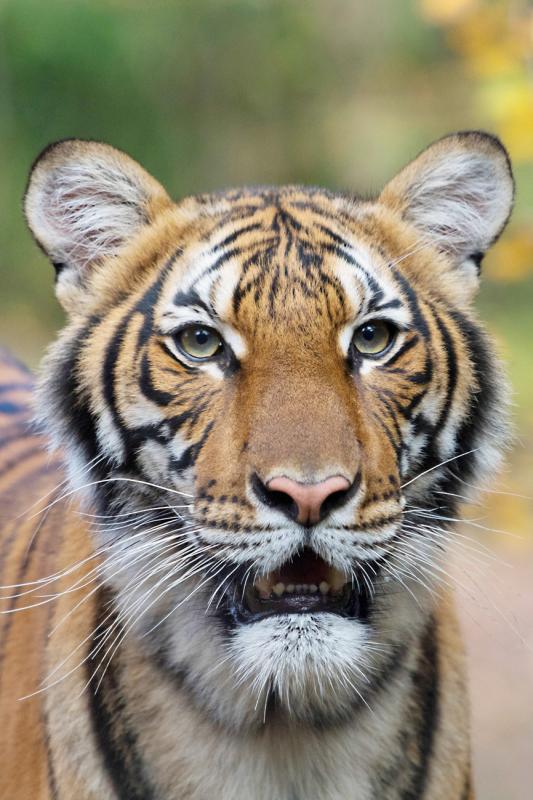
Photo: AFP / Julie Larsen Maher / Wildlife Conservation Society
“Though they have experienced some decrease in appetite, the cats at the Bronx Zoo are otherwise doing well under veterinary care and are bright, alert, and interactive with their keepers,” it said. “It is not known how this disease will develop in big cats since different species can react differently to novel infections, but we will continue to monitor them ... and anticipate full recoveries.”
All four of the zoos and the aquarium in New York City — where the virus death toll has topped 4,000 — have been closed to the public since March 16.
The Bronx Zoo emphasized that there is “no evidence that animals play a role in the transmission of COVID-19 to people other than the initial event in the Wuhan [China] market, and no evidence that any person has been infected with COVID-19 in the US by animals, including by pet dogs or cats.”
According to the US Department of Agriculture Web site there had “not been reports of pets or other animals” in the US falling ill with coronavirus prior to news of tiger Nadia.
A pet cat was discovered infected with the novel coronavirus in Belgium late last month, following similar cases in Hong Kong where two dogs tested positive. All of those animals are believed to have contracted the virus from the people they live with.
Veterinarian Sarah Caddy, a clinical research fellow at the University of Cambridge, said that since domestic cats had been shown to be potentially susceptible to the virus, the tiger becoming infected was “not wholly unexpected.”
“However, it is surprising that the tiger has become infected with what must have been a fairly low dose of virus — we can assume the tiger did not have continual close contact with the asymptomatic zoo keeper,” she said. “The bottom line is that there is no evidence that any cat, large or small, can transmit [the] virus back to humans.”

A humanoid robot that won a half-marathon race for robots in Beijing on Sunday ran faster than the human world record in a show of China’s technological leaps. The winner from Honor, a Chinese smartphone maker, completed the 21km race in 50 minutes and 26 seconds, said a WeChat post by the Beijing Economic-Technological Development Area, also known as Beijing E-Town, where the race began. That was faster than the human world record holder, Ugandan Jacob Kiplimo, who finished the same distance in about 57 minutes in March at the Lisbon road race. The performance by the robot marked a significant step forward

Four contenders are squaring up to succeed Antonio Guterres as secretary-general of the UN, which faces unprecedented global instability, wars and its own crushing budget crisis. Chile’s Michelle Bachelet, Argentina’s Rafael Grossi, Costa Rica’s Rebeca Grynspan and Senegal’s Macky Sall are each to face grillings by 193 member states and non-governmental organizations for three hours today and tomorrow. It is only the second time the UN has held a public question-and-answer, a format created in 2016 to boost transparency. Ultimately the five permanent members of the UN’s top body, the Security Council, hold the power, wielding vetoes over who leads the
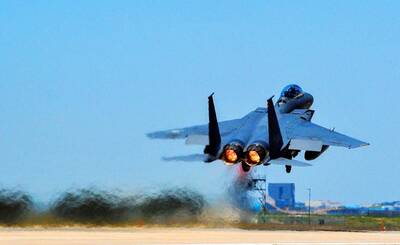
South Korea’s air force yesterday apologized for a 2021 midair collision involving two fighter jets, a day after auditors said the pilots were taking selfies and filming during the flight and held them responsible for the accident. “We sincerely apologize to the public for the concern caused by the accident that occurred in 2021,” an air force spokesman told a news conference, adding that one of the pilots involved had been suspended from flying duties, received severe disciplinary action and has since left the military. The apology followed a report released on Wednesday by the South Korean Board of Audit and Inspection,

An earthquake registering a preliminary magnitude of 7.7 off northern Japan on Monday prompted a short-lived tsunami alert and the advisory of a higher risk of a possible mega-quake for coastal areas there. The Cabinet Office and the Japan Meteorological Agency said there was a 1% chance for a mega-quake, compared to a 0.1% chance during normal times, in the next week or so following the powerful quake near the Chishima and Japan trenches. Officials said the advisory was not a quake prediction but urged residents in 182 towns along the northeastern coasts to raise their preparedness while continuing their daily lives. Prime


 RSS
RSS