


Eight members of a neo-Nazi cell were jailed on Tuesday after a German court found them guilty of forming a “terrorist organization” that was planning a campaign of violence.
The higher regional court in Dresden sentenced the accused, aged between 22 and 32, to prison terms ranging from two years and three months to five-and-a-half years for the ringleader of the group that called itself “Revolution Chemnitz.”
The trial, which lasted six months, was closely watched in Germany where concern has been growing over an increasingly militant far-right scene.
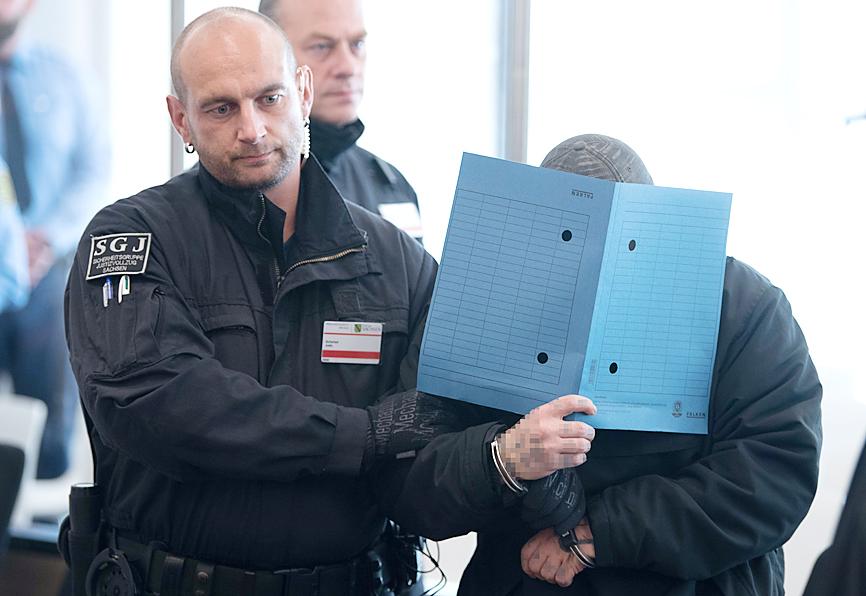
Photo: AFP
A racist gunman shot dead nine people at a shisha bar and a cafe in the city of Hanau last month, stunning the country and prompting German Chancellor Angela Merkel to urge Germans to resist the “poison” of xenophobia and hatred.
The eight jailed were part of the hooligan, neo-Nazi and skinhead scene in and around the city of Chemnitz in Saxony state, in Germany’s former communist East.
They banded together in an online chat group in September 2018, shortly after the murder of a German man by a Syrian sparked anti-migrant street riots in Chemnitz.
The court heard how the ringleader, electrician Christian Keilberg, asked the other seven to sign up to a manifesto in the chat group, that called for perceived enemies to be targeted through armed violence.
The text said that the group’s aim was to make the National Socialist Underground “look like a kindergarten group” — a reference to a neo-Nazi extremist group uncovered in 2011 that murdered 10 people and planted three bombs.
During the trial, defense lawyers argued that their clients had either not fully understood the manifesto or did not take it seriously.
Five of the defendants carried out a first attack on Sept. 14, 2018, “armed with glass bottles, weighted knuckle gloves and an electroshock appliance” that hurt several foreign residents in Chemnitz, prosecutors said.
The violence was believed to have been a “test run” for a larger attack on Oct. 3, 2018, the day Germany celebrates reunification.
Judges in Dresden found the five who took part in the assault guilty of serious breaches of the peace.

‘IN A DIFFERENT PLACE’: The envoy first visited Shanghai, where he attended a Chinese basketball playoff match, and is to meet top officials in Beijing tomorrow US Secretary of State Antony Blinken yesterday arrived in China on his second visit in a year as the US ramps up pressure on its rival over its support for Russia while also seeking to manage tensions with Beijing. The US diplomat tomorrow is to meet China’s top brass in Beijing, where he is also expected to plead for restraint as Taiwan inaugurates president-elect William Lai (賴清德), and to raise US concerns on Chinese trade practices. However, Blinken is also seeking to stabilize ties, with tensions between the world’s two largest economies easing since his previous visit in June last year. At the

UNSETTLING IMAGES: The scene took place in front of TV crews covering the Trump trial, with a CNN anchor calling it an ‘emotional and unbelievably disturbing moment’ A man who doused himself in an accelerant and set himself on fire outside the courthouse where former US president Donald Trump is on trial has died, police said yesterday. The New York City Police Department (NYPD) said the man was declared dead by staff at an area hospital. The man was in Collect Pond Park at about 1:30pm on Friday when he took out pamphlets espousing conspiracy theories, tossed them around, then doused himself in an accelerant and set himself on fire, officials and witnesses said. A large number of police officers were nearby when it happened. Some officers and bystanders rushed

Beijing is continuing to commit genocide and crimes against humanity against Uyghurs and other Muslim minorities in its western Xinjiang province, U.S. Secretary of State Antony Blinken said in a report published on Monday, ahead of his planned visit to China this week. The State Department’s annual human rights report, which documents abuses recorded all over the world during the previous calendar year, repeated language from previous years on the treatment of Muslims in Xinjiang, but the publication raises the issue ahead of delicate talks, including on the war in Ukraine and global trade, between the top U.S. diplomat and Chinese

RIVER TRAGEDY: Local fishers and residents helped rescue people after the vessel capsized, while motorbike taxis evacuated some of the injured At least 58 people going to a funeral died after their overloaded river boat capsized in the Central African Republic’s (CAR) capital, Bangui, the head of civil protection said on Saturday. “We were able to extract 58 lifeless bodies,” Thomas Djimasse told Radio Guira. “We don’t know the total number of people who are underwater. According to witnesses and videos on social media, the wooden boat was carrying more than 300 people — some standing and others perched on wooden structures — when it sank on the Mpoko River on Friday. The vessel was heading to the funeral of a village chief in


 RSS
RSS