


There are the elderly couples who died hours apart and without their families around them. There is the 47-year-old woman who died at home, and who remained there for almost two days because funeral companies refused to collect her body. There are the doctors who lost their lives after assisting their infected patients.
Among the 2,158 people killed by the COVID-19 pandemic in Italy as of Monday, the oldest was 95 and the two youngest were 39.
“The reality is this virus is spreading like wildfire. Death is not certain, but the contagion is real,” said Luca Franzese, whose sister, Teresa, 47, died at home in Naples on 7 March.

Photo: AFP
“My parents are heartbroken, they are destroyed,” he said.
Teresa Franzese, who lived with her elderly parents, sister, brother-in-law and their two children, suffered from epilepsy, but was otherwise in good health. A week before she died, she came down with the flu.
“My parents called her doctor, but they refused to come to the house, despite knowing she had a disability,” Luca Franzese said.
“She went into a coma on 7 March, we tried to call the emergency hotline, they arrived after 40 minutes. In the meantime, I tried to give her mouth-to-mouth resuscitation,” he said.
Teresa Franzese tested positive for the virus postmortem. Luca Franzese spoke of his family’s frustration at being “abandoned” by the authorities after his sister was left to die at home.
It was only after he made an appeal for help via Facebook that a local funeral company eventually came to collect her body. However, as with other COVID-19 victims, she was buried quickly and without ceremony to mitigate the risk of infection posed by her corpse. Her parents, who have underlying health issues, tested negative for the virus, as did Luca Franzese and a nephew. The rest of her immediate family of seven have tested positive.
Silvio Brusaferro, the president of Italy’s Higher Institute of Health, said on Friday that the average age of COVID-19 victims was 80.3, with the majority having suffered underlying illnesses. The most common additional health issue was arterial hypertension followed by chronic heart disease, atrial fibrillation and cancer.
More than 70 percent of those who have died were men. The two 39-year-old victims were a man with diabetes and a woman with cancer. The vast majority of deaths have been in the northern Lombardy region (1,420 as of Monday night), followed by Emilia-Romagna (346) and Veneto (69).
However, not all of the dead had other health issues, at least as far as is known. Luca Carrara lost his father, Luigi Carrara, 86, and mother, Severa Belotti, 82, within a few hours of each other. He told the Italian press they were in good health.
“I was unable to see my parents, they died alone, that’s what this virus is,” he added. “The truth is this is not a banal flu and if you end up in hospital, you leave either alive or dead.”
The couple lived in Albino, a town in the badly affected province of Bergamo in Lombardy. The harrowing impact of the virus on the area can be gleaned from the obituary section of the local newspaper L’Eco di Bergamo.
On Friday, reader Giovanni Locatelli shared online footage comparing the newspaper’s obituary section on Feb. 9, when listings took up just one page, to a copy dated 13 March, when 10 pages were needed to commemorate the dead.
In Codogno, the Lombardy town where the outbreak began, Enrico Palestra lost his 80-year-old father, Giovanni, who was otherwise in good health.
“It’s not a normal flu like people are saying,” Palestra said, without elaborating.
Another victim in Codogno was the 74-year-old uncle of Alessandro, who asked for his surname not to be used.
“He got a fever five days ago and died on Sunday,” Alessandro said. “He was in good form, didn’t smoke and had no previous illnesses. A good part of my family are sick with this virus.”
Alessandro, who lives in Lake Garda, between the Lombardy and Veneto regions, added: “People who don’t live here don’t realize how bad it is. We’re hearing ambulances every half an hour as they take the sick to hospital. It’s striking.
“What amazes me is that other countries are seeing these things, not only England, but have taken precautions too late — or not been decisive enough ones. This worries me,” he said.
Several medics have died, among them Roberto Stella, the president of the order of doctors in Varese, Lombardy. The 67-year-old was tending to patients until he started to suffer symptoms and went into intensive care himself. He died on Wednesday last week.
“They are all doctors who had no fear of going into combat knowing the risks they were running,” said Saverio Chiaravalle, vice president of the Varese doctors order and a close friend of Stella.
“They died on the field, but when you are in combat you don’t imagine it could happen to you. The enemy is invisible, but this is like a war, and the only solution is to isolate — those who have to work must work with precautions, the rest must stay at home,” he said.
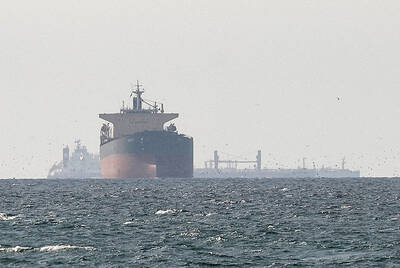
A ship that appears to be taking on the identity of a scrapped gas carrier exited the Strait of Hormuz on Friday, showing how strategies to get through the waterway are evolving as the Middle East war progresses. The vessel identifying as liquefied natural gas (LNG) carrier Jamal left the Strait on Friday morning, ship-tracking data show. However, the same tanker was also recorded as having beached at an Indian demolition yard in October last year, where it is being broken up, according to market participants and port agent’s reports. The ship claiming to be Jamal is likely a zombie vessel that

German Chancellor Friedrich Merz’s conservative Christian Democratic Union (CDU) yesterday faced a regional election battle in Rhineland-Palatinate, now held by the center-left Social Democratic Party (SPD). Merz’s CDU has enjoyed a narrow poll lead over the SPD — their coalition partners at the national level — who have ruled the mid-sized state for 35 years. Polling third is the far-right Alternative for Germany (AfD), which spells a greater threat to the two centrist parties in several state elections in September in the country’s ex-communist east. The picturesque state of Rhineland-Palatinate, bordering France, Belgium and Luxembourg and with a population of about 4 million,

LAW CONSTRAINTS: The US has been pressing allies to send warships to open the Strait, but Tokyo’s military actions are limited under its postwar pacifist constitution Japan could consider deploying its military for minesweeping in the Strait of Hormuz if a ceasefire is reached in the war on Iran, Japanese Minister of Foreign Affairs Toshimitsu Motegi said yesterday. “If there were to be a complete ceasefire, hypothetically speaking, then things like minesweeping could come up,” Motegi said. “This is purely hypothetical, but if a ceasefire were established and naval mines were creating an obstacle, then I think that would be something to consider.” Japan’s military actions are limited under its postwar pacifist constitution, but 2015 security legislation allows Tokyo to use its Self-Defense Forces overseas if an attack,

Ugandan wildlife authorities have reintroduced rhinos into a remote protected area where they were once poached into extinction, an event seen by conservationists as a milestone in efforts to support the recovery of a species threatened by poaching. On Tuesday, two southern white rhinos from a private ranch in the East African country were reintroduced into Kidepo Valley National Park in the country’s northeast. Two more rhinos in metallic crates arrived on Thursday. There have been no rhinos in the park since 1983, the result of poaching. However, a private ranch in central Uganda — the Ziwa Rhino Sanctuary — has been


 RSS
RSS