


Seeking justice for victims of the Soviet regime to heal historical trauma has become a top priority for Lithuania as it marks 30 years since it became the first republic to break away from the USSR.
Take Auksute Ramanauskaite Skokauskiene, who is one of Lithuania’s most prominent victims of historical trauma.
She spent her childhood living under an assumed identity to avoid Soviet authorities tracing her father who led Lithuania’s armed resistance against Soviet rule in the Baltic state after World War II.
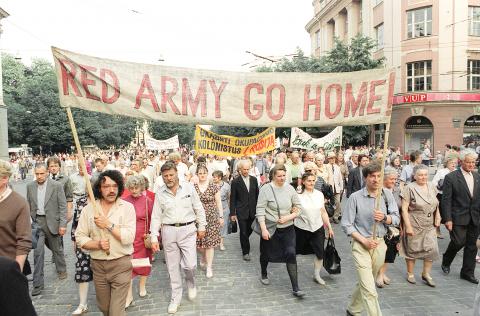
Photo: AFP
Captured in 1956 and executed the following year, Adolfas Ramanauskas was only given a full state funeral about six decades later in 2018, after archeologists identified his body in a mass grave.
“I always felt very disturbed that the Soviets slandered my dad and other freedom fighters,” Ramanauskaite Skokauskiene, a former lawmaker and retired engineer, told reporters. “For me, it was very important that now I have a grave where I can come.”
A big advocate of helping others like her to heal, Ramanauskaite Skokauskiene threw her support behind an unprecedented conference on trauma that featured prominent government officials.
However, the jury is still out on how much historic trauma hurts the country until this day.
Lithuania left the USSR on March 11, 1990, and has since enjoyed impressive economic growth — notably after joining the EU and NATO in 2004.
However, the Baltic nation of 2.8 million people struggles with some of Europe’s highest rates of suicide, alcoholism and emigration.
Some critics blame persistent poverty and high levels of income inequality for these social ills, but others insist they are also symptoms of intergenerational trauma rooted in the undigested past.
“Can it be that our society is ill, and the name of the disease is not coronavirus?” Laimonas Talat Kelpsa, a senior Lithuanian Ministry of Foreign Affairs official, told a conference in Vilnius focused on collective trauma, the first of its kind.
“One of the reasons for Lithuanians to be depressed could be our difficult and complicated history,” Kelpsa told psychotherapists, diplomats and victims attending the conference.
Experts suggest that historical injustice and the failure to meet the needs of the victims have a huge impact on societies haunted by history.
Simon Wessely, a professor of psychological medicine at King’s College London, said acknowledging the past is important both individually and collectively.
“A single person can be a perpetrator, a victim and a bystander at different times in their lives. So it is with countries and so it is with culture,” he told delegates.
“Sometimes [the past] is too painful to acknowledge, but acknowledge it we must,” Wessely said.
Like fellow Baltic states Latvia and Estonia, Lithuania was annexed by the Soviets during World War II, and then deeply scarred by the Stalinist-era deportation of hundreds of thousands of its people to Siberia and Central Asia in the 1940s and 1950s.
While the trio remained firmly under Moscow’s thumb for decades, cracks first began to show with then-Soviet president Mikhail Gorbachev’s arrival in the Kremlin in 1985.
Within the space of a few years, his perestroika and glasnost political and economic reforms began to spiral out of control, presenting an opportunity that was not lost on Lithuanians.
On March 11, 1990, Lithuanian lawmakers, including Communist Party rebels, voted overwhelmingly for independence.
Moscow recognized Lithuania’s independence following a failed coup by communist hardliners in the Soviet capital in August 1991. The USSR was formally dissolved four months later.
The Baltic states have had rocky relations with Moscow ever since, not least because of different perceptions about the war and the Soviet era.
In 2016, Lithuania declared an ex-KGB official guilty of genocide for his role in arresting partisan leader Ramanauskas. The European Court of Human Rights approved the verdict.
Last year, a Lithuanian court found more than 60 former Soviet officials guilty of war crimes in absentia for their role in a bloody 1991 crackdown against the pro-independence movement that killed 14 civilians and wounded more than 700.
Moscow said the trial was politically motivated. It has refused to recognize the Soviet takeover of the Baltic states as an occupation. Lithuania has never received an apology or reparations.
Organization for Security and Co-operation in Europe Commissioner on National Minorities Lamberto Zannier said that this year “could potentially be a very critical year” as divisions grow over the interpretation of history.
Without naming countries, he said that “acknowledgement, public apologies and reparations” are key elements in seeking “historical closure.”
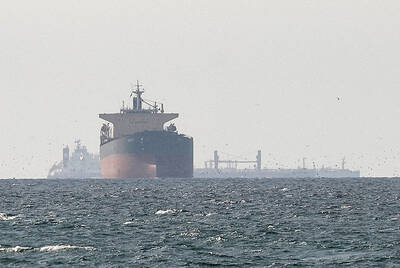
A ship that appears to be taking on the identity of a scrapped gas carrier exited the Strait of Hormuz on Friday, showing how strategies to get through the waterway are evolving as the Middle East war progresses. The vessel identifying as liquefied natural gas (LNG) carrier Jamal left the Strait on Friday morning, ship-tracking data show. However, the same tanker was also recorded as having beached at an Indian demolition yard in October last year, where it is being broken up, according to market participants and port agent’s reports. The ship claiming to be Jamal is likely a zombie vessel that

German Chancellor Friedrich Merz’s conservative Christian Democratic Union (CDU) yesterday faced a regional election battle in Rhineland-Palatinate, now held by the center-left Social Democratic Party (SPD). Merz’s CDU has enjoyed a narrow poll lead over the SPD — their coalition partners at the national level — who have ruled the mid-sized state for 35 years. Polling third is the far-right Alternative for Germany (AfD), which spells a greater threat to the two centrist parties in several state elections in September in the country’s ex-communist east. The picturesque state of Rhineland-Palatinate, bordering France, Belgium and Luxembourg and with a population of about 4 million,
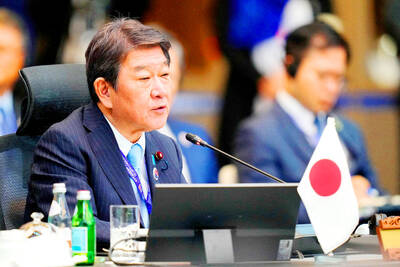
LAW CONSTRAINTS: The US has been pressing allies to send warships to open the Strait, but Tokyo’s military actions are limited under its postwar pacifist constitution Japan could consider deploying its military for minesweeping in the Strait of Hormuz if a ceasefire is reached in the war on Iran, Japanese Minister of Foreign Affairs Toshimitsu Motegi said yesterday. “If there were to be a complete ceasefire, hypothetically speaking, then things like minesweeping could come up,” Motegi said. “This is purely hypothetical, but if a ceasefire were established and naval mines were creating an obstacle, then I think that would be something to consider.” Japan’s military actions are limited under its postwar pacifist constitution, but 2015 security legislation allows Tokyo to use its Self-Defense Forces overseas if an attack,
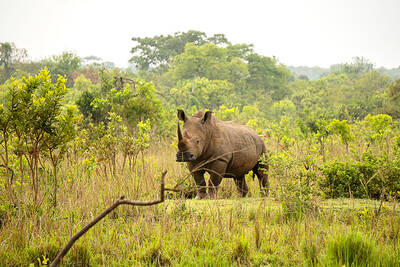
Ugandan wildlife authorities have reintroduced rhinos into a remote protected area where they were once poached into extinction, an event seen by conservationists as a milestone in efforts to support the recovery of a species threatened by poaching. On Tuesday, two southern white rhinos from a private ranch in the East African country were reintroduced into Kidepo Valley National Park in the country’s northeast. Two more rhinos in metallic crates arrived on Thursday. There have been no rhinos in the park since 1983, the result of poaching. However, a private ranch in central Uganda — the Ziwa Rhino Sanctuary — has been


 RSS
RSS