


Dutch Prime Minister Mark Rutte on Sunday made the Netherlands’ first official apology for the wartime persecution of Jews.
“Now the last survivors are still with us, I apologize today in the name of the government for what the authorities did at that time,” Rutte said.
He was giving an address in Amsterdam in memory of victims of the Holocaust, on the eve of the 75th anniversary of the liberation of the Nazi death camp at Auschwitz.

Photo: EPA-EFE
Only 38,000 of the 140,000 Jews who lived in the Netherlands survived World War II, but no government apology had been offered for the role the authorities played.
The question of an apology was raised in 2012, when Rutte was also prime minister.
He said then that not enough information was available about government action during the war and there was “not broad enough support” for an official apology.
In 1995, Queen Beatrix said in a speech to the Israeli parliament that the Dutch had done enough to help their Jewish compatriots during the war.
In 2000, then-prime minister Wim Kok apologized for the “icy welcome” Nazi camp survivors received on their return to the Netherlands, which the Nazis occupied from 1940 to 1945.
On Sunday, Rutte went further, saying: “Our government institutions did not act as guardians of justice and security. Too many civil servants carried out the orders of the occupiers.”
“The bitter consequences of the drawing up of registers [of Jews] and of the expulsions have not been adequately recognized, nor recognized in time,” he added.
“On the whole, it was too little, too late. Too little protection. Too little help. Too little recognition,” he said.
“Seventy-five years after Auschwitz, anti-Semitism is still amongst us. That’s exactly why we fully recognize what happened and say it out loud,” Rutte said.
A number of Holocaust survivors were present at the ceremony to hear Rutte’s apology.
“I lost everything during the war,” Zoni Weisz told Dutch broadcaster NOS.
Weisz, who was a child during the war, lost his parents, brother and sisters, all of whom perished in the Nazi death camps.
“They cannot have died in vain,” the 82-year-old said. “In this respect, it is important that apologies be made. And for myself, I accepted them.
“A pity we had to wait 75 years,” he added.
Holocaust survivors yesterday gathered in Auschwitz to mark 75 years since Soviet troops liberated the camp, while world leaders held a somber remembrance ceremony in Jerusalem on Thursday last week.
More than 1.1 million people, mainly Jews, were killed at Auschwitz-Birkenau.

VAGUE: The criteria of the amnesty remain unclear, but it would cover political violence from 1999 to today, and those convicted of murder or drug trafficking would not qualify Venezuelan Acting President Delcy Rodriguez on Friday announced an amnesty bill that could lead to the release of hundreds of prisoners, including opposition leaders, journalists and human rights activists detained for political reasons. The measure had long been sought by the US-backed opposition. It is the latest concession Rodriguez has made since taking the reins of the country on Jan. 3 after the brazen seizure of then-Venezuelan president Nicolas Maduro. Rodriguez told a gathering of justices, magistrates, ministers, military brass and other government leaders that the ruling party-controlled Venezuelan National Assembly would take up the bill with urgency. Rodriguez also announced the shutdown
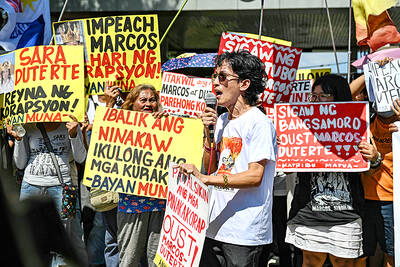
Civil society leaders and members of a left-wing coalition yesterday filed impeachment complaints against Philippine Vice President Sara Duterte, restarting a process sidelined by the Supreme Court last year. Both cases accuse Duterte of misusing public funds during her term as education secretary, while one revives allegations that she threatened to assassinate former ally Philippine President Ferdinand Marcos Jr. The filings come on the same day that a committee in the House of Representatives was to begin hearings into impeachment complaints against Marcos, accused of corruption tied to a spiraling scandal over bogus flood control projects. Under the constitution, an impeachment by the
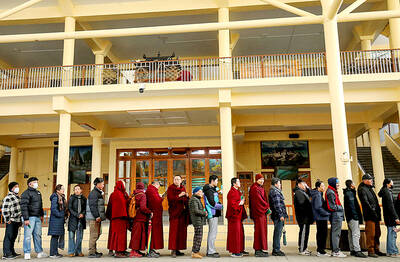
Exiled Tibetans began a unique global election yesterday for a government representing a homeland many have never seen, as part of a democratic exercise voters say carries great weight. From red-robed Buddhist monks in the snowy Himalayas, to political exiles in megacities across South Asia, to refugees in Australia, Europe and North America, voting takes place in 27 countries — but not China. “Elections ... show that the struggle for Tibet’s freedom and independence continues from generation to generation,” said candidate Gyaltsen Chokye, 33, who is based in the Indian hill-town of Dharamsala, headquarters of the government-in-exile, the Central Tibetan Administration (CTA). It

China executed 11 people linked to Myanmar criminal gangs, including “key members” of telecom scam operations, state media reported yesterday, as Beijing toughens its response to the sprawling, transnational industry. Fraud compounds where scammers lure Internet users into fake romantic relationships and cryptocurrency investments have flourished across Southeast Asia, including in Myanmar. Initially largely targeting Chinese speakers, the criminal groups behind the compounds have expanded operations into multiple languages to steal from victims around the world. Those conducting the scams are sometimes willing con artists, and other times trafficked foreign nationals forced to work. In the past few years, Beijing has stepped up cooperation


 RSS
RSS