


Former Interpol president Meng Hongwei (孟宏偉), who was detained on a visit to China in 2018, was yesterday sentenced to more than 13 years in prison for bribery in a case that shook the international police organization.
Meng — a former Chinese vice minister of public security — is among a growing group of Chinese Communist Party (CCP) cadres caught in Chinese President Xi Jinping’s (習近平) anti-graft campaign, which critics say has also served as a way to remove the leader’s political enemies.
Meng vanished during a visit to China from France, where Interpol is based, and was later accused of accepting bribes and expelled from the CCP.
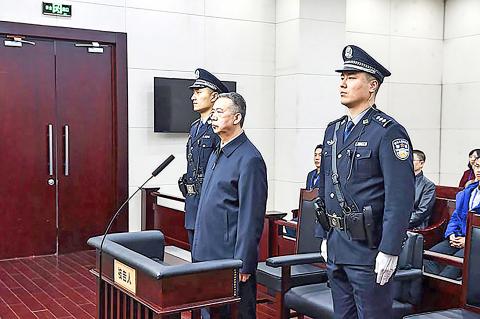
Photo: AFP / Tianjin First Intermediate People’s Court
His wife was granted political asylum in France last year, after saying she was afraid she and her two children would be the targets of kidnapping attempts.
The 66-year-old was sentenced to 13 years and six months in prison and fined 2 million yuan (US$290,000), the Tianjin First Intermediate People’s Court said.
At his trial in June last year, Meng pleaded guilty to accepting US$2.1 million in bribes, after the court said he used his status and positions to “seek improper benefit,” illegally acquire property and accumulate bribes.
The court statement said that some of the “stolen money and stolen goods could not be recovered.”
Pictures from the court showed a grim-faced Meng standing in front of a judge, flanked by two police officers.
Meng had “truthfully confessed to all the criminal facts” and would not appeal the decision, the court said.
The Chinese Public Security Bureau has linked Meng’s case to a broader initiative to “completely remove the pernicious influence” of Zhou Yongkang (周永康), a former security czar who was sentenced to life in prison in 2015 for bribery, abuse of power and leaking state secrets.
Meng was appointed vice security minister by Zhou in 2004.
In that role, he was entrusted with a number of sensitive portfolios, including the nation’s counterterrorism division, and he was in charge of the response to violence in China’s fractious northwestern region of Xinjiang.
During Meng’s tenure, the bureau also arrested and interrogated a number of prominent Chinese dissidents, including Nobel Peace Prize laureate Liu Xiaobo (劉曉波), who later died of liver cancer while in police custody.
In 2013, Meng was appointed director of China’s Maritime Police Bureau, which includes the coast guard and maritime anti-smuggling authorities.
He was the first Chinese president at Interpol and was expected to serve a four-year term until this year. When he vanished in September 2018, he sent his wife a message telling her to “wait for my call,” and then a knife emoji signifying danger.
A few weeks later, Interpol was informed that Meng had resigned, with Beijing later announcing he was being held on suspicion of taking bribes.

‘CROSSING THE LINE’: China’s embassy in Seoul criticized US Forces Korea Commander General Xavier Brunson, asking if his ‘hostile’ remarks were authorized by Washington South Korea and the US are in talks over recent public remarks by the commander of US Forces Korea, Seoul’s presidential office said yesterday, after the comments drew sharp criticism from China. In a recent podcast interview, US Forces Korea Commander General Xavier Brunson described South Korea as “the dagger in the heart of Asia” from China’s east coast, prompting the Chinese embassy in Seoul to say that he had “truly crossed the line.” The interview came amid growing speculation that Washington might seek to expand the role of US Forces Korea in countering the growing regional influence of China, a key

Through the noise of rushing papers and whirring belts at a print factory in Kyoto, two creators watch their photo essay come to life in broadsheet form — part of an effort to win new audiences in the age of artificial intelligence (AI). Despite the decline of the publishing industry, self-publication and handmade “zine” magazines are growing in popularity in Japan, reflecting the nation’s enduring love of paper in the digital era. While speaking to Agence France-Presse at the plant, his hands black with ink, one of the creators, Kazuma Obara, said: “I think [paper] is a medium that engages all five

Australian researchers have trained lab-grown brain cells on a silicon computer chip to play the 1990s shooter game Doom and said they are just scratching the surface of what the neurons could be capable of doing. It is the science-fiction work of biotech boffins at Cortical Labs, who researched and developed the technology that harnesses the workings of the brain’s networking system. Each so-called “biological computer” contains about 200,000 living human brain cells, grown from stem cells that were harvested from blood donations. Having mastered the simple computer game Pong, where a paddle is moved up and down to send a ball

France experienced its hottest spring on record, the French weather service said on Tuesday, after an exceptional early heat wave that also broke highs for the season in England and Wales. Meteo-France said the average nationwide temperature over March to May was 13.8°C — about 1.7°C above the norm, and surpassing records set in 2011 and 2020. “The warmest spring since records began in 1900,” it said in a bulletin. All three months were warmer than average, but the onset of an “unprecedented heatwave” late last month pushed the mercury to highs typically seen at the height of the summer. “Our country had never


 RSS
RSS