


China’s “one country, two systems” formula in Hong Kong is failing miserably. After more than six months of large-scale pro-democracy protests — including violent clashes with police — the territory’s voters last month dealt a powerful blow to pro-China parties, which lost 87 percent of seats to pro-democracy candidates in district council elections.
The significance of that election should not be underestimated. While district councils have little power, they select some of the 1,200 electors who choose Hong Kong’s chief executive. In the next election, pro-democracy parties will fill nearly 10 percent of those seats.
The election also had important symbolic implications. District councils are elected in a fully democratic process (compared with only half the seats in the Hong Kong Legislative Council). With an impressive 71 percent turnout, the election was widely seen as a vote of no confidence in embattled China-backed Hong Kong Chief Executive Carrie Lam (林鄭月娥).
Some Hong Kongers have lost faith in the prospect of maintaining their democracy within the “one country, two systems” scheme. This is reflected in growing demands for independence, which were never heard during 155 years of British rule. While independence remains a fringe idea — owing partly to recognition of China’s uncompromising stand on territorial integrity — almost no one younger than 30 in Hong Kong identifies exclusively as Chinese.
A similar backlash against China is now also occurring in Taiwan. Having enjoyed de facto independence since 1949, Taiwan was supposed to be drawn back into the Chinese fold by the “one country, two systems” model. However, that model’s failure in Hong Kong has hardened anti-China sentiment and turned many voters away from the pan-blue camp, which favors closer ties with Beijing.
This represents a significant shift from the local elections on Nov. 24 last year, when the Chinese Nationalist Party (KMT) secured several key victories over the pro-independence Democratic Progressive Party (DPP). That outcome was probably less about desiring closer ties with China than about delivering a sharp rebuke to the DPP.
Indeed, after Chinese President Xi Jinping (習近平) in a Jan. 2 New Year’s speech urged Taiwan to follow in Hong Kong’s footsteps, President Tsai Ing-wen (蔡英文) of the DPP revived her popularity by reasserting Taiwan’s sovereignty. Bolstered by the Hong Kong crisis, Tsai now seems to be coasting toward a landslide victory in next month’s presidential election.
Far from enabling China’s peaceful unification, the “one country, two systems” model is undermining it. Perhaps this was inevitable, owing to a cause more fundamental than Xi’s centralization of power, the Chinese Communist Party’s increasing interference in Hong Kong’s affairs, or even the basic contradiction between a one-party regime and a multiparty democracy. The Chinese state, built on a millennia-old paradigm of political order, cannot cope with intergovernmental conflict.
Modern democracy is based on division, within society and the state. In society, different groups, each with their own interests and priorities, compete for representation. In the state, there is a horizontal separation of powers (among the legislative, executive and judicial branches) and a vertical division of powers (among national and subnational governments).
For nations with a history of foreign domination, such divisions might seem like weaknesses that can be exploited by outsiders using a “divide-and-rule” strategy. Indeed, according to China’s cyclical worldview, tian xia (天下, the commonwealth) rotates between division (分, fen, marked by chaos and war) and unity (合, he, which restores peace and order).
China does maintain a separation of powers, but it is much more comfortable with horizontal checks and balances than vertical ones. For more than 2,000 years, Chinese imperial courts appointed a censor-in-chief to manage ministers and bureaucrats, and grandmasters of remonstrance to criticize emperors. The Song Dynasty even divided provincial-level power among military, administrative, fiscal and judicial officials.
However, conflicts between national and subnational governments were historically divided into three categories — warlordism (割據, ge ju), insubordination (不臣, bu chen) and foreign threat (外患, wai huan) — all of which are unambiguously negative. To this day, China’s rulers distrust leaders with a local base, often choosing outsiders to serve as provincial governors and party bosses, and reshuffling them regularly.
From the Chinese government’s perspective, “Hong Kong ruled by Hong Kongers” was already a risky concession. So it ruled out a directly elected chief executive and worked to suppress the opposition, fearing that local dissidents would act as foreign agents to challenge the central government’s authority.
This effort backfired. China’s interference undermined the ability of older “democrats” who identified as Chinese to deliver the changes the people demanded, so they were replaced by younger “localists.” When China’s central government attempted to suppress these figures — including by purging them from the Legislative Council in 2017 — resistance intensified.
By the beginning of this year, when Lam introduced a bill that would make it easier to extradite criminal suspects to China, the people of Hong Kong were fed up. China’s government attempted to silence the protesters, including by arresting leading activists. The protest movement was thus left leaderless, making it impossible to negotiate a resolution.
Many of the young protesters now believe that they have so little to lose that they effectively seek “mutually assured destruction.” This “scorched earth” approach renders Chinese threats of repression virtually impotent.
China now faces a dilemma. Unless democracy — with its requisite division — is shown to support the dream of civilizational resurgence, it will lack legitimacy among Chinese nationalists.
However, the only way to revive the “one country, two systems” rubric is to accept intergovernmental conflict — a great leap toward embracing democracy.
Institutionalized respect for regional identity and autonomy have eased separatist sentiment in Tamil Nadu, Scotland, Quebec, the Basque region and Flanders, and it could do the same in Hong Kong and possibly even Taiwan.
However, if China continues to suppress intergovernmental conflict, the collapse of the “one country, two systems” model will be only a matter of time.
Wong Chin-huat is a professor of political science at the Jeffrey Sachs Center on Sustainable Development at Sunway University in Malaysia.
Copyright: Project Syndicate
A gap appears to be emerging between Washington’s foreign policy elites and the broader American public on how the United States should respond to China’s rise. From my vantage working at a think tank in Washington, DC, and through regular travel around the United States, I increasingly experience two distinct discussions. This divergence — between America’s elite hawkishness and public caution — may become one of the least appreciated and most consequential external factors influencing Taiwan’s security environment in the years ahead. Within the American policy community, the dominant view of China has grown unmistakably tough. Many members of Congress, as
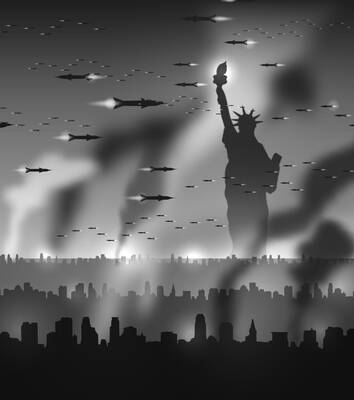
After declaring Iran’s military “gone,” US President Donald Trump appealed to the UK, France, Japan and South Korea — as well as China, Iran’s strategic partner — to send minesweepers and naval forces to reopen the Strait of Hormuz. When allies balked, the request turned into a warning: NATO would face “a very bad” future if it refused. The prevailing wisdom is that Trump faces a credibility problem: having spent years insulting allies, he finds they would not rally when he needs them. That is true, but superficial, as though a structural collapse could be caused by wounded feelings. Something
Former Taipei mayor and Taiwan People’s Party (TPP) founding chairman Ko Wen-je (柯文哲) was sentenced to 17 years in prison on Thursday, making headlines across major media. However, another case linked to the TPP — the indictment of Chinese immigrant Xu Chunying (徐春鶯) for alleged violations of the Anti-Infiltration Act (反滲透法) on Tuesday — has also stirred up heated discussions. Born in Shanghai, Xu became a resident of Taiwan through marriage in 1993. Currently the director of the Taiwan New Immigrant Development Association, she was elected to serve as legislator-at-large for the TPP in 2023, but was later charged with involvement
Out of 64 participating universities in this year’s Stars Program — through which schools directly recommend their top students to universities for admission — only 19 filled their admissions quotas. There were 922 vacancies, down more than 200 from last year; top universities had 37 unfilled places, 40 fewer than last year. The original purpose of the Stars Program was to expand admissions to a wider range of students. However, certain departments at elite universities that failed to meet their admissions quotas are not improving. Vacancies at top universities are linked to students’ program preferences on their applications, but inappropriate admission


 RSS
RSS