


A South Korean healing center is offering free funerals — but only to the living.
More than 25,000 people have participated in mass “living funerals” at the Hyowon Healing Center in Seoul since it opened in 2012, hoping to improve their lives by simulating their deaths.
“Once you become conscious of death, and experience it, you undertake a new approach to life,” said 75-year-old Cho Jae-hee, who participated in a living funeral as part of a “dying well” program offered by her senior welfare center.
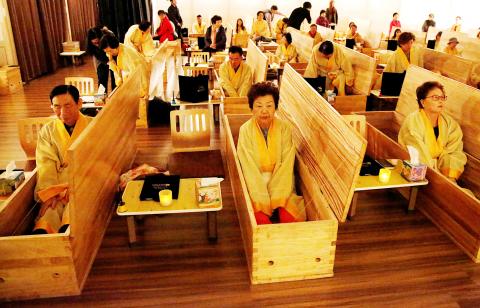
Photo: Reuters
Dozens took part in the event, from teenagers to retirees, donning shrouds, taking funeral portraits, penning their last testaments and lying in a closed coffin for about 10 minutes.
University student Choi Jin-kyu said that his time in the coffin helped him realize that too often he viewed others as competitors.
“When I was in the coffin, I wondered what use that is,” said the 28-year-old, adding that he plans to start his own business after graduation rather than attempting to enter a highly competitive job market.
South Korea ranks 33 out of 40 nations surveyed in the Organisation for Economic Co-operation and Development’s Better Life Index.
Many younger South Koreans have high hopes for education and employment, which have been dashed by a cooling economy and rising unemployment.
“It is important to learn and prepare for death, even at a young age,” said professor Yu Eun-sil, a physician at Asan Medical Center’s pathology department, who has written a book about death.
In 2016, South Korea’s suicide rate was 20.2 per 100,000 residents, almost double the global average of 10.53, WHO data showed.
Funeral company Hyowon began offering the living funerals to help people appreciate their lives, and seek forgiveness and reconciliation with family and friends, said Jeong Yong-mun, who heads the healing center.
Jeong said he is heartened when people reconcile at a relative’s funeral, but is saddened that they wait that long.
“We don’t have forever,” Jeong said. “That’s why I think this experience is so important — we can apologize and reconcile sooner, and live the rest of our lives happily.”
Occasionally, he has dissuaded those contemplating suicide.
“I picked out those people who have asked themselves whether ... they can actually commit suicide, and I reversed their decision,” Jeong said.
The center’s message of personal value resounded with Choi.
“I want to let people know that they matter, and that someone else would be so sad if they were gone,” Choi said, wiping away tears. “Happiness is in the present.”

Kouri Richins, a Utah mother who published a children’s book about grief after the death of her husband is to serve a life sentence for his murder without the possibility of parole, a judge ruled on Wednesday. Richins was convicted in March of aggravated murder for lacing a cocktail given to her husband, Eric Richins, with five times the lethal dose of fentanyl at their home near Park City in 2022. A jury also found her guilty of four other felonies, including insurance fraud, forgery and attempted murder for trying to poison her husband weeks earlier on Feb. 14, 2022, with a

DELA ROSA CASE: The whereabouts of the senator, who is wanted by the ICC, was unclear, while President Marcos faces a political test over the senate situation Philippine authorities yesterday were seeking confirmation of reports that a top politician wanted by the International Criminal Court (ICC) had fled, a day after gunfire rang out at the Philippine Senate where he had taken refuge fearing his arrest. Senator Ronald “Bato” dela Rosa, the former national police chief and top enforcer of former Philippine president Rodrigo Duterte’s “war on drugs,” has been under Senate protection and is wanted for crimes against humanity, the same charges Duterte is accused of. “Several sources confirmed that the senator, Senator Bato, is no longer in the Senate premises, but we are still getting confirmation,” Presidential

HELP DENIED? The US Department of State said that the Cuban leadership refuses to allow the US to provide aid to Cubans, ‘who are in desperate need of assistance’ US Secretary of State Marco Rubio on Wednesday said that Cuba’s leadership must change, as Washington renewed an offer of US$100 million in aid if the communist nation agrees to cooperate. Cuba has been suffering severe economic tumult led by an energy shortage that plunged 65 percent of the country into darkness on Tuesday. Cuba’s leaders have blamed US sanctions, but Rubio, a Cuban American and critic of the government established by Fidel Castro, said the system was to blame, including corruption by the military. “It’s a broken, nonfunctional economy, and it’s impossible to change it. I wish it were different,” he told

Myanmar yesterday published a parliamentary bill proposing the death sentence for those who detain or violently coerce people into working in online scam centers. Internet fraud factories have flourished in Myanmar, part of Southeast Asia’s scam economy, targeting Internet users worldwide with romance and cryptocurrency investment cons. The multibillion-dollar black market attracts many willing employees, but repatriated foreigners have also reported being trafficked to sites in Myanmar and tortured by scam center operators. The draft legislation would allow capital punishment for “violence, torture, unlawful arrest and detention, or cruel treatment against another person for the purpose of forcing them to commit online scams.” The


 RSS
RSS